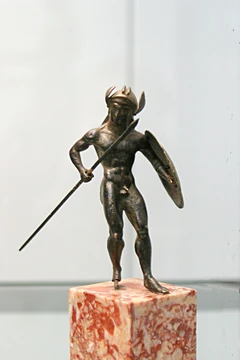
Battle of the Catalaunian Plains
A disputed battle that halted Attila's advance into Gaul.

The Battle of the Catalaunian Plains—also known as the Battle of the Campus Mauriacus, Battle of Châlons, Battle of Troyes, or the Battle of Maurica—was fought on 20 June 451 AD. On one side stood a coalition under the Roman general Flavius Aetius and the Visigothic king Theodoric I; on the other, the Huns and their subject peoples, led by their king, Attila. Although Germanic foederati made up most of the coalition’s forces, the engagement ranks among the last major military actions of the Western Roman Empire. Historians disagree about its overall strategic importance. Most agree that the siege of Aurelianum was the campaign’s decisive moment, stopping the Huns from pushing deeper into Roman territory or establishing vassal states in Roman Gaul. Even so, the Huns ravaged much of Gaul and severely weakened the military strength of both the Romans and the Visigoths. Attila died just two years later, in 453. Following the Battle of Nedao in 454, the Hunnic coalition and its incorporated Germanic vassals gradually fell apart.
By 450 AD, the Romans had reasserted control over much of Gaul, though their grip on provinces beyond Italy kept weakening. Armorica was only nominally part of the empire, and Germanic tribes living on Roman land had been forcibly settled and bound by treaty as foederati under their own leaders. Northern Gaul, between the Rhine north of Xanten and the Lys River (Germania Inferior), had been unofficially abandoned to the Salian Franks. The Visigoths along the Garonne were growing restless but still kept their treaty. The Burgundians in Sapaudia were more obedient but also waiting for a chance to rebel. The Alans on the Loire and in Valentinois remained loyal, having served the Romans since the defeat of Jovinus in 411 and the Siege of Bazas in 414. The parts of Gaul still firmly under Roman control included the Mediterranean coast; a region around Aurelianum (modern Orléans) along the Seine and Loire as far north as Soissons and Arras; the middle and upper Rhine up to Cologne; and downstream along the Rhône.
The historian Jordanes claims that the Vandal king Genseric urged Attila to attack the Visigoths while also trying to stir up conflict between the Visigoths and the Western Roman Empire. But Jordanes’s account of Gothic history is notoriously unreliable. Modern scholars think he projected contemporary events and political opinions onto Attila’s era, and that this explanation likely didn’t come from the original writer Priscus. Christiensen points out that Amalafrida, wife of Thrasamund, was imprisoned and murdered by Hilderic after Thrasamund’s death in 523, and that the story about the blinding of Theodoric’s daughter by Huneric is a fabrication.
Other writers of the time give different motives. Justa Grata Honoria, sister of Emperor Valentinian III, had been betrothed to the former consul Bassus Herculanus the year before. In 450, she sent the eunuch Hyacinthus to Attila asking for his help to escape her confinement, using her ring as proof of the letter’s legitimacy. Allegedly, Attila took this as an offer of marriage and claimed half the empire as her dowry. He demanded that Honoria be handed over along with the dowry. Valentinian refused, and Attila used this as a pretext for a destructive campaign through Gaul. Ian Hughes suggests that Honoria was actually using Attila’s honorary status as magister militum for political leverage.
Another conflict leading into the war was that in 449, the King of the Franks (possibly Chlodio) died, and his two sons argued over the succession. The older son sought Attila’s help, while the younger sided with Aetius, who adopted him. The identity of this younger prince—seen at Rome by the historian Priscus—remains unclear, though both Merowech and Childeric I have been suggested.
Attila crossed the Rhine early in 451 with his followers and many allies, sacking Divodurum (modern Metz) on 7 April. Schultheis notes, however, that this date may be a literary trope used by Hydatius and Gregory of Tours to emphasize Attila’s pagan nature to a Christian audience, and might not be reliable. Other cities attacked can be identified from hagiographies written to commemorate their bishops: Nicasius was slaughtered before the altar of his church in Reims; Servatius is said to have saved Tongeren with his prayers, just as Genevieve saved Lutetia. Lupus, bishop of Troyes, is also credited with saving his city by meeting Attila in person. Many other cities claim to have been attacked in these accounts, but archaeological evidence shows no destruction layer from that time. The most likely explanation for Attila’s widespread devastation is that his main column followed Roman roads, crossing the Rhine at Argentoratum (Strasbourg) before marching to Borbetomagus (Worms), Mogontiacum (Mainz), Augusta Treverorum (Trier), Divodurum (Metz), Durocotorum (Reims), and finally Aurelianum (Orléans), while sending a small detachment north into Frankish territory to plunder. This explanation supports the literary claims that northern Gaul was attacked, while archaeological evidence shows major population centers were not sacked.
Attila’s army reached Aurelianum (modern Orléans, France) before June. According to Jordanes, the Alan king Sangiban, whose foederati realm included Aurelianum, had promised to open the city gates. This siege is confirmed by the account in the *Vita S. Aniani* and later by Gregory of Tours, though Sangiban’s name does not appear in those accounts. The inhabitants of Aurelianum shut their gates against the advancing invaders, and Attila began the siege.
- date
- 20 June 451 AD
- location
- Catalaunian Plains (Gaul)
- combatants
- Roman-Visigothic coalition vs. Huns and vassals
- commanders
- Flavius Aetius and Theodoric I vs. Attila
- outcome
- Indecisive; Huns halted but Gaul pillaged
- significance
- One of the last major Western Roman military operations
Lore & Background
By 450 AD, Roman authority in Gaul was diminishing, with Germanic tribes settled as foederati. Attila crossed the Rhine early in 451, sacking Divodurum (Metz) on 7 April, though some scholars question the reliability of this date. Other cities claimed attacked include Reims, Tongeren, and Troyes, but archaeological evidence shows no destruction layer for many. Attila's main column likely followed Roman roads from Argentoratum to Aurelianum, while a small detachment plundered northern Frankish territory. The siege of Aurelianum began before June; the Alan king Sangiban was said by Jordanes to have promised to open the gates, but modern scholars believe the Alans were loyal defenders. After four days of heavy rain, Attila's final assault on 14 June was broken off by the approach of the Roman coalition.
Reader's Guide
The Battle of the Catalaunian Plains is significant as one of the last major military operations of the Western Roman Empire, though its exact strategic importance is disputed. Historians generally agree that the siege of Aurelianum was the decisive moment, stopping the Huns' attempt to advance further into Roman territory or establish vassals in Gaul. However, the Huns looted and pillaged much of Gaul and crippled the military capacity of the Romans and Visigoths. The battle's legacy is complicated by unreliable sources like Jordanes, who may have projected later events onto Attila's time. The conflict was also influenced by the Frankish succession dispute and Honoria's plea for help, though interpretations vary. The battle remains a key event in the decline of Roman power in the West.
Did You Know?
- The battle is also called the Battle of the Campus Mauriacus, Battle of Châlons, Battle of Troyes, or the Battle of Maurica.
- The siege of Aurelianum (Orléans) is considered by modern scholars to be the decisive moment of the campaign.
- Attila's army reached Aurelianum before June 451, and his final assault on 14 June was broken off by the approach of the Roman coalition.
- The Alan king Sangiban was accused by Jordanes of planning to defect, but modern scholars believe the Alans were loyal defenders.
More in Military History & Battles 1-20
Spotted an error? Know more?
This is a living reference — every entry is fact-audited, and reader corrections feed straight into our audit queue. Suggest an edit · See this site's audit record