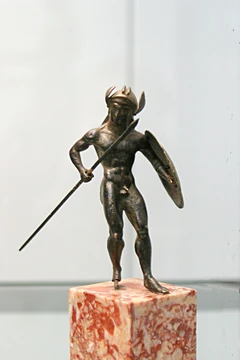
Battle of Salamis
Outnumbered Greeks defeated the Persian fleet at Salamis.

In 480 BC, a Greek alliance led by the Athenian general Themistocles clashed with the Persian king Xerxes’ fleet in the narrow waters between the island of Salamis and the Greek mainland. Though heavily outnumbered, the Greeks won. This naval engagement, known as the Battle of Salamis, was the high point of the second Persian invasion of Greece and is often considered the largest naval battle of the ancient world. It changed the course of the invasion.
Earlier, a small Greek force had tried to hold the pass at Thermopylae while an Athenian-led navy fought the Persians at Artemisium. The Spartans holding the rear at Thermopylae were wiped out, and the Greeks at Artemisium retreated after heavy losses. This let the Persians overrun Phocis, Boeotia, Attica, and Euboea. The Greek allies then planned to defend the Isthmus of Corinth, pulling their fleet back to Salamis Island.
Despite being outnumbered, Themistocles convinced the Greeks to fight the Persian fleet again, hoping a win would stop Persian naval attacks on the Peloponnese. Xerxes also wanted a decisive battle. Through a trick—Themistocles sent Xerxes a message claiming most of the Greek fleet was at Salamis—the Persian navy rowed into the straits and tried to block both ends. In the cramped space, the Persians’ larger numbers worked against them: their ships struggled to move and fell into disorder. The Greeks seized the moment, formed a line, and won.
After the battle, Xerxes retreated to Asia with most of his army, leaving a general named Mardonius to finish conquering Greece. The next year, the remaining Persian army was beaten at Plataea, and the Persian navy was defeated at Mycale. The Persians never again tried to conquer the Greek mainland. Salamis and Plataea together marked a shift in the Greco-Persian Wars: from then on, the Greek city-states went on the offensive.
The trouble began decades earlier. Athens and Eretria had backed a failed revolt against the Persian king Darius I in Ionia (499–494 BC). Darius, a usurper who had spent years putting down rebellions, saw the revolt as a threat to his empire. He vowed to punish those involved and also saw a chance to expand into Greece. In 492 BC, his general Mardonius secured Thrace and forced Macedon to become a Persian client. In 491 BC, Darius sent envoys demanding “earth and water” as a sign of submission. Most Greek cities gave in, but Athens executed the envoys, and Sparta threw them down a well. That put both cities at war with Persia.
In 490 BC, a Persian force under Datis and Artaphernes attacked Naxos, took the Cycladic Islands, besieged and destroyed Eretria, and then landed at Marathon to attack Athens. There, a much smaller Athenian army won a stunning victory, forcing the Persians to withdraw to Asia.
Darius began raising a huge new army to crush Greece, but in 486 BC his Egyptian subjects revolted, delaying the plan. Darius died while preparing to march on Egypt, and his son Xerxes took the throne. Xerxes crushed the Egyptian revolt and quickly restarted preparations for invading Greece. This was a full-scale invasion requiring long-term planning, stockpiling, and conscription. Xerxes ordered a bridge built across the Hellespont for his army and a canal dug across the isthmus of Mount Athos (where a Persian fleet had been destroyed in 492 BC). Both were extraordinary feats for the time. By early 480 BC, the army gathered at Sardis marched toward Europe, crossing the Hellespont on two pontoon bridges.
Meanwhile, the Athenians had been preparing for war since the mid-480s BC. In 482 BC, guided by Themistocles, they decided to build a massive fleet of triremes to fight the Persians. But Athens lacked the manpower to fight both on land and sea, so an alliance of Greek city-states was needed. In 481 BC, Xerxes sent envoys asking for earth and water but deliberately skipped Athens and Sparta. Support gathered around these two leading states. A congress of city-states met at Corinth in late autumn 481 BC, forming a confederate alliance that could send envoys for help and dispatch troops.
- location
- Straits between the mainland and Salamis, Saronic Gulf near Athens
- combatants
- Greek city-states (alliance) vs. Achaemenid Empire
- commanders
- Themistocles (Greek), Xerxes (Persian)
- result
- Greek victory
- significance
- Turning point in the second Persian invasion of Greece
Lore & Background
To block the Persian advance, a small force of Greeks blocked the pass of Thermopylae, while an Athenian-dominated allied navy engaged the Persian fleet in the nearby straits of Artemisium. In the resulting Battle of Thermopylae, the Spartan rearguard of the Greek force was annihilated, while in the Battle of Artemisium the Greeks suffered heavy losses and retreated after the loss at Thermopylae. This allowed the Persians to conquer Phocis, Boeotia, Attica and Euboea. The allies prepared to defend the Isthmus of Corinth while the fleet was withdrawn to nearby Salamis Island. Although heavily outnumbered, the Greeks were persuaded by Athenian general Themistocles to bring the Persian fleet to battle again, in the hope that a victory would prevent naval operations against the Peloponnese. Persian king Xerxes was also eager for a decisive battle. As a result of subterfuge on the part of Themistocles (which included a message directly sent to Xerxes letting him know that much of the Greek fleet was stationed at Salamis), the Persian navy rowed into the Straits of Salamis and tried to block both entrances. In the cramped waters, the great Persian numbers were an active hindrance, as ships struggled to maneuver and became disorganized. Seizing the opportunity, the Greek fleet formed in line and achieved a victory. Xerxes retreated to Asia with much of his army, leaving Mardonius to complete the conquest of Greece. The following year the remainder of the Persian army was defeated at the Battle of Plataea and the Persian navy at the Battle of Mycale. The Persians made no further attempts to conquer the Greek mainland. The battles of Salamis and Plataea thus mark a turning point in the course of the Greco-Persian Wars as a whole; from then onward, the Greek poleis would take the offensive.
Reader's Guide
The Allied fleet rowed from Artemisium to Salamis to assist with the final evacuation of Athens. En route Themistocles left inscriptions addressed to the Ionian Greek crews of the Persian fleet on all springs of water that they might stop at, asking them to defect to the Allied cause. Following Thermopylae, the Persian army proceeded to burn and sack the Boeotian cities that had not surrendered—Plataea and Thespiae—before marching on the now evacuated city of Athens. The Allies (mostly Peloponnesian) prepared to defend the Isthmus of Corinth, demolishing the single road that led through it, and building a wall across it. In a council-of-war called once the evacuation of Athens was complete, the Corinthian naval commander Adeimantus argued that the fleet should assemble off the coast of the Isthmus in order to achieve such a blockade. However, Themistocles argued in favour of an offensive strategy, aimed at decisively destroying the Persians' naval superiority. He drew on the lessons of Artemisium, pointing out that 'battle in close conditions works to our advantage.' He eventually won through, and the Allied navy remained off the coast of Salamis.
Did You Know?
- The Battle of Salamis was arguably the largest naval battle of the ancient world.
- Themistocles sent a message directly to Xerxes letting him know that much of the Greek fleet was stationed at Salamis, as part of a subterfuge.
- In the cramped waters of the Straits of Salamis, the great Persian numbers were an active hindrance, as ships struggled to maneuver and became disorganized.
- Xerxes retreated to Asia with much of his army after the battle, leaving Mardonius to complete the conquest of Greece.
- The following year, the remainder of the Persian army was defeated at the Battle of Plataea and the Persian navy at the Battle of Mycale.
Frequently Asked Questions
What is the Battle of Salamis?
It was a major naval engagement during the second Persian invasion of Greece, in which a smaller Greek fleet defeated the far larger Persian navy in the Saronic Gulf. It is often regarded as the largest sea battle of the ancient world.
Who fought in the Battle of Salamis?
The combatants were an alliance of Greek city-states on one side and the Achaemenid Persian Empire on the other. Despite being heavily outnumbered, the Greek coalition secured the victory.
Who commanded the forces at Salamis?
Themistocles led the Greek fleet, while King Xerxes oversaw the Persian side. Themistocles is widely credited with the tactical choices that turned the tide in favor of the Greeks.
Why is the Battle of Salamis important?
It marked the decisive turning point of the second Persian invasion, halting Xerxes' advance and shifting the strategic initiative to the outnumbered Greeks. Without this victory, the trajectory of Greek independence would likely have been very different.
Where did the Battle of Salamis take place?
The fighting unfolded in the narrow straits between the island of Salamis and the Greek mainland, within the Saronic Gulf near Athens. The confined waters helped neutralize the Persian fleet's overwhelming numerical advantage.
More in Military History & Battles 1-20
Spotted an error? Know more?
This is a living reference — every entry is fact-audited, and reader corrections feed straight into our audit queue. Suggest an edit · See this site's audit record