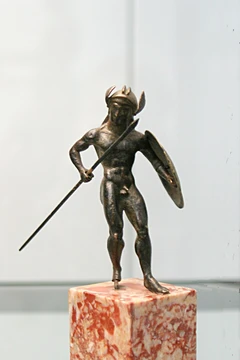
Battle of the Hydaspes
Alexander's costly victory on the Hydaspes River against Porus.
Alexander secured a decisive victory and captured Porus, but it was possibly his most costly engagement.[1] Porus was spared by Alexander and appointed as a satrap, which effectively restored him to power over the region.[2]
Quick Facts
- Part of
- Alexander's Indian campaign
- Date
- May 326 BC
- Location
- Hydaspes River (modern-day Jhelum River, Pakistan)
- Result
- Macedonian victory
Facts from the source article.
What happened
Porus drew up his army on the south bank with cavalry on both flanks, chariots in front, and infantry with war elephants stationed every fifty feet.[3] Porus, mounted on his tallest war elephant without a howdah, fought bravely but was eventually overwhelmed by thirst and surrendered.[3][4] Alexander's troops crossed the Hydaspes at a location about 27 km upstream from his camp, where a wood-covered island split the river; he landed on the island while his men waded across.[5] Arrian reported 23,000 Indian dead; Diodorus gave 12,000 dead and over 9,000 captured.[6]
What the cited sources add
Mark's World History Encyclopedia entry adds that Alexander's horse Bucephalus was killed in this battle, and Alexander named one of the two cities he founded after the battle "Bucephala" after him.[7] Wasson's account describes how Alexander sent an agent to Porus seeking a peaceful resolution before the battle, but Porus refused to pay tribute.[8] Wasson also notes that Alexander made camp directly across from Porus and gave every indication he would wait for the monsoon season to end, even sending for grain shipments from his ally King Taxila.[8] According to Wasson, Porus remained on his elephant throughout the battle despite severe wounds, shocked to see his army flee but reluctant to surrender.[8]
References
- Wikipedia, "Battle of the Hydaspes" (CC BY-SA 4.0), which cites: Peter Connolly. Greece and Rome At War. Macdonald Phoebus Ltd, 1981, p. 66 (original not read by us) en.wikipedia.org
- Wikipedia, "Battle of the Hydaspes" (CC BY-SA 4.0), which cites: "Battle of the Hydaspes Alexander the Great, Map, Tactics, & Significance Britannica", www.britannica.com (original not read by us) en.wikipedia.org
- Wikipedia, "Battle of the Hydaspes" (CC BY-SA 4.0), which cites: Kistler 2006 (original not read by us) en.wikipedia.org
- Wikipedia, "Battle of the Hydaspes" (CC BY-SA 4.0), which cites: Green 1991, p. 402; Sastri 1988, p. 56; Savill, "Alexander the Great and His Time", Barnes & Noble Publishing, 1993 (we also read that source) en.wikipedia.org
- Wikipedia, "Battle of the Hydaspes" (CC BY-SA 4.0), which cites: Farr, "History of the Macedonians", Robert Carter & Brothers, 1850, p. 172 (original not read by us) en.wikipedia.org
- Wikipedia, "Battle of the Hydaspes" (CC BY-SA 4.0), which cites: Arrian; Diodorus 17.89.3; Fuller 1990, p. 199; Roy, "Warfare in Pre-British India – 1500 BCE to 1740 CE", Routledge, 2015; "Diodorus Siculus, Library, Book XVII, Chapter 89, section 1", www.perseus.tufts.edu; "Diodorus Siculus, Library, Book XVII, Chapter 89, section 2", www.perseus.tufts.edu; "Diodorus Siculus, Library, Book XVII, Chapter 89, section 3", www.perseus.tufts.edu (we also read that source) en.wikipedia.org
- Mark, "Alexander the Great", World History Encyclopedia. facts only, no text reused. worldhistory.org
- Wasson, "Battle of Hydaspes", 26 February 2014. facts only, no text reused. worldhistory.org
Each numbered sentence above was checked against the source it cites before publication. Sentences citing Wikipedia adapt text from the English Wikipedia article Battle of the Hydaspes (contributors), used under CC BY-SA 4.0; this entry is available under the same licence. Other sources were used for facts only; no text or images are copied from them.
More in Military History & Battles
Spotted an error? Know more?
Reader corrections go straight into our review queue. Suggest an edit · How this site is sourced