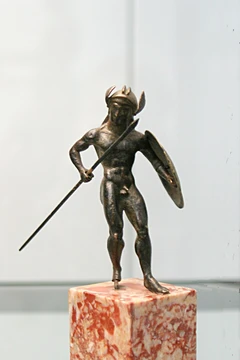
Battle of Ilipa
Scipio's reverse Cannae formation broke Carthaginian power in Iberia.
The Battle of Ilipa in 206 BC is often regarded as Scipio Africanus's most brilliant victory during the Second Punic War.[1] It likely occurred on a plain east of Alcalá del Río, Seville, Spain, near the village of Esquivel.[1]
Quick Facts
- Part of
- the Second Punic War
- Date
- Spring 206 BC
- Location
- East of Ilipa (or Silpia) (modern Alcalá del Río, Spain)
- Territory
- Roman conquest of Carthaginian Iberia
- Result
- Roman victory
Facts from the source article.
What happened
After Carthaginian defeats and Hasdrubal Barca's departure for Italy, new reinforcements arrived in Iberia under Hanno and Mago Barca in 207 BC.[2] Scipio sent Marcus Junius Silanus to surprise and scatter Mago's camp, capturing Hanno.[3][4] For several days, both armies lined up in the same formation without full battle.[5] Scipio then prepared his troops overnight and at dawn sent Velites and cavalry to raid the enemy camp, catching the Carthaginians off guard.[6]
The Roman proconsul deliberately pulled back his Iberian allies, and the legionaries overcame the enemy while Velites drove the elephants into the Carthaginian cavalry.[7] Scipio's army consisted of 45,000 infantry and 4,000 cavalry.[8] Scipio altered his battle arrangement: he put legionaries on the wings and Iberian allies in the middle, and gave the Velites the job of dealing with the elephants.[9] The Carthaginian force was almost completely destroyed; Hasdrubal and Mago fled to Gades.[10]
References
- Wikipedia, "Battle of Ilipa" (CC BY-SA 4.0), which cites: O'Connell, "The Search for the Battle-site of Ilipa: Back to Basics", www.academia.edu (original not read by us) en.wikipedia.org
- Wikipedia, "Battle of Ilipa" (CC BY-SA 4.0), which cites: Daly, "Cannae: The Experience of Battle in the Second Punic War", 2005-08-18 (original not read by us) en.wikipedia.org
- Wikipedia, "Battle of Ilipa" (CC BY-SA 4.0), which cites: "OECD Economic Surveys: Spain", OECD, 2017-03-14, p. 61–97 (original not read by us) en.wikipedia.org
- Wikipedia, "Battle of Ilipa" (CC BY-SA 4.0), which cites: "Roman Iberia : Economy, Society and Culture", Duckworth (original not read by us) en.wikipedia.org
- Wikipedia, "Battle of Ilipa" (CC BY-SA 4.0), which cites: Cartledge, "Men of Bronze", Princeton University Press, 2013-06-09 (original not read by us) en.wikipedia.org
- Wikipedia, "Battle of Ilipa" (CC BY-SA 4.0), which cites: Bloomfield, "Jones, Scipio Africanus (1863-1943), lawyer", Oxford University Press, February 2000 (original not read by us) en.wikipedia.org
- Wikipedia, "Battle of Ilipa" (CC BY-SA 4.0), which cites: "Art in the Roman Empire", Routledge, 2013-04-15, p. 85–92 (we also read that source) en.wikipedia.org
- Wikipedia, "Battle of Ilipa" (CC BY-SA 4.0), which cites: Lentzsch, "Roma Victa", J.B. Metzler, 2023, p. 185–380 (original not read by us) en.wikipedia.org
- Wikipedia, "Battle of Ilipa" (CC BY-SA 4.0), which cites: Rawlings, "New Perspectives on Ancient Warfare", BRILL, 2010-01-01, p. 253–287 (we also read that source) en.wikipedia.org
- Wikipedia, "Battle of Ilipa" (CC BY-SA 4.0), which cites: "Ilipa", Der Neue Pauly (original not read by us) en.wikipedia.org
Each numbered sentence above was checked against the source it cites before publication. Sentences citing Wikipedia adapt text from the English Wikipedia article Battle of Ilipa (contributors), used under CC BY-SA 4.0; this entry is available under the same licence. Other sources were used for facts only; no text or images are copied from them.
More in Military History & Battles
Spotted an error? Know more?
Reader corrections go straight into our review queue. Suggest an edit · How this site is sourced