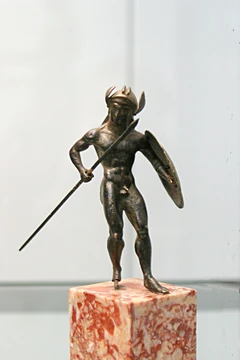
Battle of Ipsus
Decisive battle among Alexander's successors for control of his empire.
The Battle of Ipsus, fought in 301 BC near the town of Ipsus in Phrygia, was a decisive confrontation among the successors of Alexander the Great, known as the Diadochi. The combatants were Antigonus I Monophthalmus, the Greek Macedonian ruler of large parts of Asia, and his son Demetrius, against a coalition of three other successors: Cassander, ruler of Macedon; Lysimachus, ruler of Thrace; and Seleucus I Nicator, ruler of Babylonia and Persia. The principal ancient source for the period leading up to the battle is Diodorus Siculus, whose Library of History draws heavily on the now-lost account of Hieronymus of Cardia, a contemporary and possible eyewitness. However, Diodorus’s narrative breaks into fragments from the year 301 BC onward, leaving no continuous account of the battle itself. The only full description survives in Plutarch’s Life of Demetrius, written some four centuries later, though Plutarch prioritizes moral lessons over detailed military history. The battle was the culmination of the Fourth War of the Diadochi, which began in 308 BC after Antigonus resumed hostilities with Ptolemy. Antigonus and Demetrius had assumed the Macedonian crown following Demetrius’s naval victory at Salamis-in-Cyprus, and they later besieged Rhodes. By 302 BC, Demetrius was liberating Greek cities from Cassander’s garrisons, prompting Cassander to seek terms. When Antigonus refused, Cassander allied with Lysimachus and sent envoys to Ptolemy and Seleucus. Lysimachus then crossed the Hellespont into Asia Minor, capturing cities and besieging Abydos, while Cassander marched into Thessaly to confront Demetrius directly. The battle at Ipsus ultimately determined the division of Alexander’s empire.
Quick Facts
- Part of
- the Wars of the Diadochi
- Date
- 301 BC
- Location
- Ipsus, Phrygia; (modern-day Çayırbağ, Afyonkarahisar, Turkey)
- Result
- Anti-Antigonid coalition victory
Facts from the source article.
Lore & Background
The Battle of Ipsus was the culmination of the Fourth War of the Diadochi, fought in 301 BC near the town of Ipsus in Phrygia. The aging Antigonus I Monophthalmus, ruler of large parts of Asia, and his son Demetrius faced a coalition of three other successors: Cassander of Macedon, Lysimachus of Thrace, and Seleucus I Nicator of Babylonia and Persia. The principal ancient source for the period is Diodorus Siculus, whose Library of history provides the only continuous narrative of the Diadochi, though his account of the battle itself survives only in fragments. Plutarch’s Life of Demetrius, written some four centuries later, offers the only full description of the fighting, though it lacks great detail. In the years before the battle, Antigonus had been left in undisputed control of Asia Minor, Syria, and the eastern satrapies after the Second War, alarming the other successors. This led to the Third War, which ended in a compromise peace in 311 BC. Antigonus then attacked Seleucus, resulting in the Babylonian War (311–309 BC), which ended in Antigonus’s defeat and Seleucus reclaiming Babylonia. The Fourth War began in 308 BC when Antigonus resumed conflict with Ptolemy. Demetrius took Athens in 307 BC and defeated Ptolemy’s fleet at Salamis-in-Cyprus. After a failed invasion of Egypt in 306 BC, Demetrius besieged Rhodes in 305 BC, eventually reaching a compromise. He then campaigned in Greece in 303–302 BC, expelling Cassander’s garrisons. Cassander, seeing his power threatened, allied with Lysimachus and sent envoys to Ptolemy and Seleucus. Lysimachus crossed into Asia Minor in 302 BC, taking several cities, while Cassander faced Demetrius in Thessaly.
Reader's Guide
The principal ancient source for the battle is Diodorus Siculus, whose account becomes fragmentary at the year of the engagement, though he provides extensive details on the preceding Fourth War of the Diadochi. Plutarch’s Life of Demetrius, written four centuries later, offers the only surviving full description of the fighting itself, though Plutarch prioritizes moral lessons over tactical depth. The conflict arose from the ambition of Antigonus I Monophthalmus, who controlled Asia Minor, Syria, and the eastern satrapies after the Second War of the Diadochi. His growing power alarmed the other successors—Cassander of Macedon, Lysimachus of Thrace, and Seleucus of Babylonia and Persia—who formed a coalition against him. In the prelude, Lysimachus crossed the Hellespont in 302 BC, taking Lampsakos and Parion, storming Sigeion, and sending Prepelaus to attack Aeolis and Ionia while he besieged Abydos. Cassander simultaneously moved into Thessaly to confront Demetrius, who had been liberating Greek cities from Cassander’s garrisons. The battle’s significance lies in its role as the decisive clash of the Diadochi, leading to the fragmentation of Alexander’s empire into distinct Hellenistic kingdoms.
Did You Know?
- The only full description of the battle is in Plutarch's Life of Demetrius, written some 400 years after the event.
- Diodorus Siculus's account of the battle only exists in fragments from book XXI onwards.
- Hieronymus of Cardia, a contemporary and possible eyewitness, is thought to be Diodorus's source for much of this period.
Frequently Asked Questions
Where and when did the Battle of Ipsus take place?
The engagement was fought near the town of Ipsus in Phrygia, in the region of modern-day Turkey, during the period of the Fourth War of the Diadochi following Alexander the Great's death.
What was the outcome of the Battle of Ipsus?
The battle proved decisive for the coalition side, effectively ending Antigonus's attempt to reunify Alexander's former territories under one ruler and cementing the empire's division among the surviving Diadochi.
What ancient sources describe the Battle of Ipsus?
The principal surviving accounts come from Diodorus Siculus, whose narrative on the battle is only fragmentary, and from Plutarch's biographical sketch of Demetrius.
More in Military History & Battles
Spotted an error? Know more?
Reader corrections go straight into our review queue. Suggest an edit · How this site is sourced