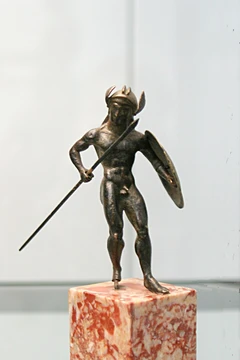
Ancient warfare
Organized armies emerged from agricultural surplus and city-states.
The chariot became a key weapon in the Ancient Near East during the 2nd millennium BC, offering tactical mobility for bowmen.[1][2] Naval warfare in the Mediterranean is traceable to the third millennium BC, with ships used for both transport and combat.[3] Bows and spears, which were originally created for hunting during prehistoric times, continued to be the primary weapons used by early ancient armies.[4]
Quick Facts
- Period
- From the beginning of recorded history to the end of the ancient period
- Key region
- Mesopotamia, Europe, Near East, China, India, Japan
- Dominant force
- Infantry
- Key innovation
- Chariot
Facts from the source article.
What happened
The chariot was first used in the Middle East around 1800 BC, initially pulled by oxen and donkeys.[5] A typical chariot had two men: a bowman and a driver.[1] In China, chariots became the central weapon of the Shang dynasty, helping unify a large area.[1] The Nataruk site in Kenya, Turkana, has been presented as showing ancient inter-group conflict and warfare, although researchers have contested this reading of the evidence.[4]
Massed infantry carrying bows and spears were employed by the early armies of both Egypt and China.[4] Horses may have been used to pull chariots as early as 2100 BC, following advances in horse training that made this possible.[5] Chariots could be floated across rivers because of their light weight.[5] The Battle of Kadesh, which occurred in 1274 BC, likely involved around 5,000 chariots and stands as the largest chariot battle ever fought.[6]
A relief at Medinet Habu, depicting Ramses III's triumph over the Sea-Peoples, provides the earliest documented physical evidence of a naval battle.[7]
What the cited sources add
Cartwright notes that chariots were used in Chinese warfare from around 1250 BCE, with their heyday between the 8th and 5th century BCE.[8] A specialized Chinese chariot, the crow’s nest chariot, had a higher chassis and tower for battlefield observation.[8] Cartwright explains that chariots needed flat terrain and could be outflanked by more mobile infantry.[8] The chariot’s limitations and the arrival of more dynamic military encounters relegated it to a minor role in Chinese warfare.[8]
According to Oakeshott in The Archaeology of Weapons, the sword evolved from the knife in both Minoan Crete and Celtic Britain during the period from 1500 to 100 BC.[9]
References
- Wikipedia, "Ancient warfare" (CC BY-SA 4.0), which cites: Cartwright, "Chariots in Ancient Chinese Warfare", World History Encyclopedia, 13 July 2017 (we also read that source) en.wikipedia.org
- Wikipedia, "Ancient warfare" (CC BY-SA 4.0), which cites: Lloyd, "A Companion to Ancient Egyp", Wiley Blackwell, 2010, p. 438; Drews, "The end of the Bronze Age: changes in warfare and the catastrophe ca. 1200 B.C", Princeton University Press, 1995, p. 221; Littauer, "Wheeled vehicles and ridden animals in the ancient Near East", Brill, 1979, p. 98; Gaebel, "Cavalry operations in the ancient Greek world", University of Oklahoma Press, 2004, p. 40 (we also read that source) en.wikipedia.org
- Wikipedia, "Ancient warfare" (CC BY-SA 4.0), which cites: Lazenby, "Essays and Reflections: Naval Warfare in the Ancient World: Myths and Realities", Taylor & Francis, Ltd., 1987, p. 438 (original not read by us) en.wikipedia.org
- Wikipedia, "Ancient warfare" (CC BY-SA 4.0), which cites: Lahr, "Inter-group violence among early Holocene hunter-gatherers of West Turkana, Kenya", Nature, 2016, p. 394–98; Stojanowski, "Contesting the massacre at Nataruk", Nature, 2016, p. E8–E10 (original not read by us) en.wikipedia.org
- Wikipedia, "Ancient warfare" (CC BY-SA 4.0), which cites: Kuznetsov, "The emergence of Bronze Age chariots in eastern Europe", Antiquity, 2006, p. 638–45 (original not read by us) en.wikipedia.org
- Wikipedia, "Ancient warfare" (CC BY-SA 4.0), which cites: Aaron Ralby, "Atlas of Military History", Parragon, 2013, p. 54–55 (we also read that source) en.wikipedia.org
- Wikipedia, "Ancient warfare" (CC BY-SA 4.0), which cites: Lazenby, "Essays and Reflections: Naval Warfare in the Ancient World: Myths and Realities.", Taylor & Francis, Ltd., 1987, p. 439 (original not read by us) en.wikipedia.org
- Cartwright, "Chariots in Ancient Chinese Warfare", World History Encyclopedia, 13 July 2017. facts only, no text reused. worldhistory.org
- Wikipedia, "Ancient warfare" (CC BY-SA 4.0), which cites: Oakeshott, "The Archaeology of Weapons", Boydell Press, 1960 (original not read by us) en.wikipedia.org
Each numbered sentence above was checked against the source it cites before publication. Sentences citing Wikipedia adapt text from the English Wikipedia article Ancient warfare (contributors), used under CC BY-SA 4.0; this entry is available under the same licence. Other sources were used for facts only; no text or images are copied from them.
More in Military History & Battles
Spotted an error? Know more?
Reader corrections go straight into our review queue. Suggest an edit · How this site is sourced