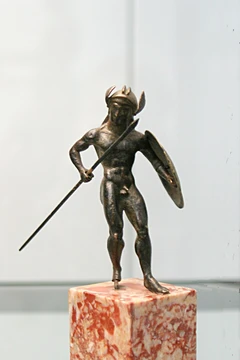
Battle of Marathon
Greek victory over Persia at Marathon ended the first invasion.
The Athenian army, aided by Plataeans, defeated a Persian force that had landed at the bay of Marathon, about 17 miles northeast of Athens.[1][2] According to Herodotus, the number of Persian dead counted on the field was 6,400, while Athenian losses were reported as 192 men.[3]
Quick Facts
- Part of
- the first Persian invasion of Greece
- Date
- 12 September 490 BC (6 Boedromion)
- Location
- Marathon, Greece
- Result
- Athenian victory
Facts from the source article.
What happened
In 490 BC, a Persian expedition under Artaphernes and Datis sailed to subjugate the Cyclades and then force Eretria and Athens to submit.[4][5] The Athenians sent the runner Pheidippides to Sparta, but the Spartans could not march until the full moon rose.[1] Miltiades ordered the Greek center to be arranged in four ranks while the flanks were eight ranks deep.[6] The Athenian wings routed the Persian flanks, then turned inward to surround the Persian center.[7]
The Athenian army then marched back to Athens and prevented the Persian fleet from landing there.[8] Under Miltiades' direction, the Athenian army rapidly positioned itself to seal off both routes leading from the Marathon plain.[1] After a standoff lasting approximately five days, the Greek forces initiated an assault on the Persian army.[9][10] The Persian center fled in disorder toward their vessels, and the Greeks succeeded in seizing seven of those ships.[11]
What the cited sources add
Herodotus reports that Darius, upon hearing of the burning of Sardis, shot an arrow toward heaven and prayed for vengeance against the Athenians.[12][13] Herodotus also states that the Athenians at Marathon were the first Greeks to endure looking at Median dress, as previously the mere name of the Medes caused panic among the Hellenes.[14] According to Vic Hurley, the Persian defeat is explained by the "complete failure... to field a representative army," calling the battle the "most convincing" example that infantry-bowmen cannot defend a position unsupported by cavalry or fortifications.[15][16] Lazenby (1993) believes the ultimate reason for the Greek success was the courage of ordinary, amateur soldiers who broke into a trot when the arrows began to fall.[17]
The conventionally accepted date of the battle, September 12, 490 BC in the Julian calendar, was concluded by August Böckh in 1855.[18]
References
- Wikipedia, "Battle of Marathon" (CC BY-SA 4.0), which cites: Herodotus VI, 102; Holland, pp. 187–90; Cornelius Nepos, Miltiades, IV; Herodotus VI, 105; Holland, pp. 187–90; Holland, pp. 187–90 (original not read by us) en.wikipedia.org
- Wikipedia, "Battle of Marathon" (CC BY-SA 4.0), which cites: Cornelius Nepos, Miltiades, V; Pausanias X, 20; Plutarch, Moralia, 305 B; Justin II, 9; Herodotus IX, 28; Pausanias I, 32; Holland, pp. 187–90; Lazenby, p. 54; A.W. Gomme. The Population of Athens in the Fifth and Fourth. Centuries B.C.. 1933 (original not read by us) en.wikipedia.org
- Wikipedia, "Battle of Marathon" (CC BY-SA 4.0), which cites: Herodotus VI, 117; Herodotus VI, 117 (original not read by us) en.wikipedia.org
- Wikipedia, "Battle of Marathon" (CC BY-SA 4.0), which cites: Roisman Worthington 2011, p. 343; Herodotus VI, 44 (original not read by us) en.wikipedia.org
- Wikipedia, "Battle of Marathon" (CC BY-SA 4.0), which cites: Herodotus VI, 94 (original not read by us) en.wikipedia.org
- Wikipedia, "Battle of Marathon" (CC BY-SA 4.0), which cites: Herodotus VI, 112; Plutarch, Aristides, V; Herodotus VI, 111 (original not read by us) en.wikipedia.org
- Wikipedia, "Battle of Marathon" (CC BY-SA 4.0), which cites: Herodotus VI, 113 (original not read by us) en.wikipedia.org
- Wikipedia, "Battle of Marathon" (CC BY-SA 4.0), which cites: Herodotus VI, 116; Holland, p. 218; Herodotus VI, 116; Herodotus VI, 115; Lazenby, pp. 72–73 (original not read by us) en.wikipedia.org
- Wikipedia, "Battle of Marathon" (CC BY-SA 4.0), which cites: Holland, pp. 187–90; Cornelius Nepos, Miltiades, VI; Lazenby, p. 56; Holland, pp. 187–90; Herodotus VI, 103; Herodotus VI, 109; Herodotus VI, 110; Herodotus VI, 110; Herodotus VI, 110; Lazenby, pp. 59–62; Lazenby, pp. 57–59; Lazenby, pp. 57–59 (original not read by us) en.wikipedia.org
- Wikipedia, "Battle of Marathon" (CC BY-SA 4.0), which cites: Lazenby, pp. 59–62; Lazenby, pp. 59–62 (original not read by us) en.wikipedia.org
- Wikipedia, "Battle of Marathon" (CC BY-SA 4.0), which cites: Herodotus VI, 113; Pausanias I, 32; Lazenby, p. 71; Herodotus VI, 115; Herodotus VI, 114 (original not read by us) en.wikipedia.org
- Wikipedia, "Battle of Marathon" (CC BY-SA 4.0), which cites: Herodotus Book 5: Terpsichore, 105 ( ): "...he inquired into who the Athenians were; and when he had been informed, he asked for his bow, and having received it (we also read that source) en.wikipedia.org
- Herodotus Book 5: Terpsichore, 105 ( ): "...he inquired into who the Athenians were; and when he had been informed, he asked for his bow, and having received it. facts only, no text reused. sacred-texts.com
- Wikipedia, "Battle of Marathon" (CC BY-SA 4.0), which cites: Lazenby, pp. 66–69; Herodotus VI, 110; Herodotus VI, 112 (original not read by us) en.wikipedia.org
- Wikipedia, "Battle of Marathon" (CC BY-SA 4.0), which cites: Hurley, "Arrows Against Steel: The History of the Bow and How It Forever Changed Warfare", Cerberus Books, 2011, p. 66 (we also read that source) en.wikipedia.org
- Open Library record, ISBN 9780983475613 ("Arrows against steel"). CC0 (metadata); book content not read. openlibrary.org
- Wikipedia, "Battle of Marathon" (CC BY-SA 4.0), which cites: Lazenby p. 258 (original not read by us) en.wikipedia.org
- Wikipedia, "Battle of Marathon" (CC BY-SA 4.0), which cites: Gongaki, Preka-Papadema, Kalachanis, Antonopoulos, "ASTRONOMICAL CALCULATION OF THE DATING THE HISTORICAL BATTLES OF MARATHON, THERMOPYLAE AND SALAMIS BASED ON HERODOTUS' DESCRIPTION", Scientific Culture, 2 December 2021; "September 12 Battle Was Seed of the Modern Marathon", Runner's World, 2014-09-12; D.W. Olson et al., pp. 34–41 (we also read that source) en.wikipedia.org
Each numbered sentence above was checked against the source it cites before publication. Sentences citing Wikipedia adapt text from the English Wikipedia article Battle of Marathon (contributors), used under CC BY-SA 4.0; this entry is available under the same licence. Other sources were used for facts only; no text or images are copied from them.
More in Military History & Battles
Spotted an error? Know more?
Reader corrections go straight into our review queue. Suggest an edit · How this site is sourced