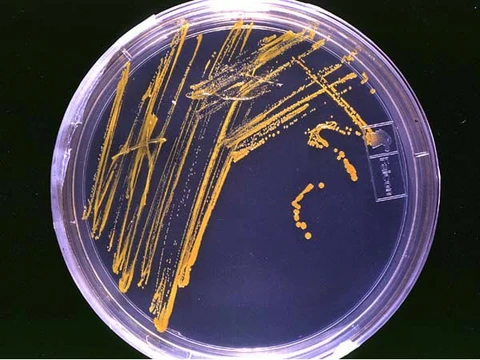
Spore
A reproductive unit adapted for dispersal and survival.
Last updated

Ivar Leidus · CC BY-SA 4.0
In biology, a unit of reproduction that can be either sexual (in fungi) or asexual, and is adapted for dispersal and long-term survival under harsh conditions, is called a spore.[1] The word "spore" originates from the Greek term σπορά (spora), which translates to 'seed, sowing'.[2]
Quick Facts
- First appearance
- Silurian period (vascular plant spores); earlier cryptospores from Ordovician
Facts from the source article.
Key facts and history
Heterosporous plants produce two different sizes: megaspores (female) and microspores (male).[3] Myxozoan spores release amoeboid infectious germs into their hosts for parasitic infection.[4] Early land plants are thought to have developed spores as an adaptation, with evidence suggesting their appearance during the mid-late Ordovician period.[1] The oldest evidence of plant life on land comes from envelope-enclosed spore tetrads, which date back to the mid-Ordovician period.[5]
Fossil records show that individual trilete spores first emerged at the close of the Ordovician period.[5] In vascular plants, spores are invariably haploid.[6] Spores of identical size and type are produced by homosporous plants.[6] Bacterial spores serve as resilient structures for enduring unfavorable conditions, rather than being part of a sexual reproductive cycle.[4]
What the research sources say
The Tree of Life Web Project notes that myxospores range in size between one hundredth and two hundredth of a millimetre.[7] Myxospores consist of several cells transformed to shell valves, polar capsules, and amoeboid infective germs.[7] The myxosporean life cycle alternates between fish and annelid hosts, with the myxospore ingested by annelids.[7] The malacosporean Tetracapsuloides bryosalmonae and some myxosporean species cause significant losses of farm-reared fish.[7]
Phylogenetic analyses of myxosporean SSU rDNA have cast doubt on the traditional taxonomic scheme based on spore morphology.[7] The Sciencing account explains that microspore mother cells in the anther undergo meiosis to produce four haploid microspores.[8]
References
- Wikipedia, "Spore" (CC BY-SA 4.0), which cites: Setlow, "Food Microbiology", 2014, p. 45–79; "Tree of Life Web Project"; Wellman, "The microfossil record of early land plants", Philosophical Transactions of the Royal Society of London. Series B, Biological Sciences, 2000-06-29, p. 717–731; discussion 731–732 (original not read by us) en.wikipedia.org
- Wikipedia, "Spore" (CC BY-SA 4.0), which cites: "Spore - Etymology, Origin & Meaning", Online Etymology Dictionary; "Sparse - Etymology, Origin & Meaning", Online Etymology Dictionary (original not read by us) en.wikipedia.org
- Wikipedia, "Spore" (CC BY-SA 4.0), which cites: "Raven Biology of Plants", p. 398 (we also read that source) en.wikipedia.org
- Wikipedia, "Spore" (CC BY-SA 4.0), which cites: Abel-Santos, "Bacterial spores: current research and applications", Caister academic press, August 2025; Ivan Fiala, "Myxozoa", Tree of Life Web Project, 10 July 2008 (we also read that source) en.wikipedia.org
- Wikipedia, "Spore" (CC BY-SA 4.0), which cites: Gray, J., "The Microfossil Record of Early Land Plants: Advances in Understanding of Early Terrestrialization, 1970–1984", Philosophical Transactions of the Royal Society B, 1985, p. 167–195; Wellman, "The microfossil record of early land plants", Philosophical Transactions of the Royal Society of London. Series B, Biological Sciences, 2000-06-29, p. 717–731; discussion 731–732; Steemans, "Origin and Radiation of the Earliest Vascular Land Plants", Science, 2009, p. 353 (original not read by us) en.wikipedia.org
- Wikipedia, "Spore" (CC BY-SA 4.0), which cites: "Plant - Homosporous, Life, Histories Britannica", www.britannica.com, 2025-08-05 (original not read by us) en.wikipedia.org
- Ivan Fiala, "Myxozoa", Tree of Life Web Project, 10 July 2008. facts only, no text reused. tolweb.org
- Jerrett, "What Is The Function Of The Anther On A Flower?", Sciencing, 30 September 2021. facts only, no text reused. sciencing.com
Each numbered sentence above was checked against the source it cites before publication. Sentences citing Wikipedia adapt text from the English Wikipedia article Spore (contributors), used under CC BY-SA 4.0; this entry is available under the same licence. Other sources were used for facts only; no text or images are copied from them.
More in Microbiology
Sources
Compiled from Wikipedia and the sources listed below. Text from Wikipedia is available under CC BY-SA 4.0; this entry is adapted from it.
- Wikipedia: Spore (CC BY-SA 4.0).
- Word definitions: the , each quoted from its Wikipedia article.
Spotted an error? Know more?
Reader corrections go straight into our review queue. Suggest an edit · How this site is sourced