Oaxaca
State in Southern Mexico known for Indigenous cultures and biodiversity.

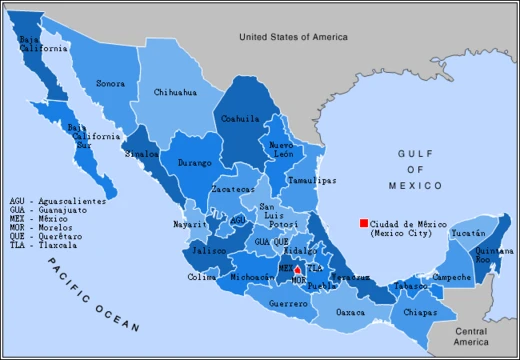
Oaxaca, officially called the Free and Sovereign State of Oaxaca, is one of Mexico’s 31 states. It lies in the southern part of the country, bordered by Guerrero to the west, Puebla to the northwest, Veracruz to the north, and Chiapas to the east. Its southern edge meets the Pacific Ocean. The capital city is Oaxaca de Juárez.
The state is divided into 570 municipalities. Of these, 418—nearly three-quarters—operate under *usos y costumbres*, a system that recognizes local customs and traditions for self-governance.
Oaxaca is especially known for its Indigenous peoples and cultures. The Zapotecs and Mixtecs are the largest and most famous groups, but 16 distinct Indigenous cultures are officially recognized. These cultures have endured better than most in Mexico, largely because the state’s rugged, isolated terrain has helped preserve them. Most Indigenous people live in the Central Valleys region, which is also a key economic area for tourism. Visitors come for archaeological sites like Monte Albán and Mitla, as well as for the region’s native cultures and crafts. Another major tourist draw is the coast, featuring the resort of Huatulco and the sandy beaches of Puerto Escondido, Puerto Ángel, Zipolite, Bahia de Tembo, and Mazunte. Oaxaca is also among Mexico’s top three most biologically diverse states, alongside Chiapas and Veracruz, with high numbers of reptiles, amphibians, mammals, and plants.
**History**
**Name** The state’s name comes from its capital, Oaxaca, which derives from the Nahuatl word *Huaxyacac*. This refers to a tree called *guaje* in Spanish (*Leucaena leucocephala*) found around the capital. The Aztecs, who spoke Nahuatl, originally used the name for the Valley of Oaxaca, and the Spanish adopted it during the conquest of the region. The modern state was created in 1824. The state seal was designed by Alfredo Canseco Feraud and approved under Governor Eduardo Vasconcelos. *Huaxyacac* was transliterated as “Oaxaca” using Medieval Spanish spelling, where the *x* stood for the sound *sh* (as in “shop”), making the pronunciation [waˈʃaka]. In the 16th century, that sound shifted to a hard *kh* (like the *ch* in Scottish “loch”), so Oaxaca became [waˈxaka]. Today, it is pronounced [waˈxaka] or [waˈhaka]—the latter common in southern Mexico, the Caribbean, much of Central America, parts of South America, and the Canary Islands and western Andalusia in Spain, where the *x* sound has softened to an *h*.
**Prehistoric and Pre-Hispanic Period** Most knowledge of prehistoric Oaxaca comes from the Central Valleys region. Evidence of human habitation dating to about 11,000 BCE was found in the Guilá Naquitz cave near Mitla. This site was named a UNESCO World Heritage site in 2010 because it contains “the earliest known evidence of domesticated plants in the continent,” and corn cob fragments from the same cave are considered the earliest documented evidence of maize domestication. Finds from nomadic peoples date to about 5000 BCE, with early signs of agriculture. By 2000 BCE, agriculture was established in the Central Valleys, with sedentary villages. The diet that developed then—based on corn, beans, chocolate, tomatoes, chili peppers, squash, and gourds—lasted until the Spanish Conquest. Meat came from hunting animals like tepescuintle, turkey, deer, peccary, armadillo, and iguana.
The oldest known major settlements, such as Yanhuitlán and Laguna Zope, are also in this area. Laguna Zope is noted for small figurines called “pretty women” or “baby face.” Between 1200 and 900 BCE, pottery was produced locally, linked to similar work in La Victoria, Guatemala. Other important settlements from that period include Tierras Largas, San José Mogote, and Guadalupe, whose ceramics show Olmec influence. The major language family, Oto-Manguean, is thought to have been spoken in northern Oaxaca around 4400 BCE and to have split into nine branches by 1500 BCE.
Historic events in Oaxaca as far back as the 12th century are recorded in pictographic codices painted by Zapotecs and Mixtecs early in the colonial period. Aside from these, little historical information from pre-colonial Oaxaca exists, so knowledge relies mostly on archaeological remains. By 500 BCE, the Central Valleys were mainly inhabited by the Zapotecs, with the Mixtecs on the western side. These groups often fought during the pre-Hispanic period. Archaeological evidence suggests that between 750 and 1521, the population may have peaked at 2.5 million.
The Zapotecs were the first to dominate the Central Valleys. Their first major dominion centered on Monte Albán, which thrived from 500 BCE to AD 750. At its height, Monte Albán had 25,000 residents and served as the Zapotec capital. It remained a secondary power center until the Mixtecs overran it in 1325. The site is notable for the Danzantes, a set of stone reliefs, and for fine-quality ceramics.
From AD 750 onward, large urban centers like Monte Albán declined across Oaxaca, and smaller dominions grew and evolved until the Spanish Conquest in 1521. Between 700 and 1300, the Mixtecs were scattered among dominions including Achiutla, Tequixtepec-Chazumba, Apoala, and Coixtlahuaca. The Zapotecs occupied a large area from the Central Valleys to the Isthmus of Tehuantepec. No major unified empire emerged during this period.
Lore & Background
The name Oaxaca comes from the Nahuatl word Huaxyacac, referring to a tree (Leucaena leucocephala) found around the capital. The name was applied by Aztecs and passed to the Spanish during the conquest. By 2000 BCE, agriculture was established in the Central Valleys, with settlements such as Yanhuitlán and Laguna Zope.
Reader's Guide
Oaxaca is significant for its enduring Indigenous cultures, which survived due to the state's rugged terrain. The Zapotecs and Mixtecs are the most numerous among 16 officially recognized groups. The state is a major tourist destination, with archaeological sites like Monte Albán and Mitla in the Central Valleys, and coastal resorts such as Huatulco, Puerto Escondido, and Zipolite. Oaxaca is also one of Mexico's most biologically diverse states, ranking in the top three for reptiles, amphibians, mammals, and plants. Its system of usos y costumbres allows local self-governance in most municipalities. The state's history includes early human habitation, the rise and fall of Monte Albán, and conflict between Zapotecs, Mixtecs, and Aztecs before Spanish colonization. The name's pronunciation evolved from [waˈʃaka] to [waˈxaka] or [waˈhaka] in modern Spanish.
Indigenous Cultures and Living Governance
Oaxaca stands apart among Mexico's thirty-one states for the extraordinary depth of its Indigenous heritage. Sixteen distinct ethnic groups hold official recognition within the state, with the Zapotecs and Mixtecs forming the largest and most widely known communities. What makes this cultural survival remarkable is the state's rugged, isolating topography, which shielded these populations from the homogenizing pressures that erased or diluted many other Indigenous traditions across the country. This living cultural presence is not merely symbolic; it is embedded in the political structure itself.
A Deep Archaeological Record
The prehistoric record of Oaxaca stretches back roughly eleven thousand years, with evidence of human habitation discovered in the Guilá Naquitz cave near the town of Mitla. This site was designated a UNESCO World Heritage location in 2010, celebrated for containing what is recognized as the earliest known evidence of domesticated plants on the American continent, along with corn cob fragments considered the oldest documented proof of maize domestication. The diet that emerged then—corn, beans, chocolate, tomatoes, chili peppers, squash, and gourds, supplemented by hunted tepescuintle, turkey, deer, peccary, armadillo, and iguana—persisted essentially unchanged until the Spanish Conquest.
Geography, Coastline, and Biological Richness
Situated in southern Mexico, Oaxaca occupies a position bordered by Guerrero to the west, Puebla to the northwest, Veracruz to the north, and Chiapas to the east, while its southern edge opens onto a substantial stretch of Pacific coastline. This geographic diversity creates two major tourist draws. The Central Valleys region, home to the bulk of the state's population, attracts visitors with its archaeological treasures—Monte Albán and Mitla stand out—alongside the living native cultures and traditional crafts that still thrive there. The coast offers a different experience, with the developed resort of Huatulco and the more laid-back sandy beaches of Puerto Escondido, Puerto Ángel, Zipolite, Bahia de Tembo, and Mazunte. Beyond human heritage, Oaxaca is one of Mexico's most biologically diverse states, ranking in the top three alongside Chiapas and Veracruz for the number of reptile, amphibian, mammal, and plant species found within its borders. The same rugged terrain that preserved Indigenous cultures also created the varied microclimates and habitats that support this extraordinary concentration of wildlife.
The Name and Its Linguistic Journey
The name Oaxaca carries a layered linguistic history that spans millennia. It derives from the Nahuatl word Huaxyacac, a reference to the guaje tree (Leucaena leucocephala) that grew abundantly around what is now the capital city. Nahuatl-speaking Aztecs originally applied this name to the Valley of Oaxaca, and it was passed to the Spanish during the conquest. The spelling Oaxaca reflects Medieval Spanish orthography, in which the letter x represented the sound [ʃ], equivalent to the sh in English shop, making the original pronunciation close to [waˈʃaka]. Over the course of the sixteenth century, that voiceless fricative shifted into a voiceless velar fricative [x], similar to the ch in Scottish loch, yielding [waˈxaka]. In many present-day dialects of southern Mexico, the Caribbean, much of Central America, parts of South America, the Canary Islands, and western Andalusia, the [x] has further softened into a glottal [h], producing the pronunciation [waˈhaka].
Frequently Asked Questions
Who is Oaxaca?
Oaxaca is one of Mexico's 31 states, nestled in the southern region with a stretch of Pacific coastline, and its seat of government is the city of Oaxaca de Juárez.
What are Oaxaca's powers or role?
The state is celebrated as a living repository of Zapotec and Mixtec Indigenous heritage and as a hotspot of biodiversity that rivals any other region in the country.
Why is Oaxaca important?
It acts as a cultural anchor for Mexico's Indigenous identity and sits at a geographic crossroads, sharing borders with Guerrero, Puebla, Veracruz, and Chiapas in Southern Mexico.
More in Mexican States 1-19
Spotted an error? Know more?
This is a living reference — every entry is fact-audited, and reader corrections feed straight into our audit queue. Suggest an edit · See this site's audit record