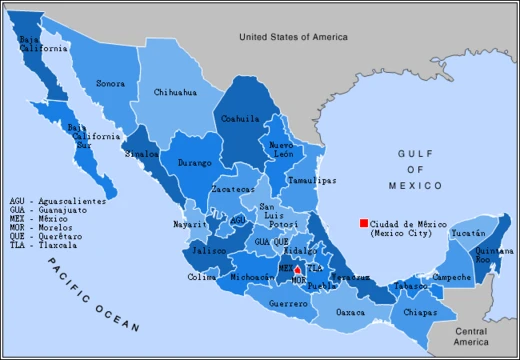
Coahuila
A northern Mexican state with rich history and industry.

Coahuila, officially the Free and Sovereign State of Coahuila de Zaragoza, is one of Mexico’s 31 states. Its capital and largest city is Saltillo; the second-largest city is Torreón, followed by Monclova (a former capital), Piedras Negras, and Ciudad Acuña. It shares borders with Nuevo León to the east, Zacatecas to the south, and Durango and Chihuahua to the west. To the north, a 512-kilometer stretch of the Rio Grande (Río Bravo del Norte) forms the boundary with the U.S. state of Texas. Covering 151,563 square kilometers, Coahuila is the third-largest state in Mexico. It is divided into 38 municipalities. According to the 2020 Census, its population was 3,146,771.
The name Coahuila comes from native terms for the region, with early variations including Cuagüila and Cuauila. Some historians interpret it as meaning “flying serpent,” “place of many trees,” or “place where serpents creep.” The state’s official name honors General Ignacio Zaragoza. Spanish exploration of northern Mexico lagged after the fall of Tenochtitlan due to the harsh climate and lack of gold. The first Spanish settlement in the area was Minas de la Trinidad in 1577. Saltillo was founded in 1586 as part of the province of Nueva Vizcaya within the Viceroyalty of New Spain, and the region later became one of the first provinces of Nueva Extremadura explored by Europeans. Among the 16th-century settlers were Tlaxcalans, who established the independent community of San Esteban de Nueva Tlaxcala near Saltillo.
Under the 1824 Constitution of the newly independent United Mexican States, Coahuila y Tejas was a constituent state that included Texas, Coahuila, and Nuevo León. Nuevo León was separated later that year, but Texas remained part of the state until it seceded in 1836 to form the Republic of Texas. Monclova served as the state capital from 1833 to 1835. In 1840, Coahuila briefly joined the short-lived Republic of the Rio Grande. During the mid-19th century, the Sánchez Navarro family owned a ranch of 6,700,000 hectares, mostly in Coahuila, making it the largest private property in the Americas. The state faced frequent Comanche raids in the 1840s and 1850s. On February 19, 1856, Santiago Vidaurri annexed Coahuila to Nuevo León, but it regained separate status in 1868. During the Mexican Revolution, Francisco Villa attacked Torreón. On April 4, 2004, flooding in Piedras Negras killed over 30 people and left more than 4,000 homeless. In 2007, Coahuila became the first Mexican state to offer civil unions (Pacto Civil de Solidaridad) to same-sex couples.
In July 2025, archaeologists from INAH and CONANP discovered a pre-Hispanic mortuary cave in Coahuila’s desert mountains. Accessed through a narrow 50-centimeter vertical shaft, the semi-circular chamber contained the bundled remains of about 17 individuals—men, women, and children—placed on baskets or mats. Twelve complete skulls were found, five of which belonged to children. Though there was evidence of modern looting, the burials closely resemble those at Coahuila’s Candelaria Cave. The finds are preserved at the Regional Museum of La Laguna in Torreón.
The Sierra Madre Oriental runs northwest to southeast through the state, with higher elevations hosting Sierra Madre Oriental pine-oak forests. Its northernmost extensions, the Sierra del Burro and Sierra del Carmen, reach the Rio Grande at the U.S. border. East of the range, the land slopes gently toward the Rio Grande, drained by rivers including the Salado and its tributary, the Sabinas. The Tamaulipan mezquital, a dry shrubland, covers the eastern part of the state and extends into southern Texas. West of the Sierra Madre Oriental lies the Mexican Plateau, part of the Chihuahuan Desert. The Bolsón de Mapimí, a large endorheic basin, covers much of the western portion and extends into Chihuahua, Durango, and Zacatecas. The Nazas River, flowing east from Durango, and the Aguanaval River, flowing north from Zacatecas, empty into lakes in the Bolsón. Torreón, the state’s most populous city, lies on the Nazas in the irrigated Laguna Region (Comarca Lagunera), which straddles the Coahuila-Durango border. Coahuila contains two biosphere reserves: Maderas del Carmen on the northern border, featuring Chihuahuan desert and sky islands of pine-oak forest in the Sierra del Carmen, and the Cuatro Ciénegas Basin west of Monclova, known for its springs, lakes, and wetlands. The state is largely arid or semi-arid, but its rivers support extensive irrigated agriculture, especially cotton. The Parras district in the south produces wines and brandies, and the Sierra Madre pine-oak forests yield timber.
The 2020 census recorded Coahuila’s population at 3,146,771, giving it a low population density of about 15 persons per square kilometer.
- Capital
- Saltillo
- Borders
- Nuevo León, Zacatecas, Durango, Chihuahua, and the U.S. state of Texas
- Largest city
- Saltillo
- Known for
- Largest coal reserves in Mexico, major automobile industry, and first state to legalize same-sex civil unions
Lore & Background
During the Mexican Revolution, Francisco Villa attacked Torreón.
Reader's Guide
Coahuila's significance lies in its economic and historical roles. It holds about 95% of Mexico's coal reserves and is the country's top mining state. The state hosts major automobile plants from General Motors and Stellantis, and Torreón is home to the world's largest silver producer. Coahuila's economy is export-oriented, with a strong manufacturing sector. Historically, it was part of the early Mexican federation and experienced Comanche raids in the mid-19th century. Coahuila's geography ranges from the Sierra Madre Oriental to the Chihuahuan Desert, supporting agriculture and timber. Its population is predominantly Mestizo, with a low density of 15 persons per square kilometer.
Did You Know?
- Coahuila's name may mean 'flying serpent,' 'place of many trees,' or 'place where serpents creep.'
- Coahuila is the Mexican state with the highest level of public debt.
Frequently Asked Questions
What are Coahuila's powers or role?
As a major industrial hub in northern Mexico, Coahuila shares a long border with the U.S. state of Texas and also touches Nuevo León, Zacatecas, Durango, and Chihuahua. This makes it a key crossroads for cross-border trade and manufacturing in the region.
Why is Coahuila important?
Beyond its sheer size and industrial output, Coahuila holds a pioneering place in Mexican social policy for leading the nation on same-sex civil unions. Its position along the U.S. border also gives it outsized economic and political weight within the federation.
More in Mexican States 1-19
Spotted an error? Know more?
This is a living reference — every entry is fact-audited, and reader corrections feed straight into our audit queue. Suggest an edit · See this site's audit record