Cancún
Planned tourist city on Mexico's Caribbean coast.

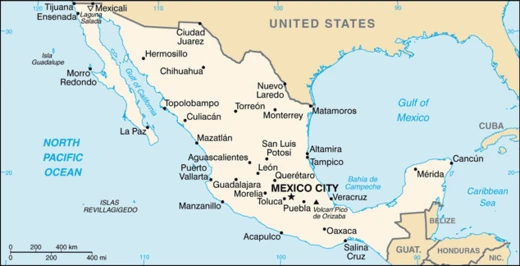
Cancún, the largest city in Quintana Roo, sits on the Caribbean coast of Mexico’s Yucatán Peninsula, near the country’s easternmost edge. It serves as the seat of Benito Juárez municipality and is a major tourist hub, with the Hotel Zone forming its primary resort area. Just south lies the Riviera Maya.
The island’s Maya inhabitants originally called it Nizuc, meaning “promontory” or “point of grass.” The name Cancún (sometimes spelled Cancoon in older English texts) first appeared on 18th-century maps. It comes from the Mayan *kàan kun*—*kàan* for “snake” and *kum/kun* for “to swell” or “overfill.” Most interpret this as “nest of snakes,” though a less common translation is “place of the golden snake.” Snake imagery was common at the pre-Columbian site of Nizuc. The city’s coat of arms, designed by Joe Vera, splits into three colors: blue for the Caribbean Sea, yellow for the sand, and red for the sun’s rays.
After the Spanish conquest, disease, war, and famine reduced the Maya population, leaving only small settlements on Isla Mujeres and Cozumel. Cancún was a planned city, created to boost tourism. On 23 January 1970, when development began, Isla Cancún had just three residents—caretakers of a coconut plantation—and nearby Puerto Juárez held 117 people. The Mexican government allocated $2 million through the Bank of Mexico in 1967 to study new resort zones, preferably where no other development options existed. INFRATUR, a Bank of Mexico agency, oversaw the project. Because investors were hesitant, the federal government financed the first nine hotels. The city launched in 1974 as an Integrally Planned Center, a pioneer of FONATUR (the National Fund for Tourism Development). It transformed from a fishing island into one of Mexico’s two most famous resorts, alongside Acapulco. From 1970 to 1980, the population grew 62.3% annually. Growth outpaced the rest of Quintana Roo, and from the 1990s onward, tourism expanded into indigenous territories and protected inland areas. Most residents come from Yucatán and other Mexican states, with a growing number from the Americas and Europe. Municipal authorities struggle to provide services for constant influxes while limiting squatters and irregular developments, which in 2006 occupied an estimated 10–15% of the mainland fringe. In 2023, a record 21 million tourists visited, exceeding the 20.5 million forecast.
Cancún largely avoided drug-trade violence in the early 21st century, though drugs are sold to tourists in bars and nightclubs, and the city has been linked to money laundering. The Juárez and Gulf cartels controlled the area in the 1990s and early 2000s; by 2010, Los Zetas had taken over many smuggling routes through the Yucatán. Violent acts related to drug trafficking have occurred: 76 murders between 2013 and 2016, at least 193 in 2017, and 33 in January 2018 alone—triple the January 2017 figure. Most homicides happen in the urban core, with some firearm incidents in the Hotel Zone. Since 2018, Cancún’s homicide rate has been above the national average.
Starting in 2015, large amounts of smelly brown Sargassum seaweed began washing up on Cancún’s white sand beaches each summer, significantly impacting tourism. By 2021, the seaweed’s arrival had become an annual event at many Caribbean beach destinations, including Cancún.
The city layout includes the island tourist zone (part of the Mesoamerican Barrier Reef System) and a mainland residential section, whose downtown is called “El Centro.” This area follows a master plan of “supermanzanas”—giant trapezoids with central open spaces and U-shaped residential streets. The mainland has diverged from the original plan, with scattered development. Undeveloped beach and lagoon areas outside the Hotel Zone remain limited.
- country
- Mexico
- state
- Quintana Roo
- climate
- Tropical wet and dry (Köppen Aw)
- annual_mean_temperature
- 27.1 °C (80.8 °F)
Lore & Background
Cancún is a planned city, created to foster tourism. Due to investor reluctance, the federal government financed the first nine hotels. Since then, it transformed from a fisherman's island to one of the two most well-known Mexican resorts, along with Acapulco. The growth of Cancún outpaced the rest of Quintana Roo during the late 20th century.
Reader's Guide
Cancún's significance lies in its role as a planned tourism hub that reshaped the economy of Quintana Roo. The city's development was part of a wider touristification of northern Quintana Roo, contrasting with the timber industry in the south and east. Most residents are from Yucatán and other Mexican states, with a growing number from the Americas and Europe. In the 21st century, Cancún has largely avoided violence associated with illegal drug trade, though drugs are sold to tourists in bars and night clubs, and the city has been reported as a center of money laundering. The city's climate is tropical, with a pronounced rainy season from late August through November and a dry season from November through April.
Did You Know?
- The name Cancún is derived from the Mayan kàan kun, meaning either 'nest of snakes' or 'place of the golden snake'.
From Three Caretakers to a Planned City
Cancún did not grow organically the way most cities do. The Mexican federal government, recognizing that private investors were unwilling to bet on an unknown stretch of coastline, stepped in with a two-million-dollar feasibility fund channeled through the Bank of Mexico and administered by INFRATUR. The mandate was specific: find recreational zones where no other viable development alternatives existed. Because the market would not commit capital, the government itself financed the first nine hotels. What began as a state-driven experiment to boost tourism eventually outgrew every projection its planners had made, transforming a near-empty island into one of Mexico's two most recognized resort destinations alongside Acapulco.
A Name Woven from Snakes and Grass
The name Cancún carries layered linguistic history stretching back to the Maya. Early Spanish records note that the island's original inhabitants called it Nizuc, a Yucatec Maya term meaning either 'promontory' or 'point of grass.' The modern spelling first surfaced on 18th-century maps, while older English documents sometimes rendered it as 'Cancoon' in an effort to capture the phonetics. The deeper etymology traces to kàan kun, combining kàan ('snake') with the verb kum or kun ('to swell, overfill'). Two interpretations have been proposed: the more widely accepted 'nest of snakes' and the less favored 'place of the golden snake.' Snake imagery was indeed prominent at the pre-Columbian archaeological site of Nizuc, lending the name a tangible cultural anchor. The municipal coat of arms, designed by Mexican-American artist Joe Vera, divides its shield into three symbolic bands: blue for the Caribbean Sea, yellow for the sand, and red for the sun and its rays—capturing the coastal identity that defines the city's visual and economic character.
Explosive Growth and the Strain of Influx
Cancún's demographic trajectory defied every planning model. The city's growth was part of a broader touristification wave sweeping northern Quintana Roo, while the state's southern and eastern regions leaned instead toward timber industry development. By the 1990s, the tourism economy had spilled beyond the original resort corridor into indigenous territories and protected inland areas. The people filling Cancún's streets are overwhelmingly from Yucatán and other Mexican states, though a growing share now arrive from across the Americas and Europe. The mainland layout, originally designed around 'supermanzanas'—giant trapezoidal blocks with central open spaces and U-shaped residential streets—has since diverged significantly, with development scattering in directions the master plan never anticipated.
The Tension Beneath the Turquoise
Beneath Cancún's reputation as a sun-soaked paradise, significant pressures have accumulated in recent decades. On the security front, while Cancún largely escaped the worst of the drug-trade violence that plagued other Mexican cities, the city was nonetheless reported as a center of money laundering. Cartel connections date to the 1990s and early 2000s, when the Juárez and Gulf cartels controlled the area; by 2010, the DEA noted that Los Zetas had seized many Yucatán smuggling routes.
Frequently Asked Questions
Who is Cancún?
Cancún is the largest city by population in Quintana Roo, serving as the administrative center of the Benito Juárez municipality on Mexico's Caribbean-facing shore of the Yucatán Peninsula.
What is Cancún's role?
It functions as a purpose-built resort hub, with its famous Hotel Zone anchoring the country's Caribbean tourism economy. The city draws millions of visitors each year to its beaches and coastal infrastructure.
Where exactly is Cancún?
It sits at the northeastern tip of the Yucatán Peninsula along the Caribbean Sea, making it one of the easternmost settlements in Mexico. The city lies just north of the broader Riviera Maya corridor.
What's the climate like in Cancún?
The city experiences a tropical wet-and-dry pattern (classified as Aw under the Köppen system), with an average annual temperature hovering around 27 °C (roughly 81 °F).
Why is Cancún important to Mexican cities?
As Quintana Roo's most populous urban center and a deliberately planned coastal resort destination, it anchors the state's economy and puts the Yucatán's Caribbean shoreline on the global tourism map.
More in Mexican Cities 1-20
Spotted an error? Know more?
This is a living reference — every entry is fact-audited, and reader corrections feed straight into our audit queue. Suggest an edit · See this site's audit record