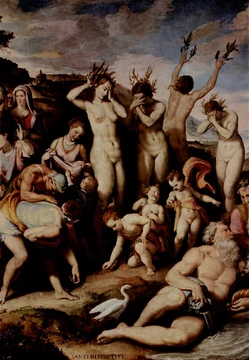
Byblis
A woman transformed into a spring from incessant tears.
Byblis, a daughter of Miletus and either Tragasia, Cyanee, or Eidothea, is a figure in Greek mythology known for her incestuous love for her twin brother Caunus. Her story is notable for its multiple versions and for the spring that was said to have formed from her unending tears.
Quick Facts
- Parents
- Miletus
- and either Tragasia
- Cyanee
- or Eidothea
- Sibling
- Caunus (twin brother)
- City named after her
- Byblos in Phoenicia
Facts from the source article.
Mythology
The most elaborate version of Byblis' story, given by Ovid, describes her acknowledging her love for Caunus and, after trying to convince herself it was natural, sending him a long love letter through a servant. Disgusted, Caunus fled. Byblis, determined to win him back, tore her clothes and stripped naked in sorrow, then followed him through much of Greece and Asia Minor until she died from grief and exhaustion. Her constant crying caused her to be changed into a spring. Parthenius of Nicaea cites two versions: one similar to Ovid's but ending with Byblis hanging herself with her girdle; another where Caunus instigates the incest but leaves to control his desires, and Byblis hangs herself after a long search. Conon follows the same version. Antoninus Liberalis portrays Byblis as rejecting suitors after Caunus leaves and attempting suicide by jumping off a cliff, but hamadryads save her, cause her to fall asleep, and transform her into a nymph. Nonnus depicts Byblis, Caunos, and Miletus as children of Asterius, with Caunus pursuing Byblis with a love song referencing divine incest. All authors mention a spring from Byblis' tears. The city Byblos in Phoenicia was believed to be named after her.
Caunus and Byblis in art
Between 1706 and 1715, sculptor Pierre Le Gros the Younger restored a fragmented antique group of Amor and Psyche in Rome for the Portuguese ambassador. He instead depicted Caunus and Byblis, with Caunus defending himself against his sister's advances. This invention, later purified back to Amor and Psyche and destroyed in a 1931 fire, inspired drawings, reproductions, and copies by artists including Pompeo Batoni, Francesco Carradori, Martin Gottlieb Klauer, and Laurent Delvaux. A plaster cast in Tiefurt House near Weimar preserves the most faithful impression of Le Gros' work.
More in Metamorphoses Into Bodies of Water in Greek Mythology
Spotted an error? Know more?
Reader corrections go straight into our review queue. Suggest an edit · How this site is sourced