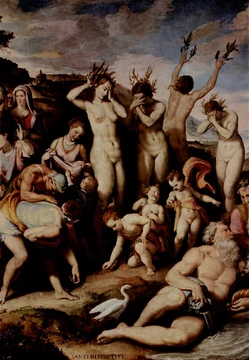
Arethusa (nymph)
Nymph transformed into a fountain on Ortygia.
Arethusa, a nymph in Greek myth, fled Arcadia under the sea and rose as a freshwater fountain on Ortygia in Syracuse. Her story involves transformation into a stream and appears in art and on ancient coins.
Quick Facts
- Origin
- Arcadia
- Destination
- Ortygia
- Syracuse
- Sicily
- Associated deity
- Artemis
- Roman name
- Alpheias
- Patron figure of
- Syracuse
Facts from the source article.
Did You Know?
- The head of Arethusa surrounded by dolphins was a usual type on coins of Syracuse, regarded among the most famous and beautiful Ancient Greek coins.
- The Cook Islands issued three commemorative coins in 2023 depicting Arethusa with two dolphins near the rim, in the style of the ancient originals.
- The Princess Royal was composed for the eldest daughter in Carolan's time of The MacDermott Roe of Coolavin.
Mythology
Arethusa, a nymph in the retinue of Artemis, was bathing in a stream in Arcadia, unaware that the water belonged to the river god Alpheus. He saw her and fell in love, but when she realized his presence and his intentions, she fled, determined to stay chaste. Alpheus chased her for a long time, and in desperation Arethusa prayed to Artemis for help. Artemis hid her in a cloud, but Alpheus would not give up. Terrified, Arethusa began to sweat heavily, and soon her body transformed into a stream. Artemis then split the earth, giving the new stream a path to escape. Arethusa’s waters flowed underground and under the sea to the island of Ortygia, but Alpheus followed her through the sea itself and mingled his waters with hers. The poet Virgil later asked Arethusa for a safe, salt-free passage beneath the sea in exchange for songs about unhappy loves—not her own, but those of his friend Cornelius Gallus, whom Virgil imagined dying of unrequited love under the Arcadian mountains Maenalus and Lycaeus. When Demeter was searching for her daughter Persephone, Arethusa begged the goddess to stop punishing Sicily for the girl’s disappearance, explaining that while flowing underground she had seen Persephone reigning as queen of Hades. The Roman writer Ovid called Arethusa “Alpheias” because her stream was thought to connect underground with the river Alpheus in the Peloponnese. A Sicilian legend still says that a wooden cup thrown into the Alpheus will reappear in the Fountain of Arethusa in Syracuse. The myth enjoyed a revival during the Renaissance and Romanticism, inspiring works by sculptor Battista Lorenzi, painter Leopold Burthe, and poets Percy Bysshe Shelley and John Keats. Modern retellings include Anne Ridler’s “Evenlode” (1959), a radio fable about rivers with music, featuring Alpheus and Arethusa as the central characters.
In music
The first of Karol Szymanowski's three poems for violin and piano, collectively titled "Myths," is called "The Fountain of Arethusa." An 18th-century song, "The Saucy Arethusa," tells the story of a British naval vessel that bore the nymph's name. Benjamin Britten included a movement titled "Arethusa" in his oboe work "Six Metamorphoses After Ovid." Ottorino Respighi wrote a tone poem he called "Aretusa." In his 1923 quick march "Sea Songs," for brass or wind band, Ralph Vaughan Williams incorporated a Morris Dance tune known both as "The Royal Princess" and "The Arethusa," along with two shanty melodies. Turlough O'Carolan's "The Princess Royal" gained much of its fame through its link to the lyrics of "The Aretusa," which William Shield set to that tune near the end of the 1700s. That song first appeared in the 1796 musical entertainment "The Lock and Key."
More in Metamorphoses Into Bodies of Water in Greek Mythology
Spotted an error? Know more?
Reader corrections go straight into our review queue. Suggest an edit · How this site is sourced