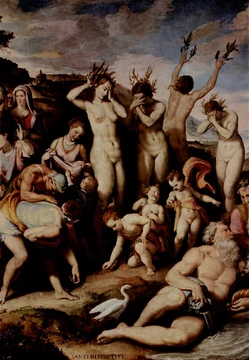
Achelous
River god whose broken horn became the cornucopia.
He was considered the oldest and most honored of the river-god offspring of Oceanus according to the mythographer Acusilaus.[1] In ancient times, the name Achelous was employed as a general term for water, as seen in Euripides' reference to a house being sprinkled with "Achelous' water" and Aristophanes' character calling out "Achelous, you're on!" while pouring water.[2]
Quick Facts
- Parents
- Oceanus and Tethys
- Offspring
- Sirens
- Hippodamas
- Orestes
- several nymphs
- Domain
- Achelous River (largest river in Greece)
- Notable contest
- Wrestled Heracles for Deianeira
- Symbol
- Cornucopia (from broken horn)
Facts from the source article.
Key facts and history
The story of Achelous battling Heracles for Deianeira was told as early as the 7th century BC in a lost poem by Archilochus.[3] In Sophocles' play Women of Trachis, Deianeira describes Achelous wooing her in the shapes of a bull, a snake, and a half-man/half-bull.[4] Achelous purified the hero Alcmaeon and gave him his daughter Callirrhoe as a wife.[5] The oracle at Dodona often commanded sacrifices to Achelous, according to the historian Ephorus.[6]
His cult declined in significance from the end of the fourth-century BC.[7] Various ancient sources name Achelous as the father of the Sirens and of multiple nymphs linked to notable springs, such as Pirene, Castalia, and Dirce.[8][9] The only river-god to attain Panhellenic cult status was Achelous, as attested by the 2nd-century geographer Pausanias.[10]
What the cited sources add
The same source notes that recent arguments suggest a Semitic origin for the name, with the initial Αχ- stemming from the Akkadian word for "bank of the river"[11] Strabo reports that some writers rationalized the broken horn as Heracles' diversion of the Acarnanian river by embankments and channels.[12] The 2nd-century geographer Pausanias reports seeing an altar to Achelous near Megara erected by the 7th-century BC tyrant Theagenes.[10]
References
- Wikipedia, "Achelous" (CC BY-SA 4.0), which cites: Hesiod, Theogony 340, 366–370; so also Hyginus, Fabulae Theogony.6.; Fowler 2013, pp. 12–13; Gantz, p. 28; Andolfi, fr. 1; Jebb, ln. 9; Freeman, p. 16; Acusilaus fr. 1 Fowler [= FGrHist 2 1 = Vorsokr. 9 B 21 = Macrobius, Sa (original not read by us) en.wikipedia.org
- Wikipedia, "Achelous" (CC BY-SA 4.0), which cites: West 1983, p. 92 with n. 39; D'Alessio, pp. 20, 32; Fowler 2013, p. 12; Andolfi, commentary on Acusilaus fr. 1; Macrobius, Saturnalia 5.18.1–12; Servius, ; Euripides, Andromache 165–168.; Euripides, Bacchae 625.; Aristophanes, Lysistrata 381. (original not read by us) en.wikipedia.org
- Wikipedia, "Achelous" (CC BY-SA 4.0), which cites: Gantz, pp. 28–29, 41–42, 431–433; Hard, pp. 41, 279–280; Fowler 2013, pp. 323–324; Fontenrose, pp. 350–356; Sophocles, Women; Gantz, pp. 28, 41–42, 432; Hard, p. 280; Jebb, Introduction 5; Archilochus, fr. 286 West [= Dio Chrysostom, 60.1], fr. 287 West [= Scholiast on Homer, Ili (original not read by us) en.wikipedia.org
- Wikipedia, "Achelous" (CC BY-SA 4.0), which cites: Gantz, p. 432. (original not read by us) en.wikipedia.org
- Wikipedia, "Achelous" (CC BY-SA 4.0), which cites: Apollodorus, 3.7.5; Thucydides, 2.102.2–6. Compare with Ovid, Fasti 2.43–46; Pausanias, 8.24.8–9.; Apollodorus, 3.7.7. (original not read by us) en.wikipedia.org
- Wikipedia, "Achelous" (CC BY-SA 4.0), which cites: Fowler 2013, p. 12, D'Alessio, p. 32; Andolfi, fr. 1; Ephorus FGrHist 70 20a = Macrobius, Saturnalia 5.18.6–8.; D'Alessio, p. 18; Andolfi, fr. 1; Ephorus, FGrHist 70 20a = Macrobius, Saturnalia 5.18.6–8. (original not read by us) en.wikipedia.org
- Wikipedia, "Achelous" (CC BY-SA 4.0), which cites: Isler 2006, s.v. Achelous 2; Fowler, p. 12. For a list of the epigraphical attestations of cult, see Isler 1981, p. 12. (original not read by us) en.wikipedia.org
- Wikipedia, "Achelous" (CC BY-SA 4.0), which cites: Parada, s.v. Achelous, p. 3.; Grimal, s.vv. Achelous, Sirens; Kerényi 1951, pp. 56, 58.; Lycophron, Alexandra 712–716, with Mair's notes; Ovid, Metamorphoses 5.552–555, 14.87–88.; Apollonius of Rhodes, Argonautica 4.893; Nonnus, Dionysiaca 13.313–315.; Apollodorus, 1.3.4, E 7.18; Hyginus, Fabulae Theogony.30, 125.13, 141.; Apollodorus, 1.7.10.; Hard, p. 410; Apollodorus, 1.7.3; Hesiod, fr. 10.34–45 Most (pp. 54–55). (original not read by us) en.wikipedia.org
- Wikipedia, "Achelous" (CC BY-SA 4.0), which cites: Isler 1981, p. 12; Grimal, s.v. Achelous.; Pausanias, 2.2.3.; Panyassis fr. 2 West = Pausanias, 10.8.9.; Hard, p. 304; Euripides, Bacchae 519–520.; Plato, Phaedrus 263d.; D'Alessio, p. 30; Panyassis fr. 23 West.; Hard, p. 327; Grimal, s.v. Achelous; Ovid, Metamorphoses 9.413–414; Apollodorus, 3.7.5; Pausanias, 8.24.9.; See D'Alessio, p. 30, which attributes to Panyassis, and "many other fifth-century authors the idea that all springs derive" from Achelous, and Isler 1981, p. 1 (original not read by us) en.wikipedia.org
- Wikipedia, "Achelous" (CC BY-SA 4.0), which cites: D'Alessio, p. 27 with n. 33; Pausanias, 1.41.2. (original not read by us) en.wikipedia.org
- Wikipedia, "Achelous" (CC BY-SA 4.0), which cites: Molinari and Sisci, pp. 93–95.; Duridanov, "Die Sprache der Thraker", Hieronymus Verlag, 1985, p. 20 (we also read that source) en.wikipedia.org
- Wikipedia, "Achelous" (CC BY-SA 4.0), which cites: Isler 2006, s.v. Achelous 2; Fontenrose, p. 351.; Frazer, note 2 to Apollodorus 2.7.5; Smith 1873, s.v. Achelous; Diodorus Siculus, 4.35.3–4; Strabo, 10.2.19. (original not read by us) en.wikipedia.org
Each numbered sentence above was checked against the source it cites before publication. Sentences citing Wikipedia adapt text from the English Wikipedia article Achelous (contributors), used under CC BY-SA 4.0; this entry is available under the same licence. Other sources were used for facts only; no text or images are copied from them.
More in Metamorphoses Into Bodies of Water in Greek Mythology
Spotted an error? Know more?
Reader corrections go straight into our review queue. Suggest an edit · How this site is sourced