Alpheus (deity)
Greek river god who pursued the nymph Arethusa.
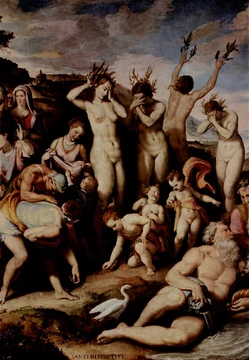
Alpheus is a river god in Greek mythology who personifies the river of the same name. He is notable for his pursuit of the nymph Arethusa, which led to both of them transforming into bodies of water.
Quick Facts
- Parents
- Oceanus and Tethys
- Children
- Orsilochus (son with Telegone)
- Melantheia
- Phoenissa
- Grandchildren
- Diocles
- Eirene (through Melantheia)
- Endymion (possible through Phoenissa)
- Great-grandchildren
- Crethon and Orsilochus
- Associated river
- Alpheus
Facts from the source article.
Did You Know?
- Alpheus is often associated with Antinous, the lover of Roman Emperor Hadrian.
- Coins of the period depict Antinous as Alpheios or Hadrian with Alpheios.
Family
Alpheus was a son of the Titans Oceanus and Tethys. Through Orsilochus, Alpheus was grandfather of Diocles and great-grandfather of the soldiers Crethon and Orsilochus. He was also father of Melantheia, who bore Eirene to Poseidon, and in later accounts father of Phoenissa, possible mother of Endymion by Zeus.
Mythology
According to Pausanias, Alpheus was a passionate hunter who fell in love with the nymph Arethusa. She fled from him to the island of Ortygia near Syracuse and metamorphosed into a well. Alpheus then became a river, flowing from the Peloponnese under the sea to Ortygia, where his waters united with the well Arethusa. Ovid relates the story differently: Arethusa, bathing in the river Alpheus in Arcadia, was surprised and pursued by the river god; Artemis took pity and changed her into a well that flowed underground to Ortygia. Alpheus took on water form by jumping into the stream, but the earth opened and the stream flowed underground to appear in a bay near Syracuse. Other traditions say Artemis herself was the object of Alpheus's love. When pursued by him, she fled to Letrini in Elis and covered her face and those of her companions with mud, so Alpheus could not distinguish her and returned. This led to a temple of Artemis Alphaea at Letrini. Another version has Artemis fleeing to Ortygia, where she had a temple named Alphaea. At Olympia the two divinities shared one altar. These accounts likely originated in the belief of a natural subterranean connection between the river Alpheios and the well Arethusa; a cup thrown into the Alpheus was thought to reappear in the well. Plutarch gives an unrelated account: Alpheus, son of Helios, killed his brother Cercaphus in a contest and, haunted by despair and the Erinyes, leapt into the river Nyctimus, which was later named Alpheus. Alpheus was also the river Heracles rerouted in his fifth labor to clean the Augean Stables.
More in Metamorphoses Into Bodies of Water in Greek Mythology
Spotted an error? Know more?
Reader corrections go straight into our review queue. Suggest an edit · How this site is sourced