
Cognitive behavioral therapy
Last updated

Urstadt · CC BY-SA 3.0
By merging fundamental ideas from cognitive psychology and behaviorism, cognitive behavioral therapy (CBT) constitutes a type of psychotherapy.[1] Through challenging and adjusting beliefs and assumptions, and by guiding patients to practice new behaviors, CBT works to lessen the symptoms of mental health conditions.[1]
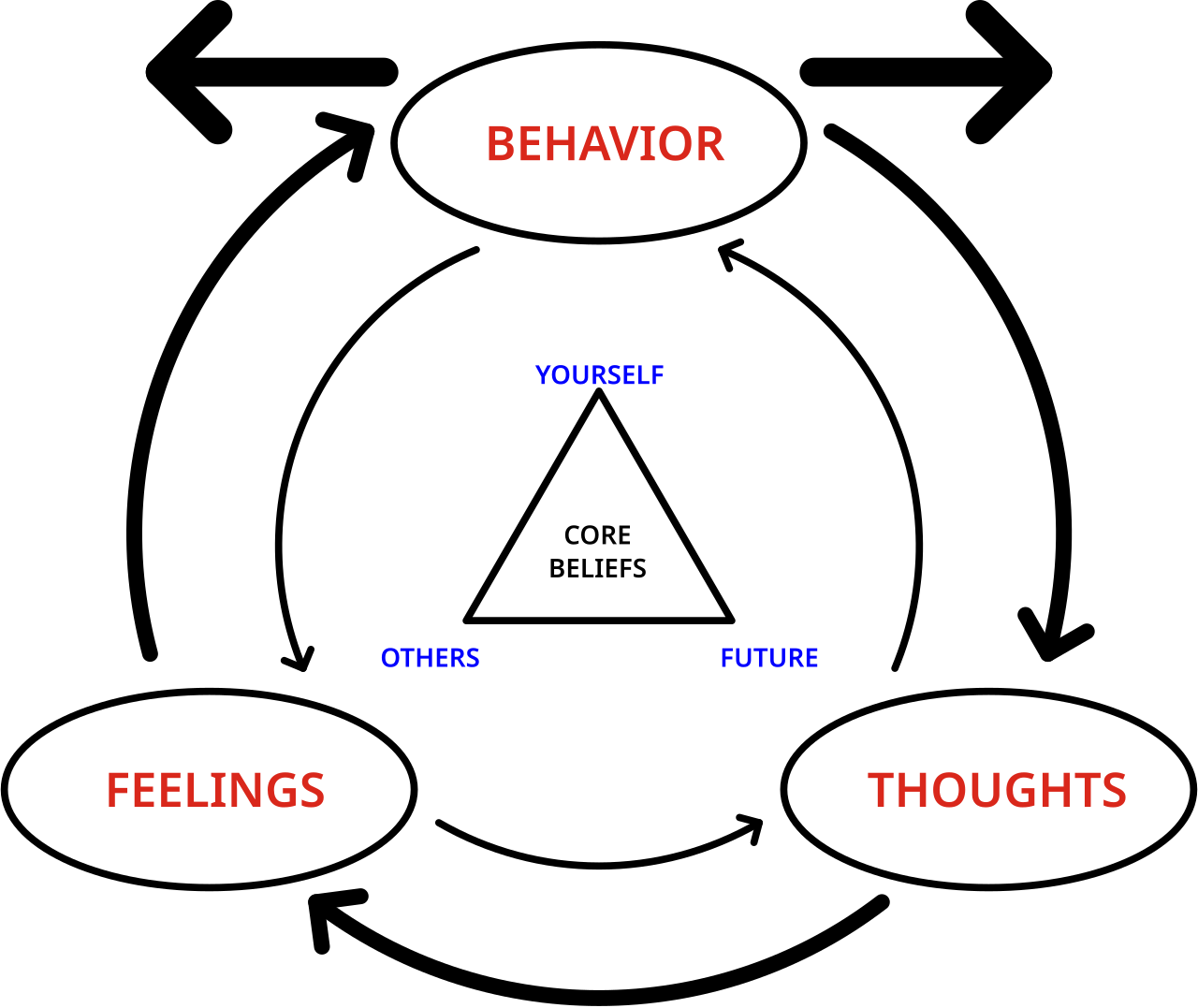
Quick Facts
- Field
- Psychotherapy
Facts from the source article.
Key facts and history
Behavior therapy's emergence in the early 20th century, cognitive therapy's development in the late 1950s to early 1960s, and their later integration are the modern origins of CBT.[2] Behaviorism's creation in the 1920s and behavioral therapy's development in the 1950s and 1960s constituted the initial wave.[3] John B. Watson and Rosalie Rayner's 1920 conditioning studies marked the start of foundational behaviorism work.[4] Psychoanalyst Aaron Beck's creation of cognitive therapy in the 1950s, which highlighted the role of cognitions, defined the second wave.[3]
All cognitive-based psychotherapies eventually fell under the umbrella term of cognitive behavior therapy.[5][6] The belief that many psychological disorders develop partly due to thought distortions and maladaptive behaviors is what CBT is founded on.[7]
What the research sources say
Exposure and response prevention's effectiveness holds true whether delivered in-person or remotely.[8] Drawing on the research literature, Chaloult, Ngo, Cousineau and Goulet have worked to pinpoint the core assumptions of cognitive therapy as applied in CBT.[9]
References
- Wikipedia, "Cognitive behavioral therapy" (CC BY-SA 4.0), which cites: "Cognitive behavior therapy: Basics and beyond", The Guilford Press, 2011, p. 19–20 (original not read by us) en.wikipedia.org
- Wikipedia, "Cognitive behavioral therapy" (CC BY-SA 4.0), which cites: Nakao, "Cognitive–behavioral therapy for management of mental health and stress-related disorders: Recent advances in techniques and technologies", BioPsychoSocial Medicine, 2021-10-03, p. 16 (original not read by us) en.wikipedia.org
- Wikipedia, "Cognitive behavioral therapy" (CC BY-SA 4.0), which cites: "Bergin and Garfield's Handbook of Psychotherapy"; "Cognitive behavior therapy: Basics and beyond", The Guilford Press, 2011, p. 19–20; "The New ABCs: A Practitioner's Guide to Neuroscience-Informed Cognitive-Behavior Therapy", Journal of Mental Health Counseling, 2015, p. 206–20 (original not read by us) en.wikipedia.org
- Wikipedia, "Cognitive behavioral therapy" (CC BY-SA 4.0), which cites: "Clinical psychology", Thomson/Wadsworth, 2007; "Science and practice of cognitive behaviour therapy", Oxford University Press, 1997, p. 1–26; "The Elimination of Children's Fears", Journal of Experimental Psychology, 1924, p. 382–390; "Clinical psychology", Thomson/Wadsworth, 2007; "Clinical psychology", Thomson/Wadsworth, 2007; "Current psychotherapies", Thomson Brooks/Cole, 2008 (we also read that source) en.wikipedia.org
- Wikipedia, "Cognitive behavioral therapy" (CC BY-SA 4.0), which cites: "Current psychotherapies", Thomson Brooks/Cole, 2008, p. 63–106; "The compassionate mind: a new approach to life's challenges", Constable, 2009; "Clinical psychology", Thomson/Wadsworth, 2007 (we also read that source) en.wikipedia.org
- Wikipedia, "Cognitive behavioral therapy" (CC BY-SA 4.0), which cites: "Clinical psychology", Thomson/Wadsworth, 2007; "Clinical psychology", Thomson/Wadsworth, 2007 (original not read by us) en.wikipedia.org
- Wikipedia, "Cognitive behavioral therapy" (CC BY-SA 4.0), which cites: "Psychology", Worth Pub, 2010, p. 600; "The New ABCs: A Practitioner's Guide to Neuroscience-Informed Cognitive-Behavior Therapy", Journal of Mental Health Counseling, 2015, p. 206–20; "Bergin and Garfield's Handbook of Psychotherapy"; "Psychology", Worth Pub, 2010, p. 600; "Theoretical foundations of cognitive-behavior therapy for anxiety and depression", Annual Review of Psychology, 1996, p. 33–57; "Cognitive behavior therapy: Basics and beyond", The Guilford Press, 2011, p. 19–20; "History of cognitive-behavioral therapy en.wikipedia.org
- Wikipedia, "Cognitive behavioral therapy" (CC BY-SA 4.0), which cites: "Diagnosis and Management of Obsessive Compulsive Disorders in Children", 2024 (original not read by us) en.wikipedia.org
- Wikipedia, "Cognitive behavioral therapy" (CC BY-SA 4.0), which cites: Chaloult, "La thérapie cognitivo-comportementale: théorie et pratique", Gaëtan Morin, 2008, p. 68–80; "Cognitive Therapy and the Emotional Disorders", Plume, 1979; Walen, "A practitioner's guide to rational-emotive therapy", Oxford University Press, 1980; Beck, "Anxiety Disorders And Phobias: A Cognitive Perspective", Basic Books, 1985; Auger, "La démarche émotivo-rationnelle", Éditions Ville-Marie, 1986 (original not read by us) en.wikipedia.org
Each numbered sentence above was checked against the source it cites before publication. Sentences citing Wikipedia adapt text from the English Wikipedia article Cognitive behavioral therapy (contributors), used under CC BY-SA 4.0; this entry is available under the same licence. Other sources were used for facts only.
More in Mental Health & Psychology
Sources
Compiled from Wikipedia and the sources listed below. Text from Wikipedia is available under CC BY-SA 4.0; this entry is adapted from it.
- Wikipedia: Cognitive behavioral therapy (CC BY-SA 4.0).
- Word definitions: the Codexery glossary, each quoted from its Wikipedia article.
Spotted an error? Know more?
Reader corrections go straight into our review queue. Suggest an edit · How this site is sourced