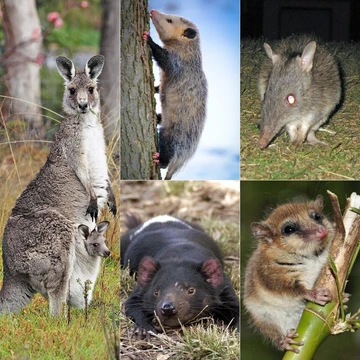
Bilby
The long-eared, rabbit-like marsupial of Australia.
Last updated
Bilbies are desert-dwelling marsupial omnivores with large ears and a long muzzle, belonging to the genus Macrotis in the order Peramelemorphia.[1] They are about 29–55 cm long and have softer, silkier fur than bandicoots.[2]
Scientific classification
- KingdomAnimalia
- PhylumChordata
- InfraclassMarsupialia
- OrderPeramelemorphia
- FamilyThylacomyidae
- GenusMacrotis
Named by Reid, 1837
Sources: Wikipedia taxobox: Macrotis (CC BY-SA 4.0)
Quick Facts
- Scientific name
- Macrotis
- Species
- Greater bilby (Macrotis lagotis) and extinct lesser bilby (Macrotis leucura)
- Status
- Greater bilby listed as vulnerable; lesser bilby extinct since 1950s
- Average length
- 55 cm (22 in) excluding tail; tail about 29 cm (11 in)
- Gestation
- 12–14 days
Facts from the source article.
Biology and range
Bilbies have very large ears that radiate heat and provide better hearing.[2] They are nocturnal omnivores that obtain moisture from their food, including insects, seeds, spiders, bulbs, fruit, fungi, and very small animals.[2] The bilby lineage extends back 15 million years, and a 2014 fossil find showed shorter teeth probably used for eating forest fruit.[3] A national recovery plan is being developed, including captive breeding, monitoring, and reestablishment programs.[4]
Reintroductions have occurred at the Arid Recovery Reserve in South Australia in 2000 and at Currawinya National Park in Queensland in 2019.[4] Among mammals, the bilby's gestation period of roughly 12 to 14 days is notably brief.[5] Approximately 20 million years ago, the bilby's evolutionary path separated from that of its nearest relative, a bandicoot that originally ate meat.[6] Threats such as habitat loss and competition from introduced predators like foxes and cats are causing bilbies to become endangered.[4]
What the specialist sources record
A 2019 Brisbane Times article reported that six bilbies were released into a predator-proof enclosure at Currawinya National Park after a major fence upgrade.[7] The same article noted that floods in 2011 and 2012 had damaged the original enclosure, allowing feral cats to devastate the bilby population.[7] The article also recorded that Save the Bilby Fund and Dreamworld ran a captive breeding program preparing bilbies for release.[7] The article mentioned that chocolate bilbies are still made by Fyna Foods Pink Lady as an Easter fundraiser.[7]
Kevin Bradley, the head of Save the Bilby Fund, described the release as an important achievement for protecting the species' future.[7]
References
- Wikipedia, "Macrotis" (CC BY-SA 4.0), which cites: Unabridged (original not read by us) en.wikipedia.org
- Wikipedia, "Macrotis" (CC BY-SA 4.0), which cites: "Greater bilby", Department of Environment and Science – Queensland Government, 2003-08-08; "Bilby – Australia's Easter bunny", Environmental Protection Agency/Queensland Park and Wildlife Service, 24 November 2005 (original not read by us) en.wikipedia.org
- Wikipedia, "Macrotis" (CC BY-SA 4.0), which cites: Johnson, "15-million-year-old bilby fossil found in Qld", Australian Geographic, 2014-03-19 (original not read by us) en.wikipedia.org
- Wikipedia, "Macrotis" (CC BY-SA 4.0), which cites: Moseby K. E. and O'Donnell E. O. (2003) Reintroduction of the greater bilby, Macrotis lagotis (Reid) (Marsupialia: Thylacomyidae), to northern South Australia: ; "Greater Bilby", aridrecovery.org.au; Caldwell, "Bilbies hop into their new home just in time for Easter", Brisbane Times, 2019-04-18 (we also read that source) en.wikipedia.org
- Wikipedia, "Macrotis" (CC BY-SA 4.0), which cites: Gordon, Greg, "The Encyclopedia of Mammals", Facts on File, 1984, p. 846–849 (we also read that source) en.wikipedia.org
- Wikipedia, "Macrotis" (CC BY-SA 4.0), which cites: Young, "Carnivorous bilby fossil unearthed", Australian Geographic, 2010-09-07 (original not read by us) en.wikipedia.org
- Caldwell, "Bilbies hop into their new home just in time for Easter", Brisbane Times, 2019-04-18. facts only, no text reused. brisbanetimes.com.au
Each numbered sentence above was checked against the source it cites before publication. Sentences citing Wikipedia adapt text from the English Wikipedia article Macrotis (contributors), used under CC BY-SA 4.0; this entry is available under the same licence. Other sources were used for facts only; no text or images are copied from them.
More in Marsupials
Sources
Compiled from Wikipedia and the sources listed below. Text from Wikipedia is available under CC BY-SA 4.0; this entry is adapted from it.
- Wikipedia: Macrotis (CC BY-SA 4.0).
- Word definitions: the , each quoted from its Wikipedia article.
Spotted an error? Know more?
Reader corrections go straight into our review queue. Suggest an edit · How this site is sourced