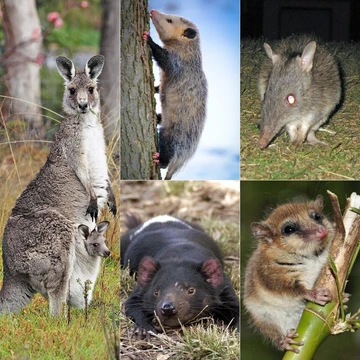
Diprotodontia
The largest extant order of marsupials, including kangaroos, koalas, and wombats.
Last updated
Koalas and kangaroos are the most familiar representatives of this group.[1] With roughly 155 species, including kangaroos, koalas, and wombats, Diprotodontia is the marsupial order that contains the most members.[2] Two traits together set this order apart: syndactyly (the fusion of the second and third foot digits) and a pair of large, forward-projecting lower incisors.[3]
Scientific classification
- KingdomAnimalia
- PhylumChordata
- InfraclassMarsupialia
- OrderDiprotodontia
Named by Owen, 1866
Sources: Wikipedia taxobox: Diprotodontia (CC BY-SA 4.0)
Quick Facts
- Earliest fossil date
- Late Oligocene (approximately 28.4–23.03 million years ago)
Facts from the source article.
Biology and range
All diprotodonts have a large pair of incisors on the lower jaw and lack canine teeth, leaving a gap in the upper jaw.[1] The second and third digits of the foot are fused up to the claws, a condition called syndactyly.[3] Members of the order look very different from each other at first glance.[1] The order includes families such as Macropodidae (kangaroos, wallabies), Phascolarctidae (koalas), and Vombatidae (wombats).[1]
Until recently, only two suborders were recognized: Vombatiformes and Phalangerida.[4] Wombats are an exception among diprotodonts, possessing only one pair of upper incisors, whereas most members of the order have three pairs.[3] The fourth digit on the foot is commonly much larger than the others, while the fifth digit is typically missing.[3] A 1997 study by Kirsch and colleagues reorganized the families of Diprotodontia into three suborders.[4]
What the specialist sources record
The Tolweb account notes that diprotodonts have a unique marsupial reproductive system compared to other mammals.[1] GBIF Backbone Taxonomy accepts Diprotodontia as an order within class Mammalia.[5] The Tolweb page lists eleven families, including Acrobatidae (feathertail gliders) and Tarsipedidae (honey possums).[1] As of 14 October 2026, the GBIF database contains 4,062,764 occurrence records for this order.[5]
References
- Tolweb. facts only, no text reused. tolweb.org
- Wikipedia, "Diprotodontia" (CC BY-SA 4.0), which cites: Meredith, "A phylogeny of Diprotodontia (Marsupialia) based on sequences for five nuclear genes", Molecular Phylogenetics and Evolution, 26 February 2009, p. 554–571 (original not read by us) en.wikipedia.org
- Wikipedia, "Diprotodontia" (CC BY-SA 4.0), which cites: Tolweb (we also read that source) en.wikipedia.org
- Wikipedia, "Diprotodontia" (CC BY-SA 4.0), which cites: Eldridge, "An emerging consensus in the evolution, phylogeny, and systematics of marsupials and their fossil relatives (Metatheria)", Journal of Mammalogy, 2019-05-23, p. 802–837 (original not read by us) en.wikipedia.org
- GBIF Backbone Taxonomy and occurrence index, Diprotodontia (taxon key 1452). CC BY 4.0 (backbone); counts are facts. gbif.org
Each numbered sentence above was checked against the source it cites before publication. Sentences citing Wikipedia adapt text from the English Wikipedia article Diprotodontia (contributors), used under CC BY-SA 4.0; this entry is available under the same licence. Other sources were used for facts only; no text or images are copied from them.
More in Marsupials
Sources
Compiled from Wikipedia and the sources listed below. Text from Wikipedia is available under CC BY-SA 4.0; this entry is adapted from it.
- Wikipedia: Diprotodontia (CC BY-SA 4.0).
- Word definitions: the Codexery glossary, each quoted from its Wikipedia article.
Spotted an error? Know more?
Reader corrections go straight into our review queue. Suggest an edit · How this site is sourced