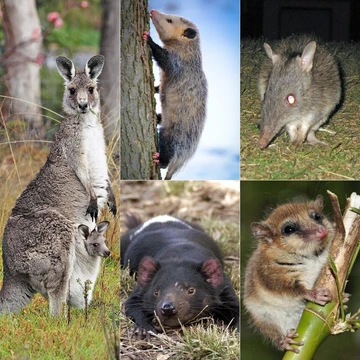
Kangaroo
Large marsupials native to Australia and New Guinea.
Last updated
The subfamily Macropodinae, which includes kangaroos, translates to "large foot" and these animals are marsupials.[1]
Quick Facts
- Scientific classification
- Family Macropodidae, subfamily Macropodinae
- Largest species
- Red kangaroo (Osphranter rufus)
- Maximum size
- 2 m (6 ft 7 in) tall, 90 kg (200 lb)
- Indigenous to
- Australia and New Guinea
- Distinguishing feature
- Large hind legs
- long muscular tail
- marsupial pouch
Facts from the source article.
Biology and range
The red kangaroo is the largest surviving marsupial anywhere in the world.[2] Kangaroos are the only large mammals to use hopping on two legs as their primary means of locomotion.[3] Kangaroos have single-chambered stomachs and sometimes regurgitate vegetation to chew as cud.[4] Kangaroos release virtually no digestive methane, unlike ruminants.[5]
Australia and New Guinea are the native lands of kangaroos.[1] A red kangaroo that is a large male can attain a height of 2 meters and a weight of 90 kilograms.[6] From northern Queensland down through Victoria and into Tasmania, the eastern grey kangaroo can be found.[7] Rather than serving only as a balancing strut, a kangaroo's tail functions as an additional leg.[8]
What the specialist sources record
The "Kangaroo" account notes that red kangaroos occupy inland plains and rangelands across much of the arid and semi-arid zone.[9] The same source states that most large kangaroo species are assessed as Least Concern on the IUCN Red List.[9] A Live Science article reports that kangaroos can cover 15 feet in a single hop and hop as fast as 30 mph.[10] That article also notes that kangaroos use their muscular tail as a fifth leg when walking.[10]
McGuinness adds that the red kangaroo grazes mostly at night but may extend into late evening and early mornings.[11]
References
- Wikipedia, "Kangaroo" (CC BY-SA 4.0) en.wikipedia.org
- Wikipedia, "Kangaroo" (CC BY-SA 4.0), which cites: "Names List for MACROPODIDAE, Australian Faunal Directory", Australian Biological Resources Study, Australian Department of the Environment and Energy, 13 February 2020 (original not read by us) en.wikipedia.org
- Wikipedia, "Kangaroo" (CC BY-SA 4.0), which cites: Briggs, "When did the kangaroo hop? Scientists have the answer", BBC News, 6 February 2019; Penny, "The Secret World of Kangaroos", Raintree Steck-Vaughn, 2002 (original not read by us) en.wikipedia.org
- Wikipedia, "Kangaroo" (CC BY-SA 4.0), which cites: Hume, "Principal Features of Digestion in Kangaroos", Proceedings of the Nutritional Society of Australia, 1984, p. 76–81; Romer, Alfred Sherwood, "The Vertebrate Body", Holt-Saunders International, 1977, p. 347 (original not read by us) en.wikipedia.org
- Wikipedia, "Kangaroo" (CC BY-SA 4.0), which cites: Vendl, "Decreasing methane yield with increasing food intake keeps daily methane emissions constant in two foregut fermenting marsupials, the western grey kangaroo and red kangaroo", Journal of Experimental Biology, 4 No (original not read by us) en.wikipedia.org
- Wikipedia, "Kangaroo" (CC BY-SA 4.0), which cites: Dawson, "Kangaroos", CSIRO Publishing, 2012; "Red Kangaroo", NAT GEO Wild, 11 November 2010; "Names List for MACROPODIDAE, Australian Faunal Directory", Australian Biological Resources Study, Australian Department of the Environment and Energy, 13 February 2020 (original not read by us) en.wikipedia.org
- Wikipedia, "Kangaroo" (CC BY-SA 4.0), which cites: Dawson, "Kangaroos", CSIRO Publishing, 2012; "Names List for MACROPODIDAE, Australian Faunal Directory", Australian Biological Resources Study, Australian Department of the Environment and Energy, 13 February 2020 (original not read by us) en.wikipedia.org
- Wikipedia, "Kangaroo" (CC BY-SA 4.0), which cites: "Kangaroos use tail like a leg to walk", Australian Geographic, 2 July 2014 (original not read by us) en.wikipedia.org
- "The Kangaroo". facts only, no text reused. australianwildlife.com.au
- "Live Science article", Live Science, 2 March 2016. facts only, no text reused. livescience.com
- McGuinness, "Re: Kangaroos", MadSci Network, 25 November 1996. facts only, no text reused. madsci.org
Each numbered sentence above was checked against the source it cites before publication. Sentences citing Wikipedia adapt text from the English Wikipedia article Kangaroo (contributors), used under CC BY-SA 4.0; this entry is available under the same licence. Other sources were used for facts only; no text or images are copied from them.
More in Marsupials
Sources
Compiled from Wikipedia and the sources listed below. Text from Wikipedia is available under CC BY-SA 4.0; this entry is adapted from it.
- Wikipedia: Kangaroo (CC BY-SA 4.0).
- Word definitions: the Codexery glossary, each quoted from its Wikipedia article.
Spotted an error? Know more?
Reader corrections go straight into our review queue. Suggest an edit · How this site is sourced