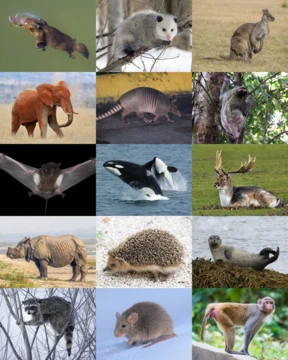
Earless seal
True seals are specialized marine mammals of the family Phocidae.

Earless seals, called phocids or true seals, form one of the three main groups in the seal lineage, Pinnipedia. They belong to the family Phocidae and are sometimes referred to as crawling seals to set them apart from fur seals and sea lions, which are in the family Otariidae. These seals inhabit oceans in both hemispheres and, aside from the more tropical monk seals, are largely found in polar, subpolar, and temperate regions. The Baikal seal is the only species that lives exclusively in freshwater. The earliest known fossil of an earless seal, *Noriphoca gaudini*, comes from the late Oligocene or earliest Miocene of Italy. Other early phocid fossils date to the mid-Miocene, around 15 million years ago, in the north Atlantic. For a long time, many researchers thought phocids evolved separately from otariids and odobenids, descending from otter-like animals like *Potamotherium* that lived in European freshwater lakes. However, recent evidence strongly points to a single common ancestor for all pinnipeds, possibly *Enaliarctos*, which is most closely related to mustelids and bears. It was once believed that monk seals and elephant seals first entered the Pacific through open straits between North and South America, with Antarctic true seals taking the same route or traveling down Africa’s west coast. Now, scientists think monk seals, elephant seals, and Antarctic seals all evolved in the southern hemisphere and likely spread to their current ranges from more southern latitudes. In the 1980s and 1990s, morphological phylogenetic analysis of phocids led to new ideas about how the various genera are related. More recent molecular studies have confirmed that the two phocid subfamilies, Phocinae and Monachinae, are each monophyletic. Monachinae, known as the “southern” seals, includes three tribes: Lobodontini, Miroungini, and Monachini. The four Antarctic genera—*Hydrurga*, *Leptonychotes*, *Lobodon*, and *Ommatophoca*—belong to Lobodontini. The tribe Miroungini consists of elephant seals, while monk seals (*Monachus* and *Neomonachus*) are in Monachini. The subfamily Phocinae, or “northern” seals, also has three tribes: Erignathini (containing *Erignathus*), Cystophorini (containing *Cystophora*), and Phocini (all other phocines). More recently, five species were split off from *Phoca*, creating three additional genera. Alternatively, the three monachine tribes have been treated as separate families, with elephant seals and Antarctic seals considered more closely related to the phocines. Adult phocids range in size from the ringed seal, at 1.17 meters (3.8 feet) long and 45 kilograms (99 pounds), to the southern elephant seal, the largest member of the order Carnivora, reaching 5.8 meters (19 feet) and 4,000 kilograms (8,800 pounds). Phocids have fewer teeth than land-based carnivores but still have strong canines; some species lack molars entirely. Their dental formula is 2–3.1.4.0–2 over 1–2.1.4.0–2. While otariids are known for speed and agility, phocids are built for efficient, energy-saving movement. This lets most phocids travel far from land to find food, whereas otariids depend on rich upwelling zones near breeding sites. Phocids swim by moving their bodies side to side; their front flippers mainly steer, while their hind flippers provide propulsion underwater. Their streamlined bodies make them better long-distance swimmers than otariids, but unlike fur seals, their hind flippers are attached to the pelvis and cannot rotate forward for walking. This makes them clumsy on land, forcing them to wriggle using their front flippers and abdominal muscles. Phocid respiratory and circulatory systems are adapted for deep diving, allowing them to stay underwater for long periods. When a seal dives, air is pushed from the lungs into the upper respiratory passages, where gases cannot easily enter the bloodstream, protecting the seal from decompression sickness. The middle ear is lined with blood sinuses that inflate during a dive, helping to maintain steady pressure. Phocid bodies are more specialized for aquatic life than otariids, as seen in their ear holes (instead of external ears), retractable nipples, internal testicles, and an internal penile sheath. They can also divert blood flow to a smooth layer of blubber beneath the skin to help regulate body temperature. Unlike otariids, phocine seals do not bark to communicate. Instead, they slap the water and grunt, and a few species have been observed clapping at each other underwater. One study in *Animal Behaviour* reported that seals use rhythmic percussive signaling, or clapping, in both aggressive interactions and display behavior. Monachine seals, on the other hand, are well known for vocalizing. Elephant seals often call out on land, with males roaring to establish dominance and identify themselves. Weddell and leopard seals are famous for their underwater singing. Because their front flippers are short and their rear flippers cannot rotate, true seals cannot walk on land like sea lions. Instead, they bounce forward in a motion called galumphing; polar explorer Edward Wilson described it as lolloping. It is also referred to as worm-style locomotion. Phocids spend most of their time at sea but return to land or pack ice to breed and give birth. Pregnant females forage for long periods at sea, building up fat reserves, and then return to the breeding site to use that stored energy to nurse their pups.
- Classification
- Family Phocidae, order Carnivora
- Key adaptations
- Streamlined bodies, ear holes, retractable nipples, internal testicles, internal penile sheath
- Feeding strategies
- Suction feeding, grip-and-tear feeding, filter feeding, pierce feeding
- Lactation range
- Three to five days (hooded seal) to five to seven weeks (monk seal)
- Postweaning fast
- Two weeks (hooded seal) to 9–12 weeks (northern elephant seal)
Lore & Background
The earliest known fossil earless seal is Noriphoca gaudini from the late Oligocene or earliest Miocene of Italy. Other early fossil phocids date from the mid-Miocene, 15 million years ago in the north Atlantic. Until recently, many researchers believed that phocids evolved separately from otariids and odobenids, and that they evolved from otter-like animals such as Potamotherium. Recent evidence strongly suggests a monophyletic origin for all pinnipeds from a single ancestor, possibly Enaliarctos, most closely related to the mustelids and bears. Monk seals and elephant seals were previously believed to have first entered the Pacific through open straits between North and South America, but it is now thought that the monk seals, elephant seals, and Antarctic seals all evolved in the southern hemisphere and likely dispersed to their current distributions from more southern latitudes.
Reader's Guide
Earless seals represent a major evolutionary branch of pinnipeds, distinguished from fur seals and sea lions by their lack of external ears, bound hind flippers, and specialized aquatic adaptations. Their streamlined bodies and efficient swimming allow them to forage far from land, exploiting prey resources that otariids cannot reach. Phocids have fewer teeth than land-based carnivores, and some species lack molars altogether. Their respiratory and circulatory systems are adapted to facilitate deep diving, with air forced from the lungs into upper passages to prevent the bends. Phocids produce thick, fat-rich milk that allows mothers to nurse pups quickly while fasting, with lactation ranging from three to five days in the hooded seal to five to seven weeks in the monk seal. The postweaning fast, during which pups consume their own fat stores, can last up to 9–12 weeks in the northern elephant seal. Phocids use at least four feeding strategies—suction feeding, grip-and-tear feeding, filter feeding, and pierce feeding—and most are opportunistic, employing multiple strategies. Their communication differs from otariids: phocine seals do not bark but slap water and grunt, while monachine seals like elephant seals and Weddell seals are known for vocalizing. The Baikal seal is the only exclusively freshwater seal species.
Did You Know?
- The Baikal seal is the only species of exclusively freshwater seal.
- Phocids have fewer teeth than land-based members of the Carnivora, and some species lack molars altogether.
- Lactation in the hooded seal lasts only three to five days, one of the shortest among mammals.
- Phocids are known to deliberately nurse young that are not their own, a behavior that can lead to 'super weaners'.
More in Mammals 1-24
Spotted an error? Know more?
This is a living reference — every entry is fact-audited, and reader corrections feed straight into our audit queue. Suggest an edit · See this site's audit record