Anteater
Four New World mammal species specialized for eating ants and termites.

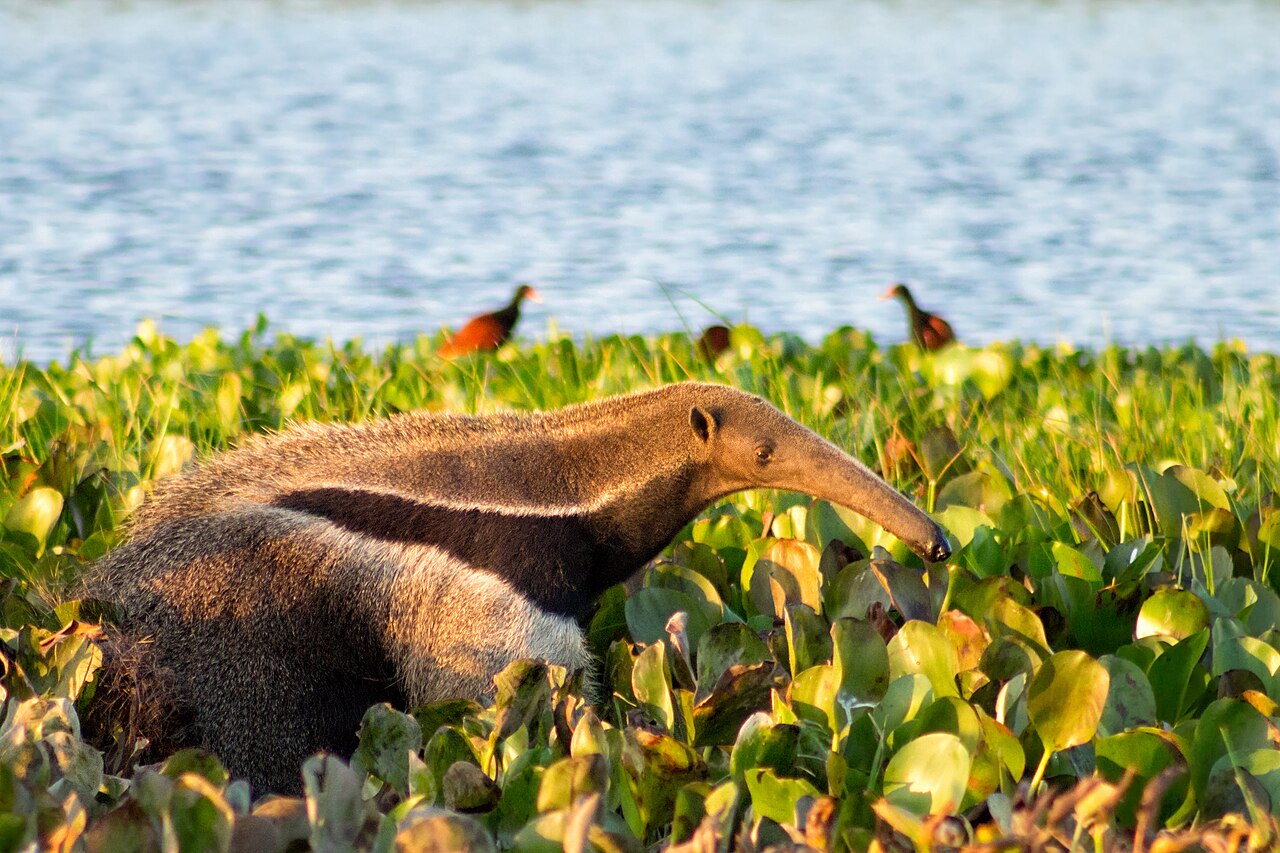
Christie L. Ward · CC BY-SA 3.0
Anteaters are four living mammal species grouped in the suborder Vermilingua, a name that means "worm tongue" and refers to their diet of ants and termites. Along with sloths, they belong to the order Pilosa. Although the common name "anteater" is also used for the aardvark, numbat, echidnas, and pangolins, those animals are not closely related to true anteaters. The four living species are the giant anteater (about 1.8 meters long including the tail), the silky anteater (roughly 35 centimeters long), the southern tamandua (around 1.2 meters long), and the northern tamandua (similar in size).
The name "anteater" comes directly from the animals' habit of feeding mainly on ants and termites. It has also been applied to unrelated creatures such as echidnas, numbats, pangolins, and aardvarks. Another term, "antbear," is sometimes used but more commonly refers to the aardvark. The word "tamandua" comes from Portuguese, which borrowed it from the Tupí word *tamanduá*, meaning "ant hunter." In Portuguese, *tamanduá* refers to all anteaters; in Spanish, it applies only to the two species in the genus *Tamandua*, while the giant anteater is called *oso hormiguero* and the silky anteater *cíclope*. All four species also have various indigenous names.
Anteaters belong to the superorder Xenarthra, a once-diverse group of mammals that evolved in South America while it was isolated from North America. Their living relatives include sloths and armadillos. Early naturalists thought anteaters were related to aardvarks and pangolins due to similar body shapes, but those resemblances are now understood to be convergent evolution—each group independently evolved powerful digging forelimbs, long tongues, and toothless, tube-like snouts to feed on termites and ants.
Among mammals, anteaters are most closely related to sloths, with armadillos as their next closest relatives. The four living species are divided into three genera. The family Cyclopedidae includes the silky anteater (*Cyclopes didactylus*) and the extinct genus *Palaeomyrmidon*. The family Myrmecophagidae contains the giant anteater (*Myrmecophaga tridactyla*), the northern tamandua (*Tamandua mexicana*), the southern tamandua (*Tamandua tetradactyla*), and the extinct genera *Neotamandua* and *Protamandua*.
All anteaters have very long snouts and a thin, long tongue coated with sticky saliva from enlarged submaxillary glands. Their mouths are small and toothless. The front feet have large claws on the third digit, used to tear open termite and ant mounds, while the other digits are smaller or absent. The body is covered in dense fur. The tail is long—sometimes as long as the body—and is prehensile in all species except the giant anteater. Color abnormalities such as albinism in giant anteaters, and albinism, leucism, and melanism in southern tamanduas, have been recorded.
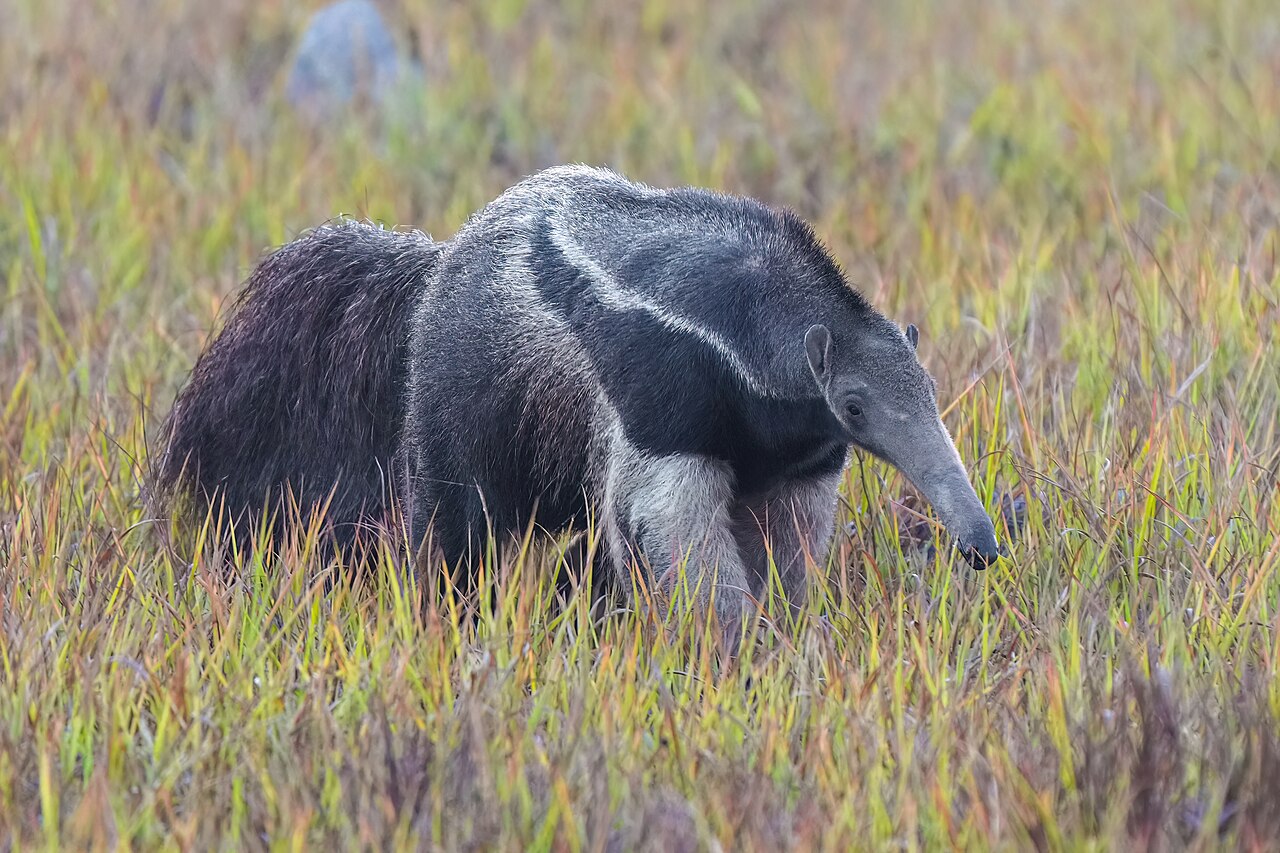
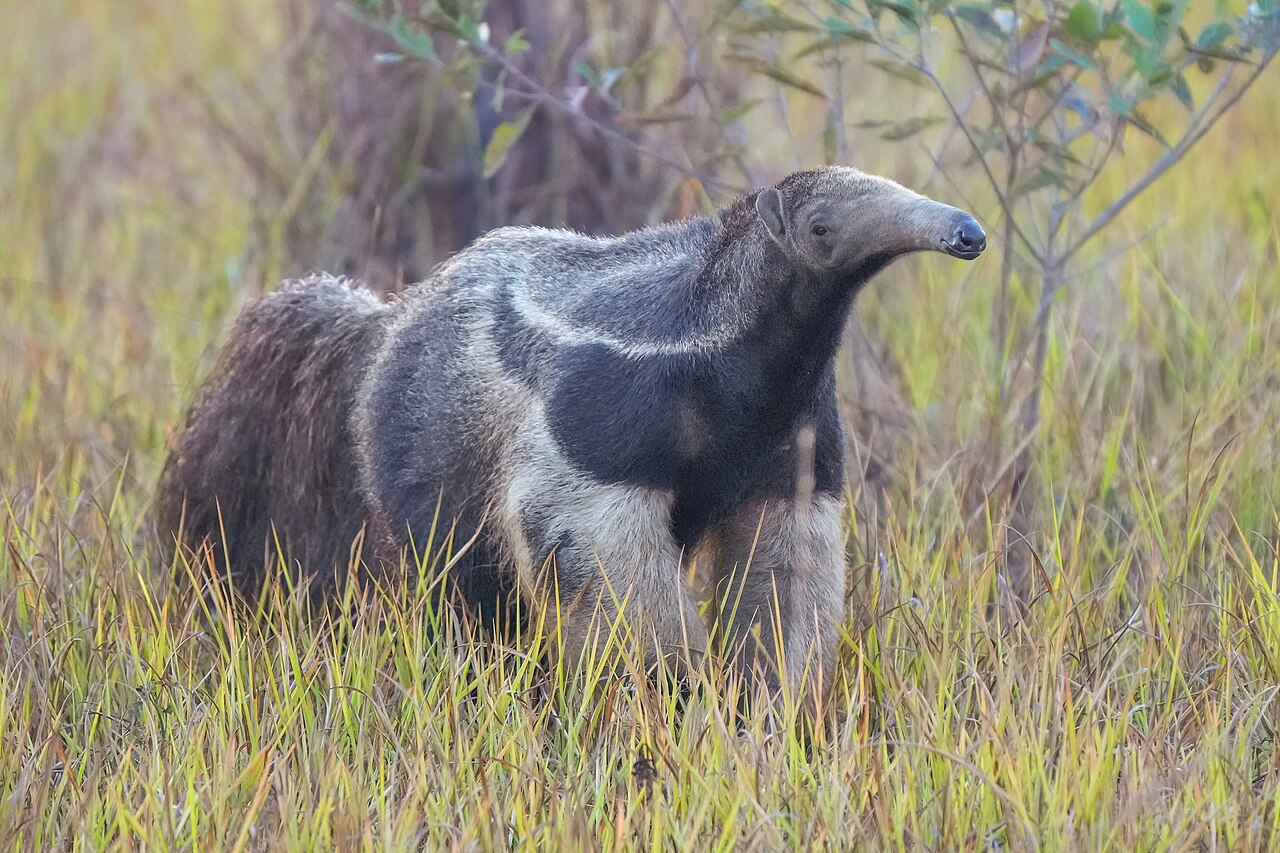
The giant anteater is the largest species, averaging about 2 meters in total length and 33 kilograms in mass. Its body is covered in long, dark brown or black fur, with a prominent black band edged in white running from the shoulders down to the chest and mid-body. The forelegs are mostly white with black markings at the wrists and above the claws. The tail is nearly as long as the body and covered in coarse hair. Among all ant-eating mammals, the giant anteater has the greatest snout elongation relative to its body size.
Tamanduas are medium-sized, with total body lengths of 0.77 to 1.33 meters and masses of 3.2 to 7.0 kilograms. They have shorter snouts, shorter claws, proportionately longer ears, and a mostly hairless, prehensile tail. Their coloration is typically golden brown to gray, with a black "vest" on the back and belly connected by two black bands across the shoulders. Some tamanduas lack this vest entirely and have a uniformly yellow, brown, or black coat.
The silky anteater is the smallest, averaging 43 centimeters in total length and 235 grams in mass. Its fur is dense, silky, and gray to golden-brown, sometimes with a silver tint on the back. In some South American populations, a chocolate brown stripe runs down the middle of the back, most noticeable in the Amazon basin. The tail is highly prehensile, and the limbs are adapted for climbing. Unlike other anteaters and many unrelated ant-eating mammals, the silky anteater’s face is only slightly longer than expected for its size and tilts strongly downward.
Anteaters are native to the New World, found from southern Mexico to northern Argentina, as well as on some Caribbean islands. Like other xenarthrans, they evolved in South America and spread into Central and North America during the Great American Interchange, which began after the Isthmus of Panama formed about 3 million years ago.
- native_range
- Southern Mexico to northern Argentina, excluding any Caribbean islands
Lore & Background
Anteaters are part of the Xenarthra superorder, a once diverse group of mammals that occupied South America while it was geographically isolated. The other living animals in this group are sloths and armadillos. At one time, anteaters were assumed to be related to aardvarks and pangolins due to physical similarities, but these similarities are now understood as convergent evolution, not a common ancestor. All have evolved powerful digging forearms, long tongues, and toothless, tube-like snouts to raid termite mounds. All anteaters have extremely elongated snouts equipped with a thin, long tongue coated with sticky saliva from enlarged submaxillary glands. The mouth is small and has no teeth. The frontal feet have large claws on the second and third digits (especially the third), used to break into termite and ant mounds. The tail is long, in some cases as long as the rest of the body, and prehensile in all species except the giant anteater. Anteaters are known to experience color abnormalities, including albinism in giant anteaters and albinism, leucism, and melanism in the southern tamandua. Anteaters are mostly solitary mammals, but their home range sizes vary widely by species and habitat: giant anteaters have home ranges from 2.5 to 25 sq mi, while tamanduas have smaller ranges. They have poor sight but an excellent sense of smell, and most species depend on the latter for foraging, feeding, and defense. Their hearing is thought to be good. With a body temperature fluctuating between 33 and 36 °C, anteaters have a relatively low body temperature compared to many mammals, though not exceptionally so—other xenarthrans and monotremes have similar or lower temperatures.
Reader's Guide
Anteaters are significant as specialized insectivores within the New World, representing a unique evolutionary lineage within the Xenarthra superorder. Their adaptations—elongated snouts, long sticky tongues, powerful claws, and toothless mouths—are classic examples of convergent evolution with other ant-eating mammals like aardvarks and pangolins. The four extant species occupy diverse habitats from rainforests to savannas, with the silky anteater being exclusively arboreal and the giant anteater primarily terrestrial. Their distribution across Central and South America, with fossils found as far north as Sonora, Mexico, reflects the Great American Interchange after the Isthmus of Panama formed around 3 million years ago. Anteaters have among the lowest body temperatures of any mammal and can tolerate significant fluctuations. Their legacy includes serving as a model for understanding ecological specialization, convergent evolution, and the biogeography of the Americas. The giant anteater has been extirpated from much of its Central American range and suffered local extinctions in the southern end of its distribution, highlighting conservation concerns.
Did You Know?
- The name 'anteater' is also applied to the aardvark, numbat, echidnas, and pangolins, though they are not closely related to true anteaters.
- The giant anteater can be distinguished by its large size, with an average total body length of around 2 m and an average mass of 33 kg.
- Anteaters have a relatively low body temperature, fluctuating between 33 and 36 °C, but this is not exceptionally low compared to other xenarthrans or monotremes.
Evolutionary Lineage and the Convergent Evolution Puzzle
Anteaters occupy a fascinating position in the mammalian family tree. Classified within the suborder Vermilingua—a name derived from their worm-like tongues—they belong to the order Pilosa, which also encompasses sloths. Their closest living relatives are sloths, with armadillos sitting just a step further away. All three groups fall under the Xenarthra superorder, a lineage that flourished in South America during its long period of geographic isolation before the land bridge to North America was established.
For much of the nineteenth and early twentieth centuries, scientists assumed anteaters shared a common ancestor with aardvarks, pangolins, and echidnas, given their striking physical parallels: powerful digging forearms, elongated toothless snouts, and extraordinarily long tongues built for raiding insect colonies. Modern biology has since revealed that these resemblances are the product of convergent evolution rather than shared heritage. Each of these unrelated lineages independently arrived at the same ant- and termite-harvesting body plan. Today, four living species survive across three genera, while several extinct lineages—including Palaeomyrmidon, Neotamandua, and Protamandua—remind us that this group was once considerably more diverse.
Anatomy Built for a Single Purpose
Every anatomical feature of an anteater is tuned to one task: extracting ants and termites from their underground colonies. The snout is extraordinarily elongated, housing a small, toothless mouth from which extends a thin, whip-like tongue bathed in sticky saliva secreted by enlarged submaxillary glands. The front feet bear oversized claws on the third digit, designed to crack open hardened termite mounds, while the remaining toes are reduced or absent. Dense fur blankets the body, and a long tail—prehensile in every species except the giant anteater—adds balance and grip.
The four species differ markedly in scale and appearance. The giant anteater stretches to roughly two metres and weighs around thirty-three kilograms, its dark coat broken by a bold triangular black-and-white band across the shoulders. The two tamandua species, weighing between three and seven kilograms, wear a distinctive black vest over golden-brown fur and possess a nearly bare, grasping tail. The silky anteater, at just forty-three centimetres and two hundred and thirty-five grams, is the smallest member of the order, its face only modestly elongated and tilted sharply downward—a unique trait among obligate ant-eaters. Color variants such as albinism, leucism, and melanism have been documented in several species.
A New World Legacy: Range and Migration
Anteaters are exclusively New World mammals, with their current mainland range stretching from southern Mexico down through Central America and the bulk of South America to northern Argentina, plus populations on select Caribbean islands. Their evolutionary story is inseparable from the continent's geography. Like all xenarthrans, anteaters originated in South America, a landmass that remained largely isolated from the rest of the world for millions of years. The construction of the Isthmus of Panama roughly three million years ago opened a corridor that allowed anteaters to colonize Central and North America as part of the Great American Interchange.
Fossil evidence hints at a once-vaster distribution. Giant anteater remains have been recovered as far north as Sonora, Mexico, suggesting that during the early Pleistocene the species occupied territories it no longer holds. The contraction of its northern range is attributed to habitat shifts following the deglaciation of North America in the later Pleistocene. Today, the giant anteater's confirmed range lies east of the Andes, spanning Bolivia, Paraguay, and northern Argentina, while the smaller tamanduas and the tiny silky anteater fill the ecological niches left open across the continent's varied landscapes.
Names, Misidentifications, and Linguistic Heritage
The very name 'anteater' is a double-edged label. It accurately describes the four true species' dependence on ants and termites, yet the same common name is routinely applied to aardvarks, pangolins, echidnas, and the numbat—animals that share no close evolutionary link with the New World Vermilingua. The alternative English term 'antbear' compounds the confusion, as it is more frequently associated with the aardvark than with any member of the Pilosa order.
The linguistic roots of anteater nomenclature reveal a rich colonial and indigenous history. The word 'tamandua' entered Portuguese from the Tupí language, where tamanduá literally means 'ant hunter.' In modern Portuguese, tamanduá serves as a blanket term for all four species. Spanish, by contrast, reserves the name for only the two Tamandua genus members; the giant anteater is called oso hormiguero, and the silky anteater is known as cíclope. Beyond these European-language labels, every one of the four species carries additional indigenous names passed down through the communities of the Americas, underscoring how deeply these animals are woven into the cultural fabric of their native continents.
Gallery


Frequently Asked Questions
What is an anteater?
Anteaters refer to a small group of four living mammal species within the suborder Vermilingua, a name that highlights their elongated, worm-like tongues. They share the order Pilosa with sloths.
Which species count as true anteaters?
There are exactly four living species: the giant anteater, the silky anteater, and two tamandua species (southern and northern). Each is adapted for a diet centered on ants and termites.
Where are anteaters found in the wild?
They occur from southern Mexico southward to northern Argentina, spanning the mainland of the Americas. No anteater species is found on any Caribbean island.
What do anteaters eat?
They feed almost exclusively on ants and termites, using their remarkably long, sticky tongues to pull insects out of nests. This dietary niche is the reason behind their suborder name, Vermilingua.
Are aardvarks, pangolins, or echidnas related to anteaters?
They are not. The label 'anteater' is informally extended to aardvarks, numbats, echidnas, and pangolins, but none of those are close relatives of the Pilosa anteaters. The shared name simply reflects a convergent insect-eating lifestyle.
More in Mammals 1-24
Spotted an error? Know more?
This is a living reference — every entry is fact-audited, and reader corrections feed straight into our audit queue. Suggest an edit · See this site's audit record