Mass concentration (astronomy)
Region of a planetary crust with a large positive gravity anomaly.
Last updated
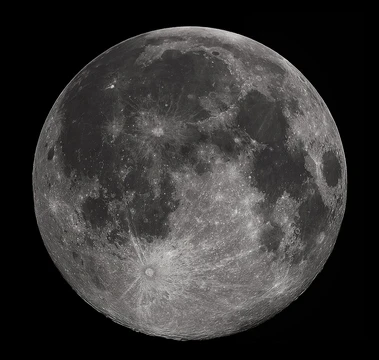
A mass concentration, or mascon, is a region of a planet's or moon's crust that exhibits a large positive gravity anomaly. The term is most commonly applied to geologic structures where a positive gravitational anomaly is associated with a feature, such as a depressed basin, that would otherwise be expected to have a negative anomaly. The Moon is the most gravitationally 'lumpy' major body known in the Solar System, with its largest mascons capable of altering a plumb bob's alignment by about a third of a degree and increasing local gravity by one-half percent.
Quick Facts
- Example lunar mascon basins
- Imbrium
- Serenitatis
- Crisium
- Orientale
- Example martian mascon basins
- Argyre
- Isidis
- Utopia
- Possible mare basalt thickness
- up to 6 kilometers
- Year of identification
- 1968
- Method of identification
- Doppler tracking of five Lunar Orbiter spacecraft
Facts from the source article.
Lunar mascons
The Moon is the most gravitationally uneven major body in the Solar System. Its biggest mass concentrations, or mascons, are so strong that they can make a plumb bob hang roughly a third of a degree away from the expected vertical, tilting toward the mascon, and boost the local pull of gravity by half a percent. Well-known lunar mascon basins include Imbrium, Serenitatis, Crisium, and Orientale, each marked by deep depressions and unusually strong gravity.
On Mars, similar mascon basins are found at Argyre, Isidis, and Utopia. Normally, a low-lying area in isostatic balance would show a slight negative gravity signal. So the positive gravity anomalies at these impact basins mean something denser must exist in the crust or upper mantle, held up by the lithosphere. One idea is that dense mare basaltic lavas, which on the Moon can pile up to 6 kilometers thick, cause the effect.
Those lavas do add to the anomalies, but the crust-mantle boundary also has to be pushed upward to explain the full strength. Interestingly, some lunar mascon basins show no signs of volcanic activity at all. In both cases, theory says all lunar mascons are super-isostatic, meaning they are propped above their isostatic level. The vast volcanic plains of Oceanus Procellarum, despite their thick basalt, do not produce a positive gravity anomaly.
First spotted in 1968 through Doppler tracking of the five Lunar Orbiter missions, the origin of these subsurface mascons was hotly debated for years. Now scientists generally agree they formed from asteroid impacts during the Late Heavy Bombardment. The gravity changes from lunar mascons are strong enough that low-flying satellites in uncorrected orbits around the Moon become unstable within months or years. Tiny orbital shifts build up over time, warping the path until the satellite crashes into the surface.
Did You Know?
- Mascons on Earth are often measured by means of satellite gravimetry, such as the GRACE satellites.
- Mascons are often reported in terms of a derived physical quantity called 'equivalent water thickness', 'equivalent water height', or 'water equivalent height'.
- Equivalent water thickness is obtained by dividing the surface mass density redistribution by the density of water.
More in Lunar Science
Sources
Compiled from Wikipedia and the sources listed below. Text from Wikipedia is available under CC BY-SA 4.0; this entry is adapted from it.
- Wikipedia: Mass concentration (astronomy) (CC BY-SA 4.0).
Spotted an error? Know more?
Reader corrections go straight into our review queue. Suggest an edit · How this site is sourced