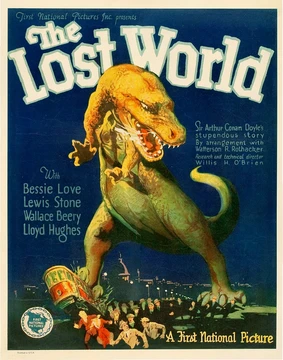
The Lost World (1992 film)
A 1992 film adaptation set in Africa.

The 1992 film *The Lost World* adapts Arthur Conan Doyle’s 1912 novel, shifting the setting from South America to Africa. It replaces the character Lord John Roxton with Jenny Nielson, a wildlife photographer played by Tamara Gorski in her first film role. A sequel, *Return to the Lost World*, premiered later that year with the same director and principal cast.
The movie was shot on location in Zimbabwe’s Mashonaland region. The edge of the plateau was represented by Ngoma Kurira in Mashonaland East. Many local performers were cast as native characters.
The story begins with junior reporter Edward Malone seeking an adventurous assignment. He interviews Professor Challenger, an explorer who claims to have found a “lost world” in Central Africa, supported only by a photograph of a cliff and a creature resembling a pterodactyl. The British scientific establishment dismisses him. After funding from the family of Jenny Nielson—daughter of a wealthy American science patron—an expedition is organized under the skeptical Professor Summerlee. Summerlee allows Malone and Nielson to join but refuses Challenger. Reluctantly, Challenger gives Malone a sealed map, to be opened at a specific time in a remote African village. Malone’s newsboy friend Jim stows away.
In Africa, the group hires a female guide named Malu and a Portuguese man named Gomez. Malone opens the map to find it blank, at which point Challenger appears and takes charge. They locate the cliff and ascend, but Gomez—revealed as the brother of a man Challenger killed on an earlier journey—strands them. Exploring the lost world, they encounter dinosaurs: a pair of Anatotitan, a pterodactyl rookery, and a predatory theropod (possibly Herrerasaurus). Jim, Malone, and Malu narrowly escape being eaten, only to find their camp destroyed and the others missing. They discover a tribe of “skeleton men” who sacrifice humans to a Tyrannosaurus rex. Malone distracts the tribe while the explorers and captured natives flee to a neighboring tribe that wears clothes. Summerlee notes that the sacrifices wear ritual vegetation necklaces, which he deduces provide a nutrient or immunization that protected the dinosaurs from extinction. The team uses modern knowledge to help the tribe with irrigation and horticulture, producing an antidote to a prehistoric plague. The skeleton tribe’s leader is killed, and the two tribes unit
- Release year
- 1992
- Based on
- The Lost World (1912 novel) by Sir Arthur Conan Doyle
- Setting
- Africa (Mashonaland region of Zimbabwe)
- Director
- Not specified in source
- Main cast
- John Rhys-Davies, David Warner, Eric McCormack, Tamara Gorski
- Sequel
- Return to the Lost World (1992)
Quick Facts
- Director
- Timothy Bond
- Producer
- Harry Alan Towers / Frank Agrama / Daniele Lorenzano / Norman Siderow
- Based On
- The Lost World / 1912 novel · Arthur Conan Doyle
- Writer
- Marion Fairfax / Harry Alan Towers / Tim Kirk
- Starring
- John Rhys-Davies / Eric McCormack / David Warner / Nathania Stanford
- Music
- Isaiah Sanders / Gerard Shadrick / Lawrence Shragge / Larry Wolff
- Cinematography
- Paul Beeson
- Editing
- Stephen Lawrence
- Released
- 1992 · 02 · 9 · df=yes
- Runtime
- 99 minutes
- Country
- Canada
- Language
- English
Facts from the source article.
Lore & Background
The film was shot on location in the Mashonaland region of Zimbabwe, with Ngoma kurira in Mashonaland East standing in for the edge of the plateau. Many local actors were hired to play native characters. The character of Lord John Roxton from the novel was replaced with a female character, Jenny Nielson, played by Tamara Gorski in her film debut.
The plot follows junior reporter Edward Malone, who is sent to interview Professor Challenger, an explorer who believes in a lost world in Central Africa. Challenger has a photograph of a cliff and a pterodactyl-like creature as evidence. The scientific community, led by the antagonistic Professor Summerlee, organizes an expedition without Challenger, but Challenger later joins them in Africa. The team discovers dinosaurs, including a Tyrannosaurus rex, and encounters two native tribes—one that sacrifices humans to carnivorous dinosaurs and another that opposes them.
The expedition helps reunite the tribes and finds a hidden cave back to their world. Upon returning to London, the Royal Zoological Society dismisses their evidence until a stowaway named Jim reveals a baby pterodactyl he brought back. The team releases the pterodactyl, named Percival, allowing it to fly back to the lost world.
Reader's Guide
The Lost World (1992) is notable as a direct-to-video or low-budget adaptation that relocates the story from South America to Africa, specifically Zimbabwe. It replaces the male Lord John Roxton with a female wildlife photographer, Jenny Nielson, reflecting a shift in character dynamics. The film's use of local Zimbabwean actors and locations gives it a distinct visual authenticity compared to other adaptations. Its sequel, Return to the Lost World, released the same year with the same director and cast, indicates an attempt to capitalize on the story's popularity. The film includes a variety of dinosaurs, such as Edmontosaurus, Brachiosaurus, and Tyrannosaurus rex, though some identifications are uncertain. Its legacy lies in being one of several film versions of Conan Doyle's novel, distinguished by its African setting and the inclusion of a female lead in a role originally written as male.
Did You Know?
- The film was shot on location in the Mashonaland region of Zimbabwe.
- Tamara Gorski made her film debut as Jenny Nielson, replacing the male character Lord John Roxton from the novel.
- A sequel, Return to the Lost World, was released the same year with the same director and main cast.
- The baby pterodactyl brought back to London was named Percival and later released to fly back to the lost world.
More in Lost world films 1-24
Spotted an error? Know more?
This is a living reference — every entry is fact-audited, and reader corrections feed straight into our audit queue. Suggest an edit · See this site's audit record