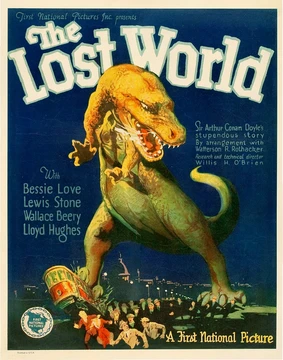
Darkest Africa
First Republic serial, loose sequel to The Lost Jungle.

Wikimedia Commons · CC BY 4.0
Darkest Africa (1936) is a Republic movie serial, notable as the first serial produced by Republic Pictures. It is a loose sequel to the Mascot Pictures serial The Lost Jungle, also starring Clyde Beatty. The serial follows big-game hunter Clyde Beatty as he helps a boy named Baru rescue his sister from the lost city of Joba.
- Production company
- Republic Pictures
- Release date
- 15 February 1936 (seventh chapter made available)
- Number of chapters
- 15
- Budget
- $107,281
- Final negative cost
- $119,343
- Director
- Not specified in source
- Starring
- Clyde Beatty, Manuel King, Elaine Shepard
Lore & Background
The cast includes Clyde Beatty as himself, Manuel King as Baru Tremaine, Elaine Shepard as Valerie Tremaine, Lucien Prival as Dagna, and Ray 'Crash' Corrigan in an ape suit as Bonga. Yakima Canutt served as stunt coordinator. The serial was re-released in 1948 as King of Jungleland and again in 1966 for television as Batmen of Africa, cut to 100 minutes.
Reader's Guide
Darkest Africa holds significance as Republic Pictures' inaugural serial, establishing production techniques and special effects that would define the studio's future success. Its use of flying effects and model work, particularly the destruction of the lost city in the final chapter, were early examples of Republic's craftsmanship. The serial also showcased Clyde Beatty's animal training, with critic Cline praising the photography of his techniques. However, Lucien Prival's performance as Dagna was criticized as monotonous. The serial's multiple re-releases under different titles—King of Jungleland and Batmen of Africa—reflect its adaptability to changing market trends. As the only 15-chapter serial Republic produced in 1936, it set a format that would be used for later serials like Dick Tracy in 1937.
Did You Know?
- Darkest Africa was the first serial produced by Republic Pictures.
- The serial was filmed under the working title Dark Continent.
- It was re-released in 1948 as King of Jungleland and in 1966 as Batmen of Africa.
The Story at the Heart of the Film
In May 1940, Britain's political landscape is in upheaval. Neville Chamberlain, widely seen as too soft against the Nazi advance, faces a demand from the opposition Labour Party to step down. His Conservative colleagues prefer Lord Halifax, but Halifax hesitates, leaving the door open for a figure both parties can tolerate: Winston Churchill, a man who had warned about Hitler's danger long before the war yet carries a rough reputation in Parliament. King George VI, still wary of Churchill over the abdication crisis, reluctantly invites him to form a government. Churchill assembles a cabinet that includes both Chamberlain and Halifax, setting the stage for internal conflict. As France crumbles and the British Expeditionary Force is cornered at Dunkirk, the War Cabinet fractures over whether to negotiate peace with Germany. Churchill, under enormous pressure, nearly dictates a letter requesting talks before choking on the words. The film's emotional climax arrives when Churchill delivers his famous 'we shall fight on the beaches' address, and the opposition rises to applaud while the Conservative backbenchers, cued by Chamberlain's handkerchief, follow suit.
Crafting the Performance
The transformation of Gary Oldman into Winston Churchill was nothing short of a physical ordeal. Over the course of filming, Oldman endured more than 200 hours of prosthetic make-up application, a grueling daily process that reshaped his face into the recognizable features of the wartime leader. He also burned through more than 400 cigars during production, a cost estimated at around twenty thousand dollars, to capture Churchill's iconic habit authentically. The casting process itself was marked by tragedy. John Hurt was originally attached to play Neville Chamberlain but was forced to withdraw while undergoing treatment for pancreatic cancer; he passed away in January 2017. Ronald Pickup stepped into the role in his place. The film also marked the final screen appearance of actor Whitrow, who died following the September 2017 premiere. Dario Marianelli composed the score, and principal photography began in late 2016, with filming taking place in Manchester, England.
Critical Acclaim and Box Office
Darkest Hour first screened at the 44th Telluride Film Festival on September 1, 2017, before embarking on a staggered theatrical rollout. A limited US release opened on November 22, 2017, expanding to wide release on December 22, while the UK audience saw it on January 12, 2018. The film ultimately collected approximately 150 million dollars at the global box office. Critics responded enthusiastically, with many singling out Oldman's portrayal as a career-defining achievement. That recognition translated into a remarkable sweep of acting honors: Oldman took home Best Actor at the Academy Awards, the BAFTA ceremony, the Golden Globes, and the Screen Actors Guild Awards, making him one of the few performers to collect all four major acting trophies in a single season. The film's success cemented its place as one of the most celebrated war dramas of the late 2010s.
Thematic Resonance and Legacy
The title itself is borrowed from a phrase widely attributed to Churchill describing the opening months of the war, framing the entire narrative as a moment when a nation's resolve was tested to its breaking point. At its core, the film is less about military strategy than about the fragile machinery of democracy under siege. The War Cabinet crisis dramatizes how a single leader's refusal to negotiate peace—backed ultimately by the will of ordinary citizens, from Underground passengers to backbench MPs—can override the instincts of seasoned statesmen. The epilogue quietly underscores the impermanence of power: Chamberlain dies within six months, Halifax is reassigned to Washington, and Churchill himself is voted out of office once the European war ends. Yet the evacuation of nearly all the soldiers trapped at Dunkirk stands as a testament to the decision to keep fighting. The film endures as a meditation on how democratic legitimacy, not military might, ultimately sustains a nation in its darkest hour.
Gallery
Frequently Asked Questions
What is Darkest Africa?
Darkest Africa is a 15-chapter film serial released in 1936 by Republic Pictures. It is a lost-world adventure in which a big-game hunter helps a young boy rescue his sister from the hidden city of Joba.
Who stars in Darkest Africa?
Clyde Beatty headlines the serial as the big-game hunter at the center of the story. He had previously appeared in the Mascot Pictures serial The Lost Jungle, which Darkest Africa loosely follows up on.
What is the plot of Darkest Africa?
The serial follows Beatty's big-game hunter character as he assists a boy named Baru in saving his sister from the lost city of Joba. The adventure unfolds across 15 chapters of escalating danger and exploration.
Why is Darkest Africa historically significant?
It is recognized as the very first serial ever produced by Republic Pictures, marking the studio's debut in the weekly serial format. It also functions as a loose sequel to the earlier Mascot Pictures production The Lost Jungle.
What was the budget for Darkest Africa?
The serial was produced with a budget of approximately $107,281, and the final negative cost came in at around $119,343. These figures reflect the modest production scale typical of Republic's early serial output.
More in Lost world films 1-24
Spotted an error? Know more?
This is a living reference — every entry is fact-audited, and reader corrections feed straight into our audit queue. Suggest an edit · See this site's audit record