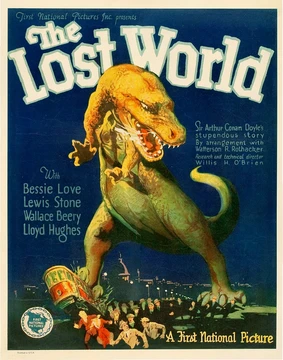
The Island at the Top of the World
A 1974 Disney adventure of a hidden Viking island.

Unknown author Unknown author or not provided · Public domain
The Island at the Top of the World is a 1974 American live-action fantasy adventure film from Walt Disney Productions, directed by Robert Stevenson and produced by Winston Hibler. Distributed by Buena Vista, it stars Donald Sinden and David Hartman.
In 1907 London, widowed British aristocrat and millionaire Sir Anthony Ross hastily organizes an Arctic expedition to find his lost son, Donald, who vanished during a whaling voyage seeking the legendary island where whales go to die. Sir Anthony hires Scandinavian-American archaeologist Professor John Ivarsson and French inventor-aeronaut Captain Brieux, who pilots their journey in his own dirigible, the Hyperion. In the Arctic, they meet Oomiak, a comically cowardly yet brave Inuk friend of Donald’s, and trick him into assisting their search.
The group becomes temporarily separated from Captain Brieux and discovers an uncharted island called Astragard, home to a hidden Viking civilization isolated for centuries. The Norsemen capture Sir Anthony and Ivarsson, but Oomiak escapes. They soon find Donald, but the xenophobic Godi (a lawspeaker and authority figure) nearly has them executed. A virtuous girl named Freyja, with whom Donald is deeply in love, saves the three men from being burned alive. They escape, rejoin Oomiak, and find the Whale’s Graveyard, but are attacked by killer whales. Captain Brieux reappears to rescue them, though the angry Godi and his reluctant warriors still pursue them.
The Godi is killed when his flaming arrow hits the Hyperion and causes an explosion. The Vikings, believing his aggression has angered the Norse gods, refuse to let the adventurers leave unless one stays as a hostage to prevent the island’s secret from reaching the outside world. Ivarsson volunteers, seeing it as a chance to relive history and noting that if humanity ever destroys itself, places like Astragard could be a final refuge. Sir Anthony, Donald, Freyja, Captain Brieux, and Oomiak depart in peace, promising secrecy, while Ivarsson watches them vanish into the Arctic mist.
The cast includes Donald Sinden as Sir Anthony Ross, David Hartman as Prof. Ivarsson, Jacques Marin as Captain Brieux, Mako as Oomiak, David Gwillim as Donald Ross, Agneta Eckemyr as Freyja, Gunnar Öhlund as The Godi, and others.
Pre-production spanned several years. The 2004 30th Anniversary Edition includes a 1968 pre-production trailer f
- Release Year
- 1974
- Director
- Robert Stevenson
- Producer
- Winston Hibler
- Studio
- Walt Disney Productions
- Distributor
- Buena Vista Distribution
- Genre
- Live-action lost world fantasy adventure
- Based On
- The 1961 novel The Lost Ones by Ian Cameron
Lore & Background
The film is set in London in 1907 and follows widowed British aristocrat Sir Anthony Ross as he organizes an expedition to the Arctic to find his lost son Donald, who disappeared on a whaling expedition seeking the fabled whale graveyard. Sir Anthony hires Scandinavian-American archaeologist Professor John Ivarsson and French inventor/aeronaut Captain Brieux, who pilots the expedition in his dirigible, the Hyperion. In the Arctic, they meet Oomiak, an Inuk friend of Donald's, and trick him into helping them search.
Reader's Guide
The expedition discovers an uncharted island called Astragard, inhabited by a lost civilization of Norsemen (Vikings) hidden from the world for centuries. Sir Anthony and Ivarsson are captured, but Oomiak escapes. They find Donald, but are nearly executed by the fanatical Godi, a lawspeaker. They are saved by Freyja, with whom Donald is in love. After escaping, they find the Whale's Graveyard, are attacked by killer whales, and are rescued by Captain Brieux. The Godi is killed by an explosion when he shoots a flaming arrow at the Hyperion. The Vikings, believing the Godi's actions angered the gods, allow the expedition to leave only if one remains as a hostage. Ivarsson volunteers to stay, and the others depart, promising not to reveal Astragard.
Did You Know?
- The film was based on the 1961 novel The Lost Ones by Ian Cameron, which was reissued with the film's title.
- The airship Hyperion was designed by the production design team.
- The film was nominated for Best Art Direction-Set Decoration, not just Best Art Direction as often misreported.
The Story of the Lost Island
The film follows a 1907 Arctic expedition led by Sir Anthony Ross, a widowed British industrialist, searching for his son Donald who was lost on a whaling voyage. The search party assembles a Scandinavian-American archaeologist, a French aeronaut, and a comical Inuk companion. Their journey leads them to Astragard, a hidden island home to a centuries-old Norse civilization. The group faces the wrath of the Godi, a xenophobic lawspeaker, and is saved by Freyja, a virtuous Norse girl who falls in love with Donald. After a harrowing encounter with killer whales at the Whale's Graveyard, the Godi is killed by his own flaming arrow. The Vikings, believing the Godi's aggression angered the Norse gods, demand one adventurer remain as a hostage to protect Astragard's secrecy. Ivarsson volunteers willingly, seeing it as a chance to relive history and noting that such hidden places might become humanity's last refuge if civilization destroys itself. The film closes with Ivarsson watching his friends vanish into the Arctic mist.
The Hyperion Airship
The Hyperion, a semi-rigid dirigible roughly 200 feet in length, serves as one of the film's most visually striking elements despite appearing for only a fraction of the runtime. Designed under the direction of production designer Peter Ellenshaw, the airship features a streamlined crimson envelope, an enclosed gondola suspended from a narrow catwalk, and twin gasoline engines driving outward-extending propellers. The press kit for the 1974 release claimed that Goodyear blimp pilots were consulted and deemed the design theoretically airworthy. The ship bears a notable resemblance to the semi-rigid airships developed by Lebaudy Frères, though whether those served as direct inspiration remains uncertain. In the film's narrative, the gondola and rear catwalk are detached after a crash landing, allowing the balloon to float free, a modification the Captain made to escape the island. The Hyperion also became central to a planned Disneyland attraction called Discovery Bay, which would have featured a life-size replica in a wooden hangar and an aerial ride over the Arctic. The film's poor box office performance meant the attraction was never realized, though planning models and artist concept art survive.
An Ensemble of Unlikely Companions
The film assembles a diverse cast of characters who form the expedition's core. Donald Sinden portrays Sir Anthony Ross, the widowed aristocrat and industrialist who funds the desperate search for his son. David Hartman plays Professor John Ivarsson, the Scandinavian-American archaeologist whose love of history ultimately leads him to remain on Astragard. Jacques Marin brings life to Captain Brieux, the French inventor and aeronaut who piloted the Hyperion. Mako delivers a memorable performance as Oomiak, the Inuk companion whose comical cowardice masks genuine bravery. David Gwillim plays the lost son Donald Ross, while Agneta Eckemyr portrays Freyja, the virtuous Norse girl whose love for Donald becomes central to the story's emotional core. Gunnar Öhlund embodies the Godi, the fanatical and xenophobic lawspeaker whose prejudice drives the island's conflict. The supporting Norse cast, including characters like Erik, Torvald, Sven, and Gunnar, populate the lost civilization and provide the backdrop for the film's climactic confrontation.
Years in the Making and a Lost Legacy
The Island at the Top of the World underwent a remarkably long pre-production period spanning several years before its 1974 release. Evidence of this extended development is preserved in a 1968 pre-production trailer, included as a bonus feature on the 30th Anniversary Edition released by Walt Disney Studios Home Entertainment in 2004. That trailer features an interview with producer Winston Hibler, offering a glimpse into the project's early stages. The film was directed by Robert Stevenson and distributed by Buena Vista Distribution under the Walt Disney Productions banner. Despite the ambitious scope of its production, including the elaborate Hyperion airship and extensive Norse village sets, the film performed poorly at the box office. This commercial disappointment had lasting consequences beyond the screen: the planned Discovery Bay attraction at Disneyland in Anaheim, California, which would have centered on a life-size Hyperion replica and an aerial Arctic ride, was never built. The film thus stands as a notable example of a Disney production whose ambitious vision outpaced its commercial success, leaving behind only the finished picture and scattered artifacts of unrealized plans.
Gallery
Frequently Asked Questions
What is The Island at the Top of the World?
It is a 1974 live-action fantasy adventure from Walt Disney Productions, directed by Robert Stevenson and produced by Winston Hibler. The film follows a 1907 Arctic expedition in search of a mythical hidden island.
What is the premise of The Island at the Top of the World?
A widowed British millionaire in 1907 London throws together a rushed Arctic expedition to find his son, who disappeared while chasing a legend about an island where whales go to die. The search ultimately leads the party to a secret Viking settlement concealed in the frozen north.
Who stars in The Island at the Top of the World?
Donald Sinden and David Hartman headline the cast. The picture was distributed by Buena Vista and falls squarely in the live-action lost-world adventure genre.
What makes the island a 'lost world'?
The island is a hidden Viking community in the Arctic that has kept its Norse traditions and way of life in total isolation from the modern world. It fits the classic lost-world trope of a civilization preserved outside of history.
Why is this film notable in Disney's catalog?
It is one of the studio's rarer 1970s live-action entries, leaning into a genuine hidden-civilization fantasy rather than the more typical family fare Disney was known for at the time.
More in Lost world films 1-24
Spotted an error? Know more?
This is a living reference — every entry is fact-audited, and reader corrections feed straight into our audit queue. Suggest an edit · See this site's audit record