Hemispheres of Earth
Equal halves of Earth divided by latitude, longitude, or cultural lines.
Last updated
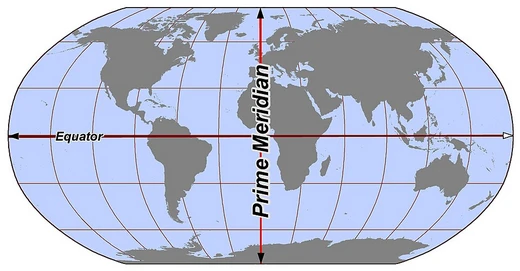
A circle drawn around Earth’s center divides it into two equal halves called hemispheres.[1][2] There are generally considered to be four hemispheres: Southern, Northern, Eastern, and Western.[1][2] The Equator divides Earth into Northern and Southern Hemispheres, while the prime meridian and International Date Line divide it into Eastern and Western Hemispheres.[1][2]
Last updated 2026-10-01 from the source article.
Quick Facts
- Primary divisions
- Northern/Southern (by Equator) and Eastern/Western (by Prime meridian)
- Alternative divisions
- Cultural
- religious
- geographic feature-based
- and land-water hemispheres
- Land hemisphere center
- Near 47°N
- 1°E
- near Nantes
- France
- Water hemisphere center
- Near 47°S
- 179°W
- southwest of the Chatham Islands
- New Zealand
Facts from the source article.
Key facts and history
In geography and cartography, hemispheres are any division of the globe into two equal halves.[3] Geographical hemispheres are primarily split by latitudinal (north-south) and longitudinal (east-west) markers.[4] Many geographers consider the 20 degree west line of longitude and the 160 degree east line of longitude as the Eastern and Western Hemispheres.[1][2] There are differences in the climates of the Northern and Southern Hemispheres because of Earth's seasonal tilt toward and away from the sun.[1][2]
The idea of Eastern and Western Hemispheres has become politically and historically significant since European nations began colonizing North America and South America.[1][2] Alternative Earth hemispheres can divide the globe along cultural or religious lines.[5] Geographic, cultural, religious, or prominent physical features can serve as the basis for dividing Earth into hemispheres.[3] Researchers employ these hemispheric divisions to analyze global population patterns, cultural variations, and a range of geographic, demographic, and socioeconomic characteristics.[3]
What the cited sources add
The National Geographic Society notes that the word "hemisphere" is also used to identify the halves of the brain.[1][2] The same source states that Earth is the only place in the known universe that supports life.[1][2] A 1945 article by Boggs in the Journal of Geography discusses alternative hemispheres used to maximize the prominence of geographic features.[5]
References
- "Hemisphere", www.nationalgeographic.org, 2011-03-22. facts only, no text reused. nationalgeographic.org
- "hemisphere National Geographic Society", education.nationalgeographic.org. facts only, no text reused. education.nationalgeographic.org
- Wikipedia, "Hemispheres of Earth" (CC BY-SA 4.0), which cites: "hemisphere Etymology, origin and meaning of hemisphere by etymonline", www.etymonline.com (original not read by us) en.wikipedia.org
- Wikipedia, "Hemispheres of Earth" (CC BY-SA 4.0), which cites: "Hemisphere", www.nationalgeographic.org, 2011-03-22; "hemisphere National Geographic Society", education.nationalgeographic.org (we also read that source) en.wikipedia.org
- Wikipedia, "Hemispheres of Earth" (CC BY-SA 4.0), which cites: Boggs, "This Hemisphere", Journal of Geography, 1945, p. 345–355 (original not read by us) en.wikipedia.org
Each numbered sentence above was checked against the source it cites before publication. Sentences citing Wikipedia adapt text from the English Wikipedia article Hemispheres of Earth (contributors), used under CC BY-SA 4.0; this entry is available under the same licence. Other sources were used for facts only; no text or images are copied from them.
More in Lines & Hemispheres
Sources
Compiled from Wikipedia and the sources listed below. Text from Wikipedia is available under CC BY-SA 4.0; this entry is adapted from it.
- Wikipedia: Hemispheres of Earth (CC BY-SA 4.0).
Spotted an error? Know more?
Reader corrections go straight into our review queue. Suggest an edit · How this site is sourced