Circle of latitude
Parallel circles defining latitude on Earth.
Last updated
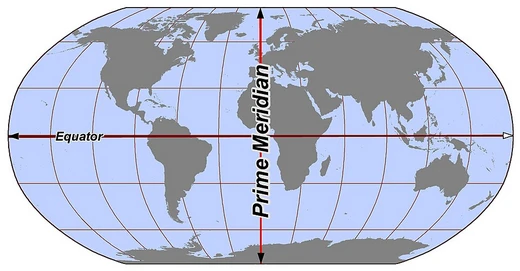
Circles of latitude are imaginary lines parallel to each other, never intersecting, and are often called parallels.[1] Unlike great-circle meridians, these circles shrink in length as distance from the Equator increases.[1] The longitude of a point on a circle of latitude indicates its position along that circle.[1]
Quick Facts
- Longest circle
- Equator (0° latitude)
- Number of integral circles
- 89 per hemisphere between Equator and poles
- Major circles
- Arctic Circle
- Tropic of Cancer
- Equator
- Tropic of Capricorn
- Antarctic Circle
Facts from the source article.
Key facts and history
There are five major circles of latitude, listed from north to south.[2] The Equator's position is fixed at 90 degrees from Earth's axis of rotation.[2] The latitudes of the other major circles depend on the axial tilt and are not perfectly fixed.[2] The axial tilt fluctuates between about 22.1° and 24.5° over a 41,000-year cycle.[3]
Shorter-term nutation, with a main 18.6-year term of amplitude 9.2″, causes daily shifts of some metres.[4] A sine or cosine function is commonly used to determine the length of a circle of latitude.[1] Except for the Equator, all circles of latitude are rhumb lines when shown on an ellipsoid or a spherical projection.[1]
What the cited sources add
A 2014 study in the Journal of Climate states that the Tropical Circles drift toward the equator by 15 m per year on average.[3] That same study reports the astronomically defined Tropics area is decreasing by 1100 km² per year.[3] The study also notes that the tropical belt defined by atmospheric conditions is expanding due to global warming.[3]
References
- Wikipedia, "Circle of latitude" (CC BY-SA 4.0), which cites: Kher, "What Are Longitudes and Latitudes?", timeanddate.com (original not read by us) en.wikipedia.org
- Wikipedia, "Circle of latitude" (CC BY-SA 4.0), which cites: "Trópico en movimiento (in Spanish)" (original not read by us) en.wikipedia.org
- Wikipedia, "Circle of latitude" (CC BY-SA 4.0), which cites: Quan, "How Fast Are the Tropics Expanding?", Journal of Climate, 1 March 2014, p. 1999–2013 (original not read by us) en.wikipedia.org
- Wikipedia, "Circle of latitude" (CC BY-SA 4.0), which cites: "Basics of Space Flight, Chapter 2", Jet Propulsion Laboratory, 2013-10-29 (original not read by us) en.wikipedia.org
Each numbered sentence above was checked against the source it cites before publication. Sentences citing Wikipedia adapt text from the English Wikipedia article Circle of latitude (contributors), used under CC BY-SA 4.0; this entry is available under the same licence. Other sources were used for facts only; no text or images are copied from them.
Also in the Codexery
More in Lines & Hemispheres
Sources
Compiled from Wikipedia and the sources listed below. Text from Wikipedia is available under CC BY-SA 4.0; this entry is adapted from it.
- Wikipedia: Circle of latitude (CC BY-SA 4.0).
Spotted an error? Know more?
Reader corrections go straight into our review queue. Suggest an edit · How this site is sourced