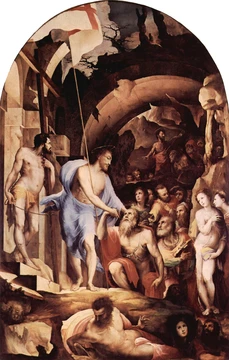
Inferno (Dante)
First part of Dante's Divine Comedy, depicting a journey through Hell.

via Wikipedia: Inferno (Dante) · Public domain
Inferno is the first part of Dante Alighieri's 14th-century narrative poem the Divine Comedy, followed by Purgatorio and Paradiso. It describes the journey of a fictionalized version of Dante through Hell, guided by the ancient Roman poet Virgil. Hell is depicted as nine concentric circles of torment within the Earth, representing the realm of those who rejected spiritual values through sin.
- Author
- Dante Alighieri
- Work
- Inferno
- Part of
- Divine Comedy
- Language
- Italian
- Genre
- Narrative poem
- Setting
- Hell (nine concentric circles within Earth)
Lore & Background
Dante likely began composing the Comedy around 1306, though some scholars argue for a start as late as 1313. He was exiled from Florence in 1302 after his political faction, the White Guelphs, were defeated. Largely removed from politics, he spent nearly the last fifteen years of his life on the Comedy. Many scholars agree Inferno was begun in 1306–1307 and completed in 1309–1310, though revisions likely continued. The earliest citations of Inferno were written as early as 1315.
Reader's Guide
Inferno is significant as the opening canticle of the Divine Comedy, an allegory of the soul's journey toward God, describing the recognition and rejection of sin. The poem's structure is based on Aristotle's ideas, with supplements from Cicero's De Officiis, dividing sins into incontinence, violence/bestiality, and fraud/malice. Each circle's punishment is a contrapasso, a symbolic instance of poetic justice. The work circulated in fragments before Dante's death in 1321, and its influence on Western literature and conceptions of Hell is profound. The poem begins on Maundy Thursday in 1300, with Dante lost in a dark wood, blocked by three beasts symbolizing the three major sin categories. Virgil rescues him, and they pass through Hell's gate, bearing the inscription 'Abandon all hope, ye who enter here.'
Did You Know?
- The poem begins on the night of Maundy Thursday, March 24 (or April 7), 1300, with Dante 35 years old.
- The three beasts blocking Dante's path—a leopard, a lion, and a she-wolf—symbolize fraud, violence, and incontinence.
- The gate of Hell bears the inscription 'Lasciate ogne speranza, voi ch'intrate' ('Abandon all hope, ye who enter here').
- Dante's Hell has nine concentric circles, with punishments that are a contrapasso, or poetic justice.
More in Characters
Elsewhere in Limbo
Spotted an error? Know more?
Reader corrections go straight into our review queue. Suggest an edit · How this site is sourced