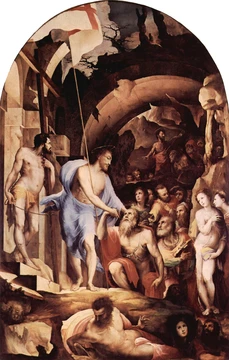
Bosom of Abraham
A biblical resting place for the righteous dead.
The Bosom of Abraham is a term for the place of comfort in the biblical Sheol, or Hades in the Greek Septuagint, where the righteous dead await redemption. The phrase appears in both Judaism and Christianity and has been depicted in religious art. It derives from the Greek word kolpos, meaning 'lap' or 'bay,' and reflects Second Temple period dining customs.
Quick Facts
- Field
- Theology, Religious art
- Known for
- Place of comfort for righteous dead in Sheol/Hades
Facts from the source article.
Origin of the phrase
The Greek term for 'bosom' is kolpos, meaning 'lap' or 'bay,' and relates to the Second Temple practice of reclining at meals, where the closest guest lay on the host's chest. Before the work of Maldonatus in AD 1583, commentators traced the phrase to the custom of parents taking tired children into their arms or onto their knees for rest, symbolizing Abraham's care for his children after life's troubles. Maldonatus proposed that the metaphor came from Jewish dining customs during and before Jesus's time, where guests leaned on their left elbow on couches, and the head of one person lay near the breast of another, described as lying 'in the bosom.' Being allowed to lie in the bosom of the feast master was a mark of honor, and Jews pictured the afterlife as a banquet given by Abraham, with the highest reward being in 'Abraham's Bosom.'
Abode of the righteous dead
In First Temple Judaism, Sheol (or Hades in the Septuagint) was a place of silence for all the dead, but during or before the Babylonian exile, ideas of activity in Sheol entered Jewish theology. During the Second Temple period, Jewish papyri first mention the 'Bosom of Abraham, Isaac and Jacob,' reflecting martyrs' belief that these patriarchs would receive them after death, as in 4 Maccabees 13:17. The Book of Enoch divides Sheol into four sections but does not feature Abraham, as Enoch predates him. Later rabbinical sources, such as Kiddushin 72b, mention Adda bar Ahavah sitting in Abraham's bosom, and Genesis Rabba 67 describes Abraham at Gehenna's gate. In the 1860s, Abraham Geiger suggested that the parable of Lazarus in Luke 16 preserves a Jewish legend where Lazarus represents Abraham's servant Eliezer.
In Christian art
Medieval Christian art depicted the Bosom of Abraham literally, showing miniature figures of souls on the lap of a larger Abraham. Gothic cathedrals in France often have reliefs of Abraham holding such a group, and other media also feature this image. A miniature from Hildegard of Bingen shows a figure called 'Synagogue' holding Jewish souls, while the Bosom of Abraham Trinity, unique to English medieval art, shows God the Father holding Christian souls.
More in Characters
Elsewhere in Limbo
Spotted an error? Know more?
Reader corrections go straight into our review queue. Suggest an edit · How this site is sourced