
Dorian Gray (2009 film)
A 2009 film adaptation of Oscar Wilde's novel about eternal youth.

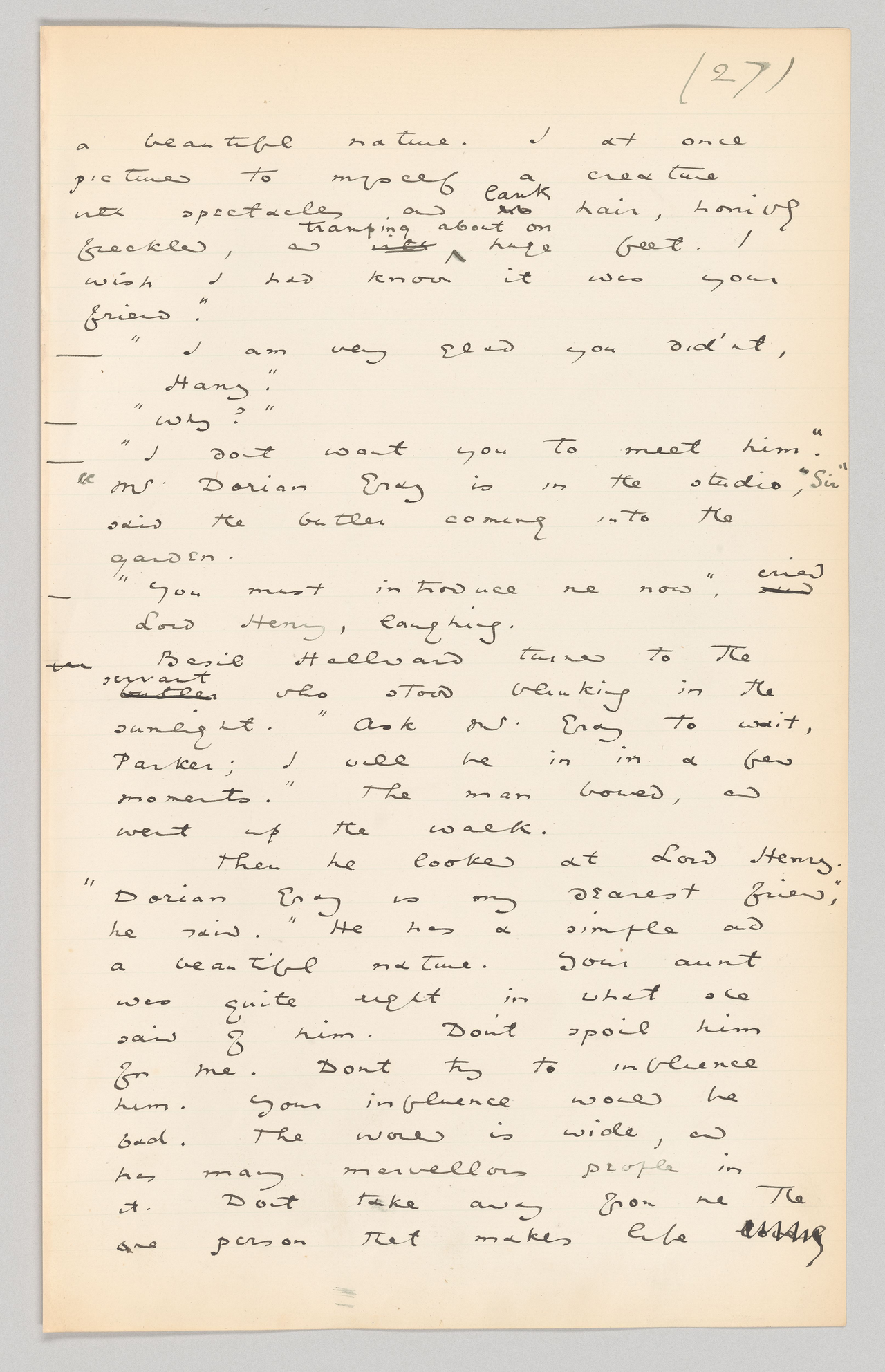
Wilde, Oscar, 1854-1900 · Public domain
**Dorian Gray (2009 film)**
*Dorian Gray* is a 2009 British dark fantasy horror film adapted from Oscar Wilde’s 1890 novel *The Picture of Dorian Gray*. Oliver Parker directed the film, and Toby Finlay wrote the screenplay. The cast includes Ben Barnes, Colin Firth, Rebecca Hall, Ben Chaplin, Emilia Fox, and Rachel Hurd-Wood. The story follows the title character, a handsome Englishman whose beauty and vitality are preserved in a painted portrait, allowing him to remain youthful while the canvas bears the marks of his misdeeds.
The film premiered in the United Kingdom on 9 September 2009, distributed by Momentum Pictures, and was part of the Official Fantàstic Competition at the 2009 Sitges Film Festival.
**Plot**
A naive young Dorian Gray arrives in Victorian London to inherit an estate from his abusive grandfather. The charismatic Lord Henry “Harry” Wotton introduces him to the city’s hedonistic pleasures. Henry’s friend, artist Basil Hallward, paints a portrait of Gray to capture his beauty. Upon seeing the finished work, Gray makes a casual vow: he would trade anything—even his soul—to stay young forever.
Gray falls in love with aspiring actress Sibyl Vane and proposes marriage. But after a brothel visit and Henry’s influence, Gray abandons her. Heartbroken, Sibyl drowns herself. Her brother Jim confronts Gray, revealing Sibyl was pregnant, and tries to strangle him before being pulled away. Henry distracts Gray from his grief, and Gray’s hedonism deepens, driving a wedge between him and Basil.
Gray discovers that Basil’s portrait has become distorted and twisted. His offhand wish has come true: he remains healthy and whole, while his sins and injuries appear as physical flaws on the canvas. When Basil insists on seeing the locked-away portrait, Gray reveals it and then kills him. He dismembers Basil’s body and dumps it in the River Thames, but the remains are recovered and buried.
Gray asks Henry to travel the world, but Henry declines because his wife is pregnant. After a 25-year absence, Gray returns to London. His unchanged youthful appearance shocks everyone at a welcoming party. Henry’s daughter Emily becomes fascinated with Gray, despite her father’s disapproval.
Gray’s memories of Sibyl resurface, filling him with remorse. He tries to distance himself from Emily but cannot resist her.
Quick Facts
- Director
- Oliver Parker
- Producer
- Barnaby Thompson
- Screenplay
- Toby Finlay
- Based On
- The Picture of Dorian Gray · Oscar Wilde
- Starring
- Ben Barnes / Colin Firth / Rebecca Hall / Ben Chaplin / Emilia Fox / Rachel Hurd-Wood
- Music
- Charlie Mole
- Cinematography
- Roger Pratt
- Editing
- Guy Bensley
- Studio
- Alliance Films / UK Film Council / Ealing Studios / Fragile Films / Aramid Entertainment / Prescience Film Partnerships
- Distributor
- Momentum Pictures (United Kingdom) / Alliance Films (Canada) / National Entertainment Media (North America)
- Released
- 9 September 2009 · United Kingdom
- Runtime
- 112 minutes
Facts from the source article.
Lore & Background
The film follows a naïve young Dorian Gray who arrives in Victorian London to inherit an estate from his abusive grandfather. He is introduced to hedonistic pleasures by Lord Henry Wotton, and society artist Basil Hallward paints a portrait capturing Gray's beauty. Upon seeing the portrait, Gray makes a flippant pledge to give anything to stay young—even his soul. Gray falls in love with actress Sibyl Vane but leaves her after a brothel visit, leading to her suicide. Her brother Jim confronts Gray, revealing Sibyl was pregnant, but is dragged away. Gray discovers the portrait has become warped, realizing his pledge has come true: his sins manifest on the canvas. When Basil insists on seeing the portrait, Gray kills him and dumps the body in the Thames.
Reader's Guide
The film received mixed reviews, with a 43% approval rating on Rotten Tomatoes as of February 2024. Critics noted that despite a lavish and polished production, the film was tame and uninspired, with a lifeless performance by Ben Barnes in the title role. Director Oliver Parker acknowledged deviating from the novel to create an effective film, including adding Lord Henry's daughter and a climax in the third act, understanding this would conflict with purists. The portrait is a central technical and narrative element, depicted as alive and capable of observing Gray, decomposing quickly and attracting flies and rats. The film explores themes of morality, as Gray disregards traditional morality for beauty and pleasure, and narcissism, with author Ramesh Kumar suggesting Gray is a grandiose narcissist.
Did You Know?
- Filming began in summer 2008 at Ealing Studios and locations across London.
- The portrait in the film attracts flies and rats, and a maggot falls from its painted canvas face.
- Director Oliver Parker stated he knew he would need to deviate from the novel to create an effective film.
Narrative Arc & Key Turning Points
The 2009 adaptation traces Dorian Gray's descent from innocence to destruction across a span of more than two decades. The story opens with the young Englishman arriving in Victorian London to claim an inheritance from his cruel grandfather, only to be immediately drawn into the orbit of the charming Lord Henry Wotton, who introduces him to the city's most decadent pleasures. Society painter Basil Hallward creates a portrait of Gray's striking beauty, and it is in that moment of vanity that Gray carelessly vows he would trade his very soul to remain forever young. His subsequent romance with the young actress Sibyl Vane collapses under the weight of his hedonism, leading to her drowning and the violent confrontation with her brother Jim. After discovering the portrait has begun to warp with his sins, Gray murders Basil and dismembers his body, dumping the remains in the Thames. A twenty-five-year gap follows, during which Gray travels the world while his appearance never changes. His return to London, the introduction of Henry's daughter Emily, and the final attic confrontation—ending in fire and the rapid aging of his body—bring the narrative to its devastating close.
Ensemble Cast & Character Dynamics
The film assembles a strong British ensemble to populate Gray's world. Ben Barnes carries the title role as the perpetually youthful protagonist, while Colin Firth brings magnetic charisma to Lord Henry Wotton, the philosophical tempter whose influence poisons Gray's moral compass. Rebecca Hall portrays Sibyl Vane, the young actress whose love for Dorian ends in tragedy, and Ben Chaplin plays Basil Hallward, the devoted artist whose portrait becomes the film's central object of dread. Emilia Fox and Rachel Hurd-Wood round out the principal cast, the latter taking on Emily, Henry's daughter whose fascination with Gray adds a new layer of danger in the story's final act. Supporting performers include Pip Torrens as Gray's loyal valet Victor, Douglas Henshall as Alan Campbell, a friend present during Jim Vane's violent attempt on Gray's life, and Max Irons as Lucius, a young man Gray assaults after the boy touches the attic key. The interplay between these characters—Henry's seductive mentorship, Basil's artistic devotion, and the Vane siblings' grief—drives the emotional engine of the narrative.
Production & Directorial Vision
Principal photography took place during the summer of 2008, with scenes shot at Ealing Studios and across various London locations. The production received £500,000 in National Lottery funding through the UK Film Council's Premiere Fund, a modest sum that nonetheless supported a lavish visual presentation. Director Oliver Parker acknowledged from the outset that a faithful page-by-page translation of Wilde's 1890 novel would not serve the story well on screen. In discussions with star Ben Barnes, he identified the need to restructure the material so the film would build toward a genuine third-act climax. One of the most significant departures was the addition of Lord Henry's daughter, Emily, a character absent from the source text but essential, in Parker's view, to give the final act emotional stakes. He openly anticipated friction with devoted readers of the novel yet believed that without such changes the adaptation would do the original a disservice. The finished film premiered in the Official Fantàstic Competition at the 2009 Sitges Film Festival before its wider UK release on 9 September 2009 through Momentum Pictures.
The Portrait as Cinematic Device
In this adaptation, Basil Hallward's painting is far more than a static prop; it functions as a living, almost sentient presence that shapes the film's visual and auditory language. Once completed and displayed prominently in an open social area of Gray's home, the portrait is positioned to observe its subject and his interactions with society. The filmmakers exploit this by shifting camera perspectives between Gray and the canvas, most notably in the scene where he learns of Sibyl Vane's death. Here the viewpoint continuously alternates: the portrait's gaze is rendered through a blurred, panning shot taken from a higher vantage point looking down upon the isolated young man, while a haunting musical score underscores the terrifying implication that the painting is watching. This technique transforms a simple object into an active participant in the drama. By the film's conclusion, after the portrait is burned and the mansion consumed by flames, the canvas reappears in its original pristine state within its charred frame—and its eyes briefly glow, leaving the audience with an uncanny, unresolved final image.
Gallery

Frequently Asked Questions
Who is Dorian Gray in the 2009 film?
Dorian is a strikingly beautiful young Englishman who makes a wish that his painted portrait will age and bear the scars of his sins while his own body stays eternally youthful. Ben Barnes portrays him in Oliver Parker's dark fantasy horror adaptation of Oscar Wilde's 1890 novel.
What supernatural power does Dorian Gray have in the 2009 film?
His central ability is that his physical appearance never shows a day past its prime, no matter how cruel or reckless he becomes. Every wound, blemish, and sign of decay from his misdeeds is transferred to the canvas instead, so the portrait grows grotesque while he looks unchanged.
How does Dorian Gray (2009) end?
Dorian ultimately destroys the portrait, and in that act his true aged and corrupted form is exposed. He dies on the spot as the painting reverts to depicting the handsome young man he had always appeared to be.
Why do LGBTQ fans care about Dorian Gray (2009)?
The film foregrounds the intense, homoerotic bond between Dorian and Lord Henry (Colin Firth), making their relationship the emotional engine of the plot. Themes of forbidden desire, aesthetic obsession, and society's punishment of nonconformity give the story a strong queer resonance that fans frequently discuss.
What genre is Dorian Gray (2009) and who made it?
It is classified as a British dark fantasy horror film, directed by Oliver Parker with a screenplay by Toby Finlay. Momentum Pictures handled production, and the project received partial National Lottery funding through the UK Film Council's Premiere Fund.
More in LGBTQ-related fantasy films 1-24
Spotted an error? Know more?
Reader corrections go straight into our review queue. Suggest an edit · How this site is sourced