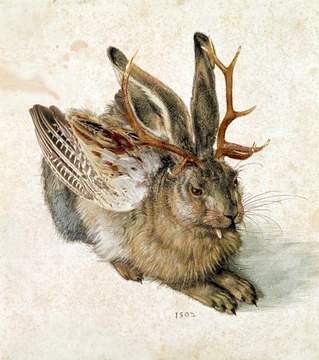
Wolpertinger
A composite creature from German alpine folklore.

The Wolpertinger is a creature from German folklore, said to inhabit the alpine forests of Bavaria and Baden-Württemberg in Southern Germany. It is a composite animal, typically depicted with parts from various local species, and has become a notable element of regional folk belief and tourist culture.
Quick Facts
- Aka
- de · Oibadrischl / de · Raurackl / de · Rammeschucksn
- Habitat
- Forests
- Folklore
- German folklore
- Grouping
- popular folklore
- Country
- Germany
- Region
- Bavarian Alps
- Similar Entities
- Jackalope
Facts from the source article.
Lore & Background
According to German folklore, the Wolpertinger inhabits the alpine forests of Bavaria and Baden-Württemberg in Southern Germany. The most widespread description portrays it as having the head of a rabbit, the body of a squirrel, the antlers of a deer, and the wings and occasionally the legs of a pheasant. No two Wolpertingers look alike because they are supposedly the result of crossbreeding between animals in the area such as foxes, roebucks, hares, ducks, and pheasants.
Folklore states that Wolpertingers only show themselves to beautiful maidens on a full moon if they are taken into secluded parts of the Bavarian forests by the right man. Images of creatures that may be Wolpertingers have been found in woodcuts and engravings dating back to the 17th century, though they might be images of rabbits infected by the Shope papilloma virus which causes tumors that can resemble horns or antlers. The origin of the name is unclear, but may come from glassmakers from the village of Wolterdingen who made schnapps glasses shaped like animals, which they called 'Wolterdinger.'
The Wolpertinger myth has increased in popularity over the past two centuries because of taxidermies created by Bavarian taxidermists in the 1800s for fun and to sell to tourists as 'local wildlife.' Stuffed 'Wolpertingers,' composed of parts of real animals that have been stuffed, are often displayed in inns or sold to tourists as souvenirs in the animal's 'native regions.' The Deutsches Jagd- und Fischereimuseum in Munich, Germany features a permanent exhibit on the creature.
Reader's Guide
The Wolpertinger holds significance as a distinctive example of German folkloric composite animals, reflecting regional creativity and the blending of local wildlife into a mythical creature. Its popularity grew notably in the 1800s due to taxidermists creating whimsical specimens for entertainment and tourism, which helped cement its place in Bavarian cultural identity. The creature is part of a larger family of horned mammals found throughout Germanic regions, with counterparts such as the Austrian Raurakl, the Rasselbock of the Thuringian Forest, the Dilldapp of the Alemannic region, and the Elwedritsche of the Palatinate. Its legacy extends into modern popular culture, appearing as a character in Walter Moers' novel 'Rumo and His Miraculous Adventures' and as a pet in the video game World of Warcraft during special events. The Wolpertinger also serves as a tourist attraction, with stuffed versions sold as souvenirs and displayed in inns, and is the subject of a permanent exhibit at the Deutsches Jagd- und Fischereimuseum in Munich. Its uncertain origins—possibly linked to 17th-century woodcuts or rabbit tumors—add to its mystique, and the unclear etymology of its name, possibly from glassmakers in Wolterdingen, further enriches its folkloric appeal.
Frequently Asked Questions
What is a Wolpertinger?
The Wolpertinger is a chimera from German alpine folklore, described as a patchwork creature assembled from the body parts of several familiar local animals. It is said to prowl the mountain forests of Bavaria and Baden-Württemberg in southern Germany.
What animals make up a Wolpertinger?
Traditional tellings stitch together parts of creatures like a fox, a cat, a goat, and a bird, though the exact recipe shifts from one regional story to the next. The unifying idea is a jumble of recognizable alpine species fused into one body.
Where does the Wolpertinger live?
Folklore places the creature in the dense, high-altitude forests of the Bavarian and Baden-Württemberg regions of southern Germany. It is treated as a local woodland spirit rather than a globally known beast.
What can a Wolpertinger do?
In the stories it is generally cast as a dangerous or mischievous presence that threatens livestock and travelers in the woods. There is no single fixed list of powers; different village accounts attribute different kinds of harm or odd behavior to it.
Why is the Wolpertinger so well known today?
Its quirky composite design made it a natural fit for Bavarian tourism branding, and it now appears on everything from roadside signs to local merchandise. That commercial embrace turned a small regional folk belief into a widely recognized symbol of German alpine culture.
More in Legendary mammals 1-22
Spotted an error? Know more?
Reader corrections go straight into our review queue. Suggest an edit · How this site is sourced