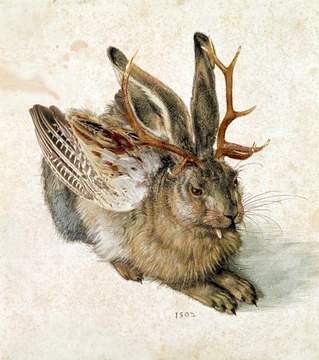
Crocotta
Mythical dog-wolf of India or Aethiopia, enemy of men and dogs.

The crocotta—also known as the corocotta, crocuta, leucrocotta, or leucrotta—is a legendary beast from India or Aethiopia, often associated with the hyena and described as a mortal threat to both humans and dogs. Ancient writers offer varying accounts of its origins and appearance. Strabo calls it the offspring of a wolf and a dog. Pliny, however, describes the corocotta as a hybrid of a hyena and a lion, with a single continuous ridge of bone instead of separate teeth, and the ability to mimic human and cattle voices. He also mentions a similar creature, the leucrocotta, as the fastest of all beasts, the size of an ass, with a stag’s hindquarters, a lion’s neck, tail, and chest, a badger’s head, cloven hooves, and a mouth that opens back to the ears. The Byzantine scholar Photius, summarizing Ctesias, reports that the crocottas of Ethiopia is also called kynolykos (dog-wolf), possesses amazing strength, imitates the human voice to call people by name at night, and devours those who approach. It is as brave as a lion, as swift as a horse, as strong as a bull, and cannot be harmed by steel weapons. Aelian links the hyena and corocotta, noting its talent for mimicking human speech. Porphyry writes that the Indian hyena, called crocotta, speaks like a human without training, going to houses and calling out to those it can easily overcome. According to the Augustan History, the emperor Antoninus Pius displayed a corocotta, likely at his decennalia in AD 148. Cassius Dio records that Septimius Severus later brought the crocotta to Rome for the first time, describing it as having the color of a lioness and tiger combined, with features of a dog and fox. Medieval bestiaries mixed these accounts, adding new traits such as the belief that the creature’s striped eyes, when placed under the tongue, granted oracular powers. The Aberdeen Bestiary describes the leucrota as a swift Indian animal the size of an ass, with a stag’s hindquarters and a lion’s chest and legs. The spotted hyena’s scientific name, *Crocuta crocuta*, derives from this myth; real hyenas share traits like powerful jaws, the ability to dig up human bodies, and unnervingly humanlike vocalizations, which likely contributed to the legend.
- Field
- Mythology, Cryptozoology
- Known for
- Mythical dog-wolf hybrid that mimics human voices and devours men
- Origin
- India or Aethiopia
- Type
- Mythical beast
Lore & Background
Strabo describes the crocotta as the mixed progeny of a wolf and a dog. Pliny, in his Natural History (Book 8, Chapter 30), presents the corocotta as a hybrid between a hyena and a lion, noting that it mimics the voices of men and cattle and has an unbroken ridge of bone in each jaw forming a continuous tooth. Pliny also writes of the leucrocotta (Natural History 8.31), a swift beast the size of an ass with a stag's haunches, lion's neck, tail and breast, badger's head, cloven hoof, and a mouth opening back to the ears, but does not attribute the ability to imitate human voices to this creature.
The Byzantine scholar Photius, summarizing Ctesias' Indica, reports that in Ethiopia the crocottas, vulgarly called kynolykos (dog-wolf), has amazing strength, imitates the human voice, calls men by name at night, and devours those who approach.
Reader's Guide
The crocotta occupies a unique place in ancient and medieval natural history as a creature that blurs the line between real and mythical animals. Its descriptions, drawn from classical authors such as Strabo, Pliny, and Ctesias, reflect a fascination with hybrid beasts and the exotic fauna of India and Ethiopia. The creature's ability to mimic human speech and its deadly enmity toward men and dogs made it a figure of both wonder and terror.
The crocotta's legacy extends into modern science: the scientific name of the spotted hyena (Crocuta crocuta) was taken from the mythological crocotta, and there are similarities in description—hyenas have powerful teeth and jaws, can digest a wide range of foods, dig up human bodies, and make unnervingly humanlike vocalizations. Local folklore about hyenas often gives them powers such as gender switching, shape shifting, and human speech, which may have contributed to the original myth.
In literature, the crocotta and leucrocotta appear in works by Cyril Tourneur, Jorge Luis Borges, Rick Riordan, Susanna Clarke, and Catherynne M. Valente, demonstrating its enduring appeal as a symbol of the strange and dangerous. The creature's presence in bestiaries and historical accounts underscores the medieval tendency to confound various sources, creating a composite beast that continues to capture the imagination.
Did You Know?
- Pliny described the corocotta as having an unbroken ridge of bone in each jaw, forming a continuous tooth without any gum.
- According to Photius, the crocottas could not be overcome by any weapon of steel.
- Later bestiaries added the idea that the eyes of a crocotta were striped gems that could give the possessor oracular powers when placed under the tongue.
Ancient Descriptions and the Hybrid Formula
From the Hellenistic period onward, Greek and Roman naturalists produced a bewildering array of descriptions for the crocotta, each offering a slightly different hybrid formula. Strabo, writing in his Geographica, called the beast a "crocuttas" and defined it as the offspring of a wolf mated with a dog. Pliny the Elder, in his Natural History, painted a more complex picture: a creature born from the crossing of a hyena and an Ethiopian lioness, possessing a single unbroken ridge of bone in each jaw rather than separate teeth, and capable of imitating the voices of both humans and livestock. The Byzantine scholar Photius, summarizing Ctesias's lost Indica, described the crocottas as a "dog-wolf" of extraordinary strength—brave as a lion, swift as a horse, strong as a bull, and impervious to steel weapons. It would call out human names at night and devour anyone who approached. Aelian and Porphyry both emphasized the creature's uncanny ability to mimic human speech without any teacher, with Porphyry noting it would go to houses and call out the specific person it judged it could overpower. These accounts, scattered across centuries and geographies, collectively built the crocotta into one of antiquity's most fearsome mythological predators.
The Hyena Connection
The modern spotted hyena carries the scientific name Crocuta crocuta, a direct nod to the mythological crocotta that inspired it. The parallels are striking enough to suggest the real animal may well have seeded the original legend. Hyenas possess extraordinarily powerful jaws and teeth, can digest an astonishingly wide range of food, and are documented digging up human remains for consumption. Perhaps most unsettling is their vocal repertoire: the famous "laugh" of a hyena bears a genuinely human quality that has unsettled listeners across cultures. Local folklore surrounding hyenas frequently attributes to them powers that mirror the crocotta's mythic traits—gender switching (a nod to the difficulty of distinguishing male and female hyenas), shape-shifting, and the ability to speak human language. These folk beliefs, layered atop the animal's real predatory behavior and eerie vocalizations, create a convincing pathway by which a real African predator could have been transformed, through oral tradition and cross-cultural transmission, into the deadly dog-wolf of India and Aethiopia that haunted ancient naturalists' pages.
Imperial Spectacle in Rome
The crocotta's journey from mythological text to living spectacle in Rome represents one of the most remarkable intersections between ancient zoology and imperial pageantry. According to the Augustan History, Emperor Antoninus Pius presented a corocotta to the Roman public, most likely during his decennalia celebrations in AD 148. The historian Cassius Dio attributed the creature's first known introduction to Rome to the later emperor Septimius Severus, describing it as an "Indian species" whose coloration blended that of a lioness and tiger, while its overall appearance curiously mixed the features of a dog and a fox. Whether these two accounts refer to the same event or to separate introductions remains unclear, but both confirm that at least one living animal was displayed in the capital and identified by Romans as the legendary crocotta. The fact that emperors chose to present such a creature—whether it was a genuine hyena or some other exotic animal—speaks to the deep cultural weight the myth held in the Roman imagination, where the crocotta was not merely a curiosity from distant lands but a symbol of the terrifying, speech-mimicking predators that ancient naturalists had catalogued for generations.
Literary Legacy from Bestiaries to Modern Fiction
By the Middle Ages, the crocotta had shed much of its ancient specificity, absorbed into bestiaries that freely blended and contradicted the classical sources. The Aberdeen Bestiary, for instance, depicts a Leucrota on Folio 15v as a swift Indian animal the size of a donkey, with a stag's hindquarters and a lion's chest and legs. Medieval compilers even invented traits absent from any ancient text, such as the belief that the creature's eyes were striped gems granting oracular power when placed beneath the tongue. In modern literature, the crocotta continues to captivate. Jorge Luis Borges devoted entries to both the crocotta and leucrocotta in his Book of Imaginary Beings. Rick Riordan's The Demigod Diaries features a small pack of leucrocottas in a haunted mansion, while Susanna Clarke's Jonathan Strange & Mr Norrell uses the term as a pointed personal insult in its chapter "Leucrocota, the Wolf of the Evening." Catherynne M. Valente's The Orphan's Tales: In The Night Garden subverts the creature's fearsome reputation by making a talking Leucrotta an aid to the protagonists. Even Cyril Tourneur's obscure allegorical poem The Transformed Metamorphosis coined the nonce word "leucrocutanized," testifying to the creature's persistent grip on the English lexicon.
Frequently Asked Questions
What is a Crocotta?
The Crocotta is a legendary predator from ancient Indian or Aethiopian lore, closely associated with the hyena and feared as a deadly threat to both humans and dogs. It appears under several alternate names, including corocotta, crocuta, leucrocotta, and leucrotta.
What does a Crocotta look like?
Strabo described it as the offspring of a wolf and a dog, while Pliny portrayed it as a hyena-lion hybrid with a single unbroken ridge of bone running through its jaw instead of separate teeth. A related variant called the leucrocotta was said to be the swiftest creature of all.
What can a Crocotta do?
According to Pliny, the beast could imitate the voices of people and cattle, making it a deceptively dangerous predator. In the regions where it was believed to live, it was considered a mortal menace to both men and their dogs.
Where does the Crocotta come from?
Ancient sources place the creature in either India or Aethiopia, though the exact homeland shifts depending on which writer you consult. No single consistent geography has ever been agreed upon across the texts.
Who wrote about the Crocotta?
The two most cited ancient authorities are Strabo, who framed it as a wolf-dog hybrid, and Pliny the Elder, who gave the more elaborate hybrid description and the voice-mimicking detail. Their conflicting accounts have kept the creature's true nature debated among fans for centuries.
More in Legendary mammals 1-22
Spotted an error? Know more?
Reader corrections go straight into our review queue. Suggest an edit · How this site is sourced