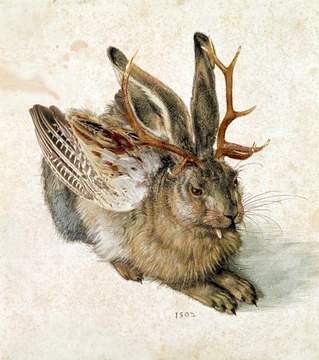
Huoshu
A fire-dwelling beast whose hair yields incombustible cloth.

The huoshu (火鼠), meaning "fire rat" or "fire mouse," is a fantastical beast in Chinese tradition said to dwell inside fire within incombustible trees growing in mountains in southern China. Cloth woven from its hair is described as becoming clean when burnt, equated with "fire-laundered cloth" (huo huan bu), which in reality was a type of asbestos cloth. The creature appears in various classical Chinese texts, with differing accounts of its size, weight, and location, and is also referenced in early Japanese literature, notably in The Tale of the Bamboo Cutter and the Genji Monogatari.
- Type
- Fantastical beast
- Tradition
- Chinese
- First attested in
- Shenyi Jing (purported Han period)
- Also known as
- Huo guang shou (fire light beast); in Japanese: kaso, hinezumi, hi no nezumi
- Associated with
- Fire-laundered cloth (asbestos cloth)
- Habitat
- Fire within incombustible trees in southern China; also volcanic islands and Western Regions
Lore & Background
According to the Shenyi Jing, the "Fire Mountains" in the south measure 40 li in length, where unincineratable trees burn day and night, unaffected by wind or rain. Within such fire dwells a mouse weighing 100 jin (var. 1000 jin), with fine white hair 2 chi long. It dies if water is poured on it, and its hair woven into cloth becomes clean when burnt. The Soushen ji identifies these mountains with the "Mountain of Flame" of mythic Kunlun. The Shizhou ji describes a rat-like "fire light beast" with hairs 3 or 4 cun long, from Yan zhou. Ge Hong's Baopuzi places a white rat on "Xiao Hill" in the South China Sea, where volcanic activity occurs seasonally, yielding three types of fireproof cloth. The Wu li records the fire rat in Rinan commandery (present-day Vietnam). The Sui shu xiyu chuan notes that during Emperor Yang of Sui's reign, Shi Guo (Kesh, modern Shahrisabz, Uzbekistan) sent fire-laundered cloth (火浣布) as tribute, not specifically fire rat fur.
Reader's Guide
The huoshu is significant as a cross-cultural symbol linking Chinese, Japanese, and Western lore about fireproof materials. In Chinese tradition, it explains the origin of "fire-laundered cloth," later understood as asbestos. The creature appears in Japanese classics such as The Tale of the Bamboo Cutter, where a suitor must obtain its pelt-robe, and in the Genji Monogatari. Scholars have drawn parallels with the European salamander, which also became associated with asbestos cloth, though the timing and direction of transmission remain debated. The huoshu's varying descriptions—from a massive 1000-jin beast to a small rat—illustrate the blend of myth and early natural history. Li Shizhen, in the Bencao Gangmu, categorized the "ashless wood" as mineral asbestos, while noting that fire rat fur, tree barks, and grasses could all be woven into fire-laundered cloth. The creature thus represents an early attempt to explain a real mineral phenomenon through fantastical zoology.
Did You Know?
- The huoshu is said to die if water is poured on it.
- In one account, the fire rat weighed 1000 catties (about 250 kg).
- The creature appears in The Tale of the Bamboo Cutter, where a suitor must bring its pelt-robe.
- Li Shizhen categorized the 'ashless wood' as a mineral (asbestos) in the Bencao Gangmu.
Mythological Origins Across Classical Texts
The fire rat appears across a remarkable constellation of Chinese classical sources, each contributing its own particular detail. The Shenyi Jing, attributed to the Han period, offers the most vivid rendering: in the southern Fire Mountains, stretching forty li, trees burn ceaselessly without being consumed by wind or rain. Within that perpetual flame dwells a mouse weighing one hundred or a thousand catties, its coat a fine white silk two chi long. Water, paradoxically, is its undoing. The Soushen ji later identifies these mountains with the Mountain of Flame atop mythic Kunlun. Ge Hong's Baopuzi relocates the creature to a thousand-li-square volcanic hill in the Nanhai that ignites each spring and dies each autumn, where the white rat's hair, along with the hill's flowers and bark, yields three varieties of fireproof fabric. The Shizhou ji offers a more modest portrait: a rat-sized fire light beast with three-to-four-cun hair in the island-province of Yan zhou. The Wu li places the creature in the Rinan commandery of present-day Vietnam, while the Sui shu xiyu chuan records Sogdian envoys bringing fire rat fur from Kesh during Emperor Yang's reign.
The Fire-Laundered Cloth and Its Material Reality
The huoshu's most celebrated attribute is its hair, which, when woven into cloth, becomes clean when subjected to fire. This fabric is known as huo huan bu, or fire-laundered cloth, and scholars widely identify it with what we now recognize as asbestos cloth. Li Shizhen, compiling his pharmaceutical encyclopedia Bencao Gangmu, noted that the beast was said to occur in both the Western Region and the Fire Province of the Nanhai, a corridor of volcanic islands in Southeast Asia. He further observed that in regions where wildfires persisted from spring through summer, it was not merely the rat's fur but also the barks, tree skins, and grasses that could be woven into fire-washed textiles. Notably, Li classified ashless wood as a mineral, specifically asbestos, under the stones section of his work. The weight figures in the older texts, ranging from several catties to a staggering thousand, roughly two hundred fifty kilograms, are likely rhetorical exaggerations rather than literal measurements.
The Fire Rat in Japanese Literature
In Japanese literary tradition, the creature, pronounced kaso, hinezumi, or hi no nezumi, occupies a position of particular significance. The mid-tenth-century Wamyō Ruijushō records the reading hinezumi and explicitly quotes the Shenyi Jing. In The Tale of the Bamboo Cutter, the historical figure Abe no Miushi appears as one of Princess Kaguya's suitors and is assigned the seemingly impossible task of producing the hinezumi no kawagoromo, a pelt robe made from the fire rat's hide. Tanaka Ōhide's commentary equates this item with the fire-laundered cloth of Chinese literature, citing the Shenyi Jing, the Wei zhi, and the Shui Jing Zhu. The Genji Monogatari, in its seventeenth chapter E-awase, features a picture scroll depicting this very episode. A Muromachi-period commentary called the Kakaishō discusses the fire rat with reference to both the Shenyi Jing and the Shizhou ji. One striking distinction: the Japanese tale specifies a fur pelt, whereas the Chinese accounts describe woven cloth, and the fur Abe supposedly obtained was golden-blue rather than the white of Chinese descriptions.
Cross-Cultural Parallels and Geographic Reach
The fire rat has drawn comparisons to the European salamander, whose lore stretches back to Greco-Roman antiquity. Pliny the Elder, writing before 79 AD, described asbestos as a form of linen or plant fiber and made no connection to animal hair. The Western idea that salamanders yielded asbestos emerged considerably later, surfacing for instance in a thirteenth-century alchemical text. The sinologist Berthold Laufer argued, however, that the salamander-asbestos link was already present in Greek and Roman thought. Geographically, the huoshu's attestations span an extraordinary range: from the southern Chinese mountains, through the Rinan commandery in present-day Vietnam, to the volcanic islands of the Nanhai, and as far west as the Sogdian city-state of Kesh in modern Uzbekistan. Li Shizhen's Fire Province of the Western Region may correspond to the Uyghur state of Qocho near Turfan, a locale that coincides with Henry Yule's identification of the site where Marco Polo reportedly witnessed an asbestos mine.
Frequently Asked Questions
What is the Huoshu?
The Huoshu, literally meaning "fire rat" or "fire mouse," is a mythical beast from Chinese folklore said to live inside flames within fireproof trees. It is also known by the alternate name Huo guang shou, or "fire light beast."
What makes the Huoshu's hair special?
The creature's fur can be woven into a fabric that paradoxically becomes cleaner the more it is burned. This striking property is what links the Huoshu to the classical concept of "fire-laundered cloth" in Chinese writing.
Where does the Huoshu live?
Classical sources place it inside the fire that burns within incombustible trees in the mountains of southern China. Some accounts extend its range further, mentioning volcanic islands and the Western Regions as additional habitats.
How does the Huoshu connect to asbestos cloth?
The "fire-laundered cloth" (huo huan bu) attributed to the Huoshu's hair is widely understood by scholars to be an early literary description of asbestos fabric, which naturally resists burning. The legend essentially personifies the strange heat-resistant property of that mineral fiber as a living creature.
In which literary works does the Huoshu appear?
The beast is first attested in the Shenyi Jing, a text purported to date from the Han dynasty. It also surfaces in early Japanese literature, including The Tale of the Bamboo Cutter and The Tale of Genji, where it goes by names such as kaso or hi no nezumi.
More in Legendary mammals 1-22
Spotted an error? Know more?
Reader corrections go straight into our review queue. Suggest an edit · How this site is sourced