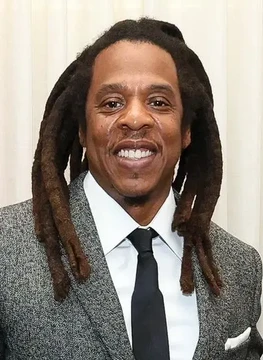
Izzo (H.O.V.A.)
A disco-fueled roll call that turned a simple list into a cultural landmark.

"Izzo (H.O.V.A.)" is the lead single from Jay-Z's 2001 album *The Blueprint 2: The Ghetto Report*, produced by Timbaland. The result is a song that feels less like a verse-and-chorus structure and more like a ceremonial procession, each name landing like a gavel strike over the four-on-the-floor kick. The track became a cultural phenomenon and a defining moment in early-2000s hip-hop, cementing the "H.O.V.A." brand (Hustlers of the Verse Association) as shorthand for Jay-Z's era of dominance. It topped the Billboard Hot 100 and remains one of the most instantly recognizable rap anthems of the 2000s, a song that turned a simple list into a landmark of hip-hop bravado.
Quick Facts
- Artist
- Jay-Z
- Album
- The Blueprint
- Released
- June 19, 2001
- Recorded
- May 2001
- Studio
- Baseline Studios (New York City)
- Genre
- East Coast hip-hop / chipmunk soul / pop-rap
- Label
- Roc-A-Fella / Def Jam
- Writer
- Shawn Carter / Kanye West / Berry Gordy / Alphonso Mizell / Freddie Perren / Deke Richards
- Producer
- Kanye West
- Prev Title
- Fiesta (Remix)
- Prev Year
- 2001
- Next Title
- Girls, Girls, Girls
Facts from the source article.
Lore & Background
In the competitive landscape of early-2000s hip-hop, where artists jockeyed for cultural supremacy through diss tracks, beefs, and elaborate storytelling, Jay-Z chose a different weapon for his second Blueprint. Rather than a narrative or a battle rap, "Izzo (H.O.V.A.)" is essentially a manifest: a confident, almost liturgical enumeration of conquests delivered over a beat that sways like a slow disco floor. The production, handled by Timbaland, is deliberately sparse and repetitive, letting the groove do the heavy lifting while Jay-Z's cadence locks into a metronomic pocket. The effect is hypnotic; the listener is pulled forward by the bounce before they even register what is being said. The H.O.V.A. acronym, introduced here as both title and identity, became far more than a song hook. It evolved into a lifestyle brand, a community identifier, and a shorthand for the particular brand of hip-hop authority Jay-Z projected during the Blueprint era. Fans adopted it the way earlier generations adopted "N.W.A." or "Wu-Tang"—as a banner, a badge, a declaration of allegiance to a specific sound and attitude. Culturally, the song sits at a crossroads between the sample-heavy, groove-driven hip-hop of the late '90s and the more polished, pop-adjacent direction the genre would take in the mid-2000s. Its disco-funk foundation, its list-based structure, and its unapologetic self-promotion made it feel simultaneously timeless and of-the-moment, a quality that has kept it in heavy rotation for over two decades.
Reader's Guide
This repetition is the engine. Jay-Z's delivery locks into the groove like a metronome, each syllable landing on or just ahead of the beat, creating a forward momentum that never breaks. The central conceit is the list. Rather than traditional verse-chorus-bridge construction, the track is structured as a rolling catalog, each entry a short phrase that names a person and a brief descriptor. The rhythm of the list mimics a drum fill: short, punchy, escalating. The H.O.V.A. acronym functions as both the song's title and its recurring hook, a three-syllable stamp that punctuates the flow and reinforces the brand identity. The wordplay operates on multiple levels: the H.O.V.A. acronym doubles as a playful echo of "H.O.V.A." sounding like a casual exclamation, and the list format itself becomes a flex—turning what could be a simple enumeration into a performance of confidence. The production's minimalism forces the listener's attention entirely onto the cadence and the content, making the delivery itself the spectacle. It appears as the lead single and the album's most recognizable track, setting the tone for the entire Blueprint 2 project.
Did You Know?
- The H.O.V.A. acronym, introduced as the song's title, grew into a full lifestyle and fashion brand, extending the song's identity well beyond the music.
- Timbaland's production relies on a single looping sample with minimal variation, making the song's impact almost entirely dependent on Jay-Z's rhythmic delivery and the groove's hypnotic bounce.
More in Songs & Singles
Elsewhere in Jay-Z
Spotted an error? Know more?
Reader corrections go straight into our review queue. Suggest an edit · How this site is sourced