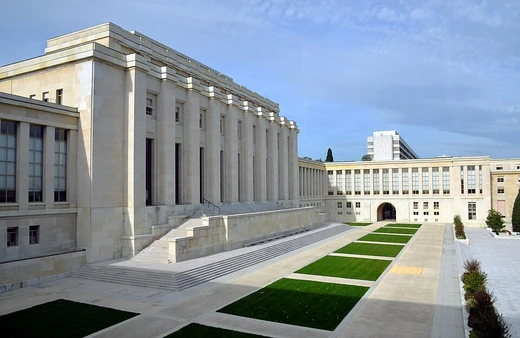
International Organization for Migration
UN agency coordinating humane and orderly migration worldwide.
The International Organization for Migration (IOM) is a Geneva-based UN agency focused on migration. Its director general is Amy Pope. The organization runs operational assistance programs for migrants, including internally displaced persons, refugees, and migrant workers.
IOM was created in 1951 to address the large numbers of displaced people and war refugees in Europe after World War II. It began as a logistics agency, moving nearly a million migrants in the 1950s. Over time, it changed names several times: from the Provisional Intergovernmental Committee for the Movement of Migrants from Europe (PICMME) in 1951, to the Intergovernmental Committee for European Migration (ICEM) in 1952, to the Intergovernmental Committee for Migration (ICM) in 1980, and finally to the International Organization for Migration (IOM) in 1989. These changes reflect how its mission grew, making it the top intergovernmental body on migration. Historians note that ICEM’s early work also clashed with existing private migration networks. Before the 1950s, private travel agencies and transport brokers handled most European migration, offering document help, medical arrangements, and passage booking. ICEM’s subsidized transport and direct migrant processing challenged these private actors, creating tensions over authority, pricing, and control in what scholars call the post-war migration industry. Eventually, this competition led to mixed arrangements, with ICEM using commercial carriers and agencies adapting to new rules.
In 1992, IOM gained observer status at the UN General Assembly. In September 2016, UN member states unanimously approved an agreement making IOM an affiliated UN organization, strengthening its ties and ability to serve migrants and member states. IOM helped create the Global Compact for Migration, the first international migration agreement, adopted in Marrakesh, Morocco, in December 2018. To support that compact, UN Secretary-General António Guterres set up the UN Network on Migration in 2019, which IOM coordinates, including agencies like UNHCR, WFP, and UNDP.
Quick Facts
- Formation
- 6 December 1951
- Headquarters
- Geneva, Switzerland
- Leader
- Amy Pope
- Budget
- US$3.7 billion (2024)
- Membership
- 174 member states and 8 observer states
- Num members year
- 2026
- Languages
- English, French and Spanish
- Num staff
- 22,351
Facts from the source article.
Lore & Background
The IOM was founded in 1951 as the Provisional Intergovernmental Committee for the Movement of Migrants from Europe (PICMME) in response to the large number of internally displaced persons and war refugees in Europe after the Second World War. It initially organized the transport of nearly one million migrants in the 1950s. The organization underwent several name changes: to the Intergovernmental Committee for European Migration (ICEM) in 1952, to the Intergovernmental Committee for Migration (ICM) in 1980, and finally to the International Organization for Migration (IOM) in 1989, reflecting its expanding mandate. Recent scholarship has emphasized that ICEM's early operations disrupted existing commercial migration networks. Prior to the 1950s, migration from Europe was largely facilitated by private travel agencies and transport brokers who provided document assistance, medical arrangements, and passage booking. Human Rights Watch criticized the IOM in a 2004 report for its involvement in Australia's 'Pacific Solution,' including operations at the Manus Regional Processing Centre (established in 2001) and the processing centre on Nauru.
Reader's Guide
The International Organization for Migration is significant as the leading intergovernmental organization in the field of migration, with a broad mandate that includes assistance to migrant workers, refugees, and internally displaced persons. Its evolution from a European-focused logistics agency to a global UN-affiliated organization reflects the growing international recognition that humane and orderly migration benefits migrants and society. The IOM has been praised for flexibility in crisis situations, responding to disasters such as the 2003 invasion of Iraq, the 2010 Haiti earthquake, and the European migrant crisis. However, it has also faced criticism for legal accountability in protection issues. Notably, in 2003, Amnesty International and Human Rights Watch criticized the IOM's role in Australia's 'Pacific Solution,' operating detention centres on Manus Island and Nauru without a refugee protection mandate. In 2022, the Refugee Council of Australia described IOM-operated housing in Indonesia as presenting a 'humanitarian veneer while carrying out rights-violating activities.' In 2024, the IOM was criticized for being unable or willing to intervene in refugee cases involving Uyghurs. Despite these controversies, the IOM remains a central actor in humanitarian aid within the UN system, coordinating camp management and shelter clusters, and its credo that orderly migration benefits all has steadily gained acceptance.
Did You Know?
- The IOM's budget in 2024 was around 3.7 billion US dollars, made up of voluntary contributions from member states and donations.
- The IOM coordinates the United Nations Network on Migration, which includes UNHCR, WFP, and UNDP.
More in International Organizations And Agreements
Spotted an error? Know more?
Reader corrections go straight into our review queue. Suggest an edit · How this site is sourced