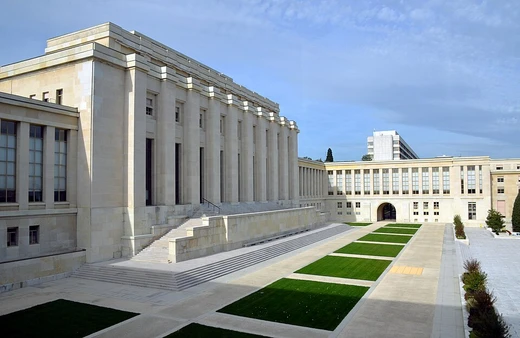
International Criminal Court
Permanent international court for genocide, war crimes, and aggression.
As of January 2025, there are 125 ICC member states.[1] The Rome Statute, a multilateral treaty, came into force on 1 July 2002, which marked the start of the ICC's operations.[1]
Quick Facts
- Membership
- 125 (Oct 2024)
- Languages
- English, French
Facts from the source article.
Key facts and history
In 1948, the UN General Assembly recognized the need for a permanent court, but Cold War tensions shelved the effort.[2] In June 1989, Trinidad and Tobago's A. N. R. Robinson revived the proposal to address the illegal drug trade.[3] The 2010 Kampala Review Conference amended the Statute to define the crime of aggression and criminalize certain weapons in non-international conflicts.[4][5] During the 1919 Paris Peace Conference, the Commission of Responsibilities first proposed establishing an international tribunal to judge political leaders for international crimes.[6]
After World War II, the allied powers set up two ad hoc tribunals: the International Military Tribunal at Nuremberg prosecuted German leaders, and the International Military Tribunal for the Far East in Tokyo prosecuted Japanese leaders.[2] The Rome Statute was adopted on 17 July 1998, with 120 countries voting in favor, 7 against, and 21 abstaining.[7] The Assembly of States Parties, composed of states that are party to the Rome Statute, governs the ICC by electing officials and approving the budget.[8]
What the cited sources add
The ICC's website notes that the State of Palestine became the thirtieth state to ratify the Kampala amendments on the crime of aggression on 29 June 2016.[9] The Open Library record for ISBN 9780415722391 lists a 2014 book titled "Justice for Victims Before the International Criminal Court", published by Taylor & Francis Group, with 320 pages.[10] The Open Library record for ISBN 9781571052094 lists a 2001 book titled "The International Criminal Court", published by Transnational Publishers, with 857 pages.[11] The Open Library record for ISBN 9780521873123 lists a 2008 book titled "Building the International Criminal Court", published by Cambridge University Press.[12]
References
- Wikipedia, "International Criminal Court" (CC BY-SA 4.0), which cites: "Rome Statute of the International Criminal Court", United Nations Treaty Collection, 2024-10-26 (original not read by us) en.wikipedia.org
- Wikipedia, "International Criminal Court" (CC BY-SA 4.0), which cites: Fichtelberg, "Fair Trials and International Courts: A Critical Evaluation of the Nuremberg Legacy", Criminal Justice Ethics, 2009, p. 5–24; "The International Criminal Court", United Nations Department of Public Information, December 2002; Dempsey, "Reasonable Doubt: The Case Against the Proposed International Criminal Court", Cato Institute, 16 July 1998 (original not read by us) en.wikipedia.org
- Wikipedia, "International Criminal Court" (CC BY-SA 4.0), which cites: Dempsey, "Reasonable Doubt: The Case Against the Proposed International Criminal Court", Cato Institute, 16 July 1998; "Election of Mr. Arthur N.R. Robinson to the Board of Directors of the Victims Trust Fund", International Criminal Court, 20 June 2006; "History of the ICC", Coalition for the International Criminal Court; Ba, "States of Justice: The Politics of the International Criminal Court", Cambridge University Press, 2020 (original not read by us) en.wikipedia.org
- Wikipedia, "International Criminal Court" (CC BY-SA 4.0), which cites: "United Nations Treaty Collection", United Nations (original not read by us) en.wikipedia.org
- Wikipedia, "International Criminal Court" (CC BY-SA 4.0), which cites: "Kampala Amendments", Parliamentarians for Global Action – Mobilizing Legislators as Champions for Human Rights, Democracy and Peace; "Uganda to host Rome Statute Review Conference", The Hague Justice Portal (original not read by us) en.wikipedia.org
- Wikipedia, "International Criminal Court" (CC BY-SA 4.0), which cites: "Commission on the Responsibility of the Authors of the War and on Enforcement of Penalties", American Journal of International Law, January 1920, p. 95–154; Schabas, "An Introduction to the International Criminal Court", Cambridge University Press, 2011-02-17; Archibugi, "Crime and global justice: the dynamics of international punishment", Polity press, 2018; Galicki, "International Law and Terrorism", American Behavioral Scientist, 2016, p. 743–757 (original not read by us) en.wikipedia.org
- Wikipedia, "International Criminal Court" (CC BY-SA 4.0), which cites: Scharf, "Results of the Rome Conference for an International Criminal Court", American Society of International Law, August 1998 (original not read by us) en.wikipedia.org
- Wikipedia, "International Criminal Court" (CC BY-SA 4.0), which cites: "Assembly of States Parties", International Criminal Court (original not read by us) en.wikipedia.org
- "Crime of Aggression – Amendments Ratification", asp.icc-cpi.int. facts only, no text reused. asp.icc-cpi.int
- Open Library record, ISBN 9780415722391 ("Justice for Victims Before the International Criminal Court"). CC0 (metadata); book content not read. openlibrary.org
- Open Library record, ISBN 9781571052094 ("The International Criminal Court"). CC0 (metadata); book content not read. openlibrary.org
- Open Library record, ISBN 9780521873123 ("Building the International Criminal Court"). CC0 (metadata); book content not read. openlibrary.org
Each numbered sentence above was checked against the source it cites before publication. Sentences citing Wikipedia adapt text from the English Wikipedia article International Criminal Court (contributors), used under CC BY-SA 4.0; this entry is available under the same licence. Other sources were used for facts only; no text or images are copied from them.
More in International Organizations And Agreements
Spotted an error? Know more?
Reader corrections go straight into our review queue. Suggest an edit · How this site is sourced