Hydrogen selenide
The most toxic selenium compound, a colorless flammable gas with a pungent odor.

Wikimedia Commons · Public domain
Hydrogen selenide (H₂Se) is an inorganic compound and the simplest hydride of selenium. Under standard conditions, it is a colorless, flammable gas. It is the most toxic selenium compound, with an 8-hour exposure limit of just 0.05 ppm. At very low concentrations, it has a sharp, irritating odor often compared to decayed horseradish or a gas leak; at higher concentrations, it smells like rotten eggs.
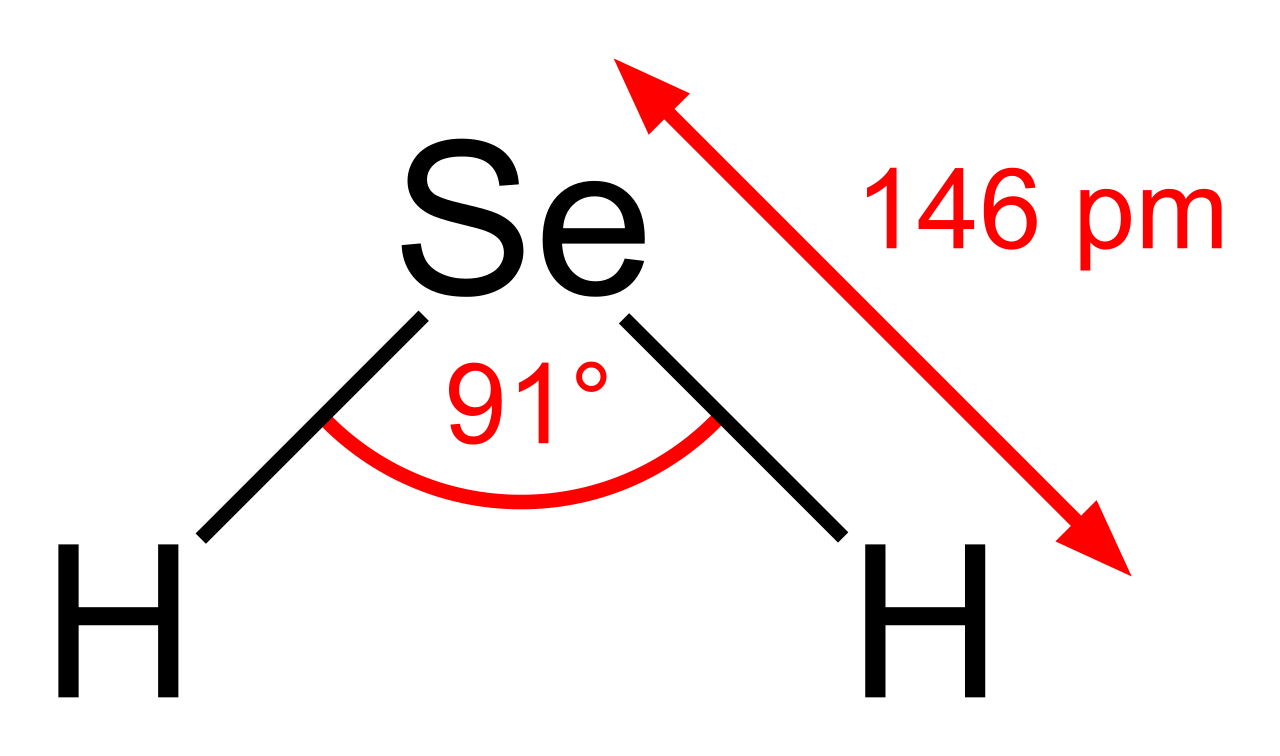
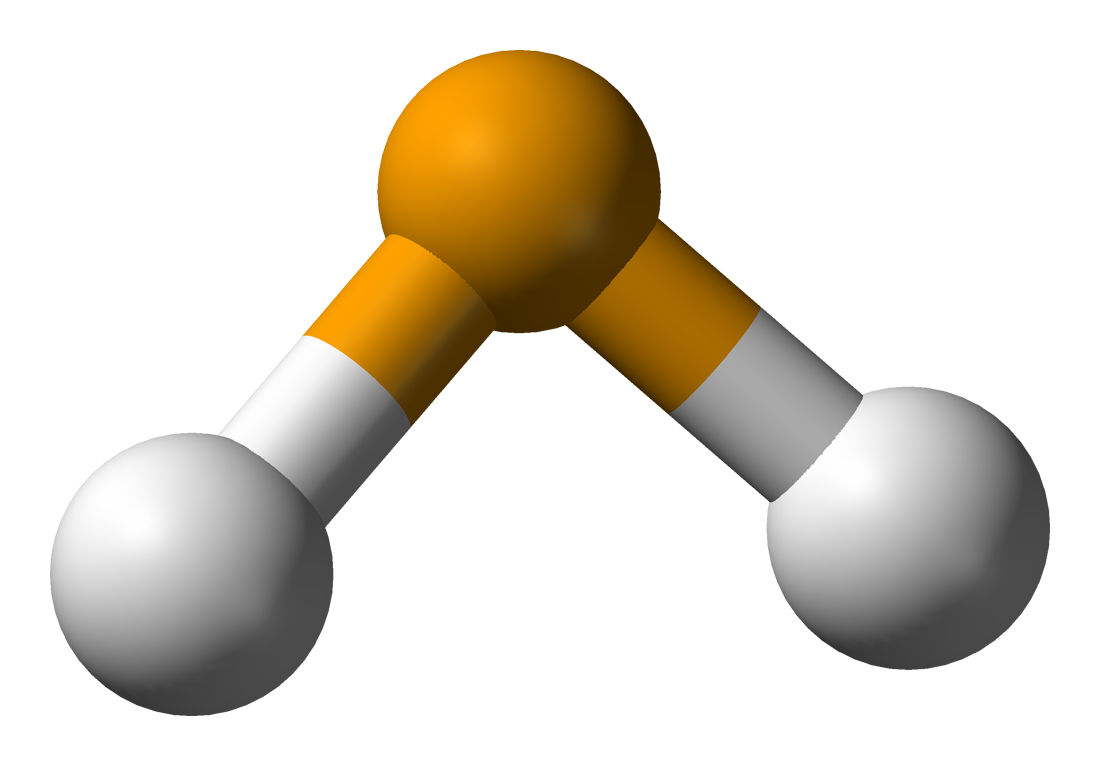
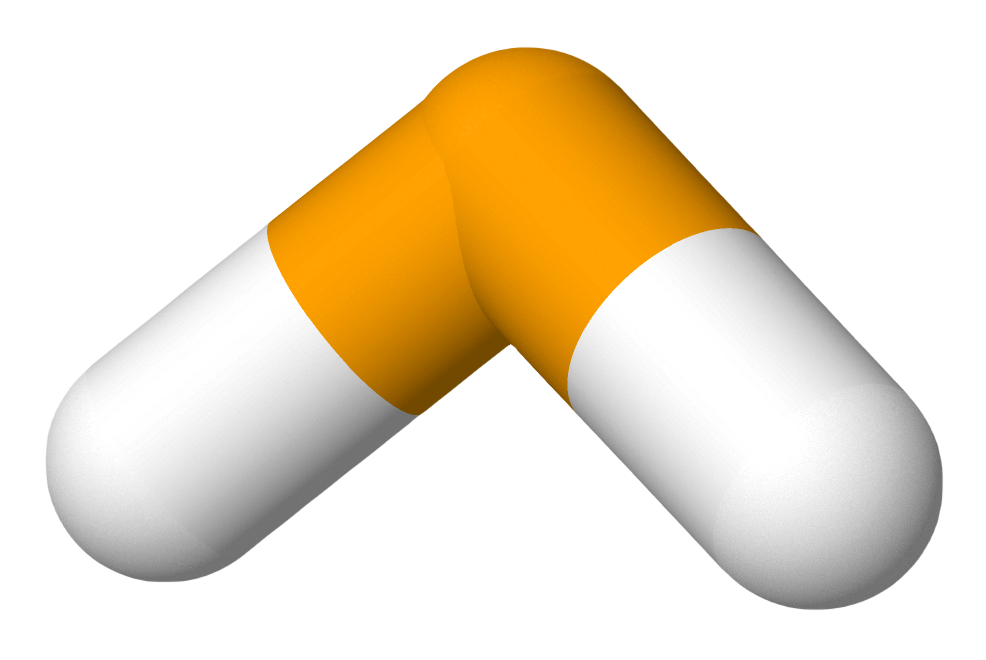
The molecule has a bent shape, with a H−Se−H bond angle of 91°. Three infrared-active vibrational bands appear at 2358, 2345, and 1034 cm⁻¹. H₂Se is similar to hydrogen sulfide (H₂S) but is more acidic, with a first pKa of 3.89 and a second pKa of 11 (or 15.05 ± 0.02 at 25 °C).
Industrially, H₂Se is made by reacting elemental selenium with hydrogen gas above 300 °C. In the lab, it is often prepared by adding water to aluminum selenide (Al₂Se₃), which also forms hydrated alumina: Al₂Se₃ + 6 H₂O ⇌ 2 Al(OH)₃ + 3 H₂Se. Another method involves acid hydrolysis of iron selenide (FeSe). It can also be generated in aqueous solution using boron hydride, the Marsh test, or Devarda’s alloy. The Sonoda method produces H₂Se from water, carbon monoxide, and selenium in the presence of triethylamine. H₂Se is also available in compressed gas cylinders.
Elemental selenium can be recovered from H₂Se by reacting it with aqueous sulfur dioxide: 2 H₂Se + SO₂ ⇌ 2 H₂O + 2 Se + S. This decomposition is used to produce highly pure selenium.
H₂Se is commonly used to synthesize selenium-containing compounds, such as adding across alkenes or reacting with cyanamides to form selenoureas. It is also used to dope semiconductors with selenium.
Hydrogen selenide is extremely hazardous—far more toxic than hydrogen sulfide. The threshold limit value is 0.05 ppm. At concentrations above 0.3 ppm, it acts as an irritant, but this warning is insufficient below 1 ppm; at 1.5 ppm, the irritation becomes intolerable. High concentrations, even for under a minute, attack the eyes and mucous membranes, causing cold-like symptoms for days afterward. In Germany, the drinking water limit is 0.008 mg/L, while the US EPA recommends a maximum of 0.01 mg/L. Despite its high toxicity, no human fatalities have been reported, likely because the gas oxidizes in mucous membranes to form less toxic red selenium.
Quick Facts
- Formula
- H2Se
- Appearance
- Colorless gas
- Toxicity
- Most toxic selenium compound; threshold limit value 0.05 ppm
- Pka
- 3.89 (first), 11 or 15.05 ± 0.02 (second) at 25 °C
Facts from the source article.
Lore & Background
H2Se adopts a bent structure with a H−Se−H bond angle of 91°. Consistent with this structure, three IR-active vibrational bands are observed: 2358, 2345, and 1034 cm−1. The properties of H2S and H2Se are similar, although the selenide is more acidic with pKa = 3.89 and the second pKa = 11, or 15.05 ± 0.02 at 25 °C.
Molecular Architecture and Sensory Signature
Hydrogen selenide, with its formula H2Se, stands as the simplest and most frequently encountered hydride of selenium in the hydrogen chalcogenide family. Under standard conditions it exists as a colorless, flammable gas, yet its molecular geometry is anything but symmetrical: the H−Se−H bond angle measures just 91°, giving the molecule a distinctly bent shape. This bent configuration is confirmed spectroscopically by three infrared-active vibrational bands observed at 2358, 2345, and 1034 cm⁻¹. Chemically, H2Se behaves as a stronger acid than its sulfur analogue H2S, with a first dissociation constant of pKa 3.89 and a second pKa reported as either 11 or 15.05 ± 0.02 at 25 °C. Perhaps the most immediately noticeable trait, however, is its odor. At trace levels the gas carries a pungent, irritating smell that has been compared to decayed horseradish or the scent of a leaking gas line; as concentration rises, the odor shifts toward that of rotten eggs.
Synthetic Pathways from Industry to Bench
The production of H2Se spans a wide range of conditions, from high-temperature industrial processes to delicate bench-scale reactions. On an industrial scale, elemental selenium is exposed to hydrogen gas at temperatures exceeding 300 °C, yielding the selenide directly. In the laboratory, the most classical route involves adding water to aluminium selenide (Al2Se3), which simultaneously generates hydrated alumina and releases H2Se gas. A closely related approach uses acid hydrolysis of iron selenide (FeSe). Beyond these, several in-situ aqueous methods have been developed, including those employing boron hydride, the Marsh test, and Devarda's alloy. The Sonoda method offers another pathway, generating H2Se from water and carbon monoxide acting on selenium in the presence of triethylamine. For practical purposes, the compound is also available commercially in pressurized cylinders, making it accessible for both large-scale and small-scale work without the need for on-site generation.
A Lethal Profile with a Curious Exception
Hydrogen selenide holds the distinction of being the most toxic selenium compound known, and it is substantially more dangerous than its congener hydrogen sulfide. Regulatory bodies set the occupational exposure limit at a mere 0.05 ppm averaged over an eight-hour shift. The gas begins acting as a respiratory irritant above 0.3 ppm, yet below 1 ppm this irritation is judged insufficient to prevent exposure, while at 1.5 ppm it becomes intolerable. At high concentrations, even a single minute of contact can assault the eyes and mucous membranes, leaving the victim with cold-like symptoms persisting for several days. Drinking-water standards reflect the danger: Germany caps selenium contamination at 0.008 mg/L, and the US EPA recommends a maximum of 0.01 mg/L. Remarkably, despite this extreme toxicity, no confirmed human fatality has been attributed to H2Se. The leading hypothesis is that the gas rapidly oxidizes upon contact with mucous membranes, depositing red elemental selenium, which is considerably less toxic than the selenide form.
Reactivity, Doping, and Elemental Recovery
Beyond its hazards, H2Se serves as a versatile reagent in selenium chemistry. It is routinely employed in the synthesis of selenium-containing organic compounds and can add across carbon–carbon double bonds in alkenes. A notable example is the preparation of selenoureas from cyanamides, where the selenide gas acts as the selenium source. In materials science, H2Se gas is used to dope semiconductors with selenium, introducing the element into crystalline lattices for electronic applications. The compound also plays a role in selenium recovery: when bubbled through aqueous sulfur dioxide, H2Se is oxidized while SO2 is reduced, yielding elemental selenium and sulfur alongside water. This reversible reaction, together with simple thermal decomposition, provides a route to highly pure elemental selenium, making the selenide both a starting material and a purification vehicle in the selenium production chain.
Gallery

More in Inorganic Compounds & Materials
Spotted an error? Know more?
Reader corrections go straight into our review queue. Suggest an edit · How this site is sourced