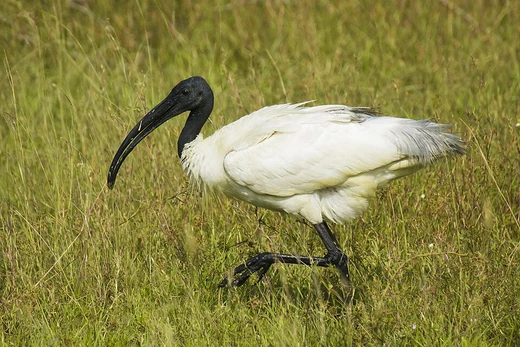
Hadada ibis
Last updated
The hadada ibis (Bostrychia hagedash) is a medium-sized ibis native to Sub-Saharan Africa, named for its loud three to four note calls uttered in flight, especially at dawn and dusk. It is notable for its close proximity to human settlements, foraging in cultivated land and gardens, and for its iridescent green or purple wing coverts. Though non-migratory, it makes nomadic movements in response to rain, particularly during droughts.
Scientific classification
- KingdomAnimalia
- PhylumChordata
- ClassAves
- OrderPelecaniformes
- FamilyThreskiornithidae
- GenusBostrychia
- SpeciesBostrychia hagedash
Named by (Latham, 1790)
Close relatives
Other species of Bostrychia with a Codexery entry.
- Wattled ibis Bostrychia carunculata
- Olive ibis Bostrychia olivacea
- Spot-breasted ibis Bostrychia rara
- São Tomé ibis Bostrychia bocagei
Sources: Wikipedia taxobox: Hadada ibis (CC BY-SA 4.0) · differs from this box at order: WoRMS AphiaID 212672 (CC BY 4.0)
Conservation status
Least Concern (LC)
- LC▲ this species
- NT
- VU
- EN
- CR
- EW
- EX
Source: IUCN Red List assessment · GBIF copy of the Red List category
How big is it?
Largest length in the source, 0.76 m, next to a 1.8 m person.
Diagram: drawn by Codexery, schematic shapes to scale (not a likeness). Length: Wikipedia: Hadada ibis
Where the hadada ibis has been recorded
Each dot is a place where the species has been observed and reported (663,939 records, half-degree grid) — not a modelled range. 208 inland records left out (institution coordinates). 1 isolated far-off record not drawn.
Map: drawn by Codexery. Data: GBIF occurrence search (records CC0 / CC BY) · Natural Earth basemap (public domain) · place coordinates: Wikipedia (CC BY-SA 4.0)
Taxonomy, systematics and etymology
John Latham proposed the scientific name Tantalus hagedash in 1790, based on a specimen collected at "Houteniquas" north of Mossel Bay by Anders Sparrman, who noted the colonists called it onomatopoeically "hagedash" and "hadelde". The species was later placed in the monotypic genus Hagedashia and subsequently in Bostrychia.
Three subspecies are recognized: the nominate form south of the Zambezi river is paler and shorter-billed; B. h. nilotica, found north of the Zambezi and east to Uganda, Tanzania, Sudan and Ethiopia, is larger and longer-billed; and B. h. brevirostris, from Senegal to Congo and Kenya, is darker brown with more brightly glossed plumage. Intermediate plumages occur, and other subspecies such as erlangeri and guineensis have been proposed. The name "hadeda" (with an e) appears in some South African works, including the Roberts VII Names Database.
Description
The hadada is a large, grey-to-partly brown ibis about 76 cm long, with a mean adult body mass of 1.2 kg. Males and females share the same plumage. A narrow white stripe across the cheeks, sometimes called a "moustache", does not reach the mouth corners. The wing coverts show an iridescent purple sheen from optical microstructures.
The legs are blackish, and the large bill is grey to black, but during breeding the basal half of the upper mandible's culmen becomes red, as do the upper surfaces of the toes. The wings are powerful and broad, enabling quick take-offs and manoeuvring through dense tree cover. Its extremely loud, distinctive "haa-haa-haa-de-dah" call is onomatopoeic, heard in flight or when startled; a single loud "haaaa" is given while roosting, and a low growl like a young puppy serves as a contact call when foraging.
Behaviour and ecology
Hadada ibises roost in groups in trees, flying out with loud calls in the mornings and returning in the evenings with regularity. They feed on insects, millipedes, earthworms, larger insects such as Parktown prawns, spiders, small lizards, and snails, using their long scimitar-like bill to probe soft soil. They are welcomed on bowling and golf greens for extracting moth and beetle larvae that damage grass roots. Like other ibises, spoonbills, sanderlings and kiwis, they have sensory pits around the bill tips that help locate unseen prey such as shallow subterranean larvae.
They have become common in many African cities, tolerate human closeness, and can judge human gaze direction and approach speed to decide escape strategies. They have been involved in bird strikes at airports in Kenya and South Africa. Monogamous, with pair bonds thought to persist year-round, they breed after the rains; in the Cape province breeding is mainly October to November. The nest is a platform of twigs in a large tree fork, and unlike most ibises they do not nest in groups.
Both parents incubate the clutch of three to four eggs for about 26 days, feeding the young by regurgitation. Many young die from falling off the nest; survivors fledge in about 33 days.
In culture
In parts of Lesotho, the calls of hadada ibises are considered a sign of impending rains. The Xhosa name ing'ang'ane or ingagane means black ibis, contrasting with the white sacred ibis. Many African languages use onomatopoeic names, such as Zililili in Chewa, Chinawa in Chiyao, Chihaha or Mwanawawa in Tumbuka, and Mwalala in Khonde. Colonial hunters regarded it as good eating.
The Bantu people of Uganda tell an origin story of a man and wife who starved themselves during a drought so their children could eat, and were turned into ibises called Mpabaana. In Zululand, the name ingqangqamathumba implies that mocking the bird causes abscesses; when the birds fly continually, they are said to foretell a rich harvest. The idiom "utahthisele amathole eng'ang'ane" (he has taken the hadada's nestlings) indicates offending a vindictive man.
Ernst Schüz examined bird depictions on bronze plaques and ceremonial staffs from Benin in German museums, finding them confusingly similar to the hadada but also prominently showing a wattle as in the wattled ibis.
More in Ibises
Test yourself
Three questions drawn from this entry’s sources. Pick an answer to check it.
Answers checked against the source article
Sources
Compiled from Wikipedia and the sources listed below. Text from Wikipedia is available under CC BY-SA 4.0; this entry is adapted from it.
- Wikipedia: Hadada ibis (CC BY-SA 4.0).
- Classification: the source article's taxobox; compare WoRMS, the World Register of Marine Species (CC BY 4.0).
- Conservation status: IUCN Red List assessment.
- Occurrence records: GBIF (CC0 / CC BY). Basemap: Natural Earth (public domain).
- Word definitions: the Codexery glossary, each quoted from its Wikipedia article.
Spotted an error? Know more?
Reader corrections go straight into our review queue. Suggest an edit · How this site is sourced