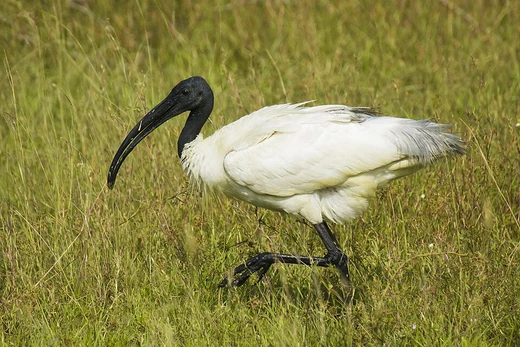
Olive ibis
Last updated
The olive ibis (Bostrychia olivacea) is a small ibis species inhabiting dense tropical forests of central Africa, measuring 65–75 cm in length. Its olive plumage displays an iridescent sheen, and four subspecies are recognized across its range.
Scientific classification
- KingdomAnimalia
- PhylumChordata
- ClassAves
- OrderPelecaniformes
- FamilyThreskiornithidae
- GenusBostrychia
- SpeciesBostrychia olivacea
Named by (Du Bus de Gisignies, 1838)
Close relatives
Other species of Bostrychia with a Codexery entry.
- Hadada ibis Bostrychia hagedash
- Spot-breasted ibis Bostrychia rara
- São Tomé ibis Bostrychia bocagei
- Wattled ibis Bostrychia carunculata
Sources: Wikipedia taxobox: Olive ibis (CC BY-SA 4.0)
Conservation status
Least Concern (LC)
- LC▲ this species
- NT
- VU
- EN
- CR
- EW
- EX
Source: IUCN Red List assessment · GBIF copy of the Red List category
How big is it?
Largest length in the source, 0.75 m, next to a 1.8 m person.
Diagram: drawn by Codexery, schematic shapes to scale (not a likeness). Length: Wikipedia: Olive ibis
Where the olive ibis has been recorded
Each dot is a place where the species has been observed and reported (891 records, half-degree grid) — not a modelled range. 50 inland records left out (institution coordinates).
Map: drawn by Codexery. Data: GBIF occurrence search (records CC0 / CC BY) · Natural Earth basemap (public domain) · place coordinates: Wikipedia (CC BY-SA 4.0)
Taxonomy and systematics
The olive ibis was once placed in the genera Geronticus, Comatibis, and Harpiprion, but now belongs to Bostrychia. It is closely related to the Madagascar crested ibis and the Geronticus ibises.
There are four recognized subspecies: Bostrychia olivacea olivacea, B. o. cupreipennis, B. o. akleyorum, and B. o. rothschildi. The dwarf olive ibis of São Tomé, Bostrychia bocagei, was once considered a subspecies but is now a separate species due to its much smaller size and different form. Geographic isolation, caused by wide grasslands or seas separating forest habitats, likely led to the development of these subspecies and the dwarf olive ibis.
Description
This relatively small ibis measures 65–75 cm in length, varying by subspecies. Recorded wing lengths range from 309–372 mm across subspecies, with the largest being akleyorum. Culmen lengths vary from 85–108 mm in males and 90–102 mm in females, though the number of available specimens is too small to confirm general size patterns. Adult plumage is dusky brown with green and bronze iridescence; the head and neck are brown with pale stripes under the eye.
The face around the orbital and loral regions is bluish black, the bill coral red, and the tail coverts and tail dark blue. The back and rump are dusky greenish bronze, while secondary flight feathers and wing coverts have a pinkish green tinge. Leg and foot colour is described as dull dark red, yellowish green, or pinkish brown, possibly varying with breeding stage. Subspecies differ slightly: olivacea has a warm brown tone; akleyorum has greener back and wing coverts; cupreipennis shows more green on neck and body; rothschildi has a purplish blue rump with olive reflections.
The olive ibis has a distinctive brown crest purple near the neck, distinguishing it from the hadada and spot-breasted ibises at close range. The purple is more extensive in rothschildi. The crest is not visible in flight due to the extended neck. The olive ibis and spot-breasted ibis are reportedly impossible to distinguish superficially in the field, but akleyorum appears heavier than the hadada ibis with a thicker neck.
Distribution and habitat
The olive ibis is patchily distributed in dense forests from West to East tropical Africa, occurring in Cameroon, the RCongo, DRCongo, Côte d'Ivoire, Gabon, Ghana, Kenya, Liberia, Nigeria, Sierra Leone, Tanzania, and the islands of Príncipe and São Tomé. It inhabits dense forests and has also been recorded in regenerating forest in Gabon and cliff holes. Subspecies occupy different regions: B. o. olivacea and B. o. cupreipennis occur in the west, with olivacea in Upper Guinea and cupreipennis in Lower Guinea and central Africa.
B. o. rothschildi lives on Príncipe and São Tomé. B. o. akleyorum inhabits montane forests of eastern Africa at altitudes of 1,800–12,000 m, found in eastern DRCongo, Mount Kenya, the Aberdares, Kilimanjaro, Mount Meru, and Mount Elgon, but is absent from lowland forests like Kakamega; its call was reportedly heard in the Bwamba lowlands of Uganda.
It is distinguished from the hadada ibis by elevation, as the latter occurs below 6,000 feet. The olive ibis may be the only resident African species inhabiting only lowland tropical forests in West Africa and only higher-altitude montane forests in the East. It is probably largely sedentary, though short migrations occur in Liberia during extremely dry weather.
Behaviour and ecology
The olive ibis feeds on insects such as beetles, grubs, and snails, as well as myriapods, forest floor vegetation, and snakes. It forages singly, in pairs, or in flocks of 5–12 individuals along fast-flowing water in densely forested areas, but also in mangroves, marshes, swamps, backwaters, and larger rivers. Observations from Kenya's Hagenia forests suggest it may preferentially forage on forest floor with little undergrowth. It roosts at night in tops of large dead trees such as silk-cotton, likely using the same trees daily, and follows the same routes between roosting and feeding grounds.
When landing, it approaches along the length of a branch and runs a short distance. It breeds solitarily; the first recorded breeding was in 1910 on Mount Kenya at 9,000 feet. Nests discovered in East Africa were adjacent to water, measuring 20–40 cm in diameter, situated 2–4 m above water, precariously balanced in slender branches, and loosely composed of dead branches. Both sexes silently construct the nest.
Only nests of akleyorum have been discovered, but others are probably similar. The only West African breeding record is from Liberia in June.
Did You Know?
- The olive ibis has reportedly never been kept in captivity, nor have live specimens been imported into Europe.
- The rothschildi subspecies was believed extinct on Príncipe in 1901 but was last sighted there in 1991; fewer than 10 wild individuals may remain.
- Non-living specimens are held in museums in Brussels, Paris, Philadelphia, Leyden, Lisbon, Nairobi, and the British Museum.
More in Ibises
Sources
Compiled from Wikipedia and the sources listed below. Text from Wikipedia is available under CC BY-SA 4.0; this entry is adapted from it.
- Wikipedia: Olive ibis (CC BY-SA 4.0).
- Conservation status: IUCN Red List assessment.
- Occurrence records: GBIF (CC0 / CC BY). Basemap: Natural Earth (public domain).
- Word definitions: the Codexery glossary, each quoted from its Wikipedia article.
Spotted an error? Know more?
Reader corrections go straight into our review queue. Suggest an edit · How this site is sourced