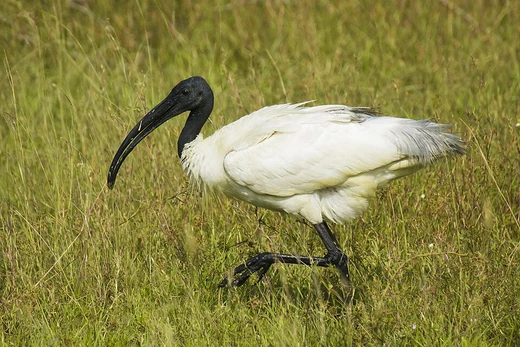
Malagasy sacred ibis
Last updated
The Malagasy sacred ibis is a large, stocky bird found only on Madagascar’s west coast and Aldabra. It looks very similar to the African sacred ibis but is now recognized as a distinct species due to clear differences in its ecology and body structure.
Scientific classification
- KingdomAnimalia
- PhylumChordata
- ClassAves
- OrderPelecaniformes
- FamilyThreskiornithidae
- GenusThreskiornis
- SpeciesThreskiornis bernieri
Named by (Bonaparte, 1855)
Close relatives
Other species of Threskiornis with a Codexery entry.
- Black-headed ibis Threskiornis melanocephalus
- Réunion ibis Threskiornis solitarius
- Straw-necked ibis Threskiornis spinicollis
Sources: Wikipedia taxobox: Malagasy sacred ibis (CC BY-SA 4.0)
Conservation status
Endangered (EN)
- LC
- NT
- VU
- EN▲ this species
- CR
- EW
- EX
Source: IUCN Red List assessment · GBIF copy of the Red List category
Where the malagasy sacred ibis has been recorded
Each dot is a place where the species has been observed and reported (585 records, half-degree grid) — not a modelled range. 19 inland records left out (institution coordinates).
Map: drawn by Codexery. Data: GBIF occurrence search (records CC0 / CC BY) · Natural Earth basemap (public domain)
Description
The adult stands 65–89 cm tall with a wingspan of 112–124 cm. Its plumage is predominantly white, often with brownish-yellow staining, and black ornamental plumes on the back with a blue or green gloss formed from the lower scapulars and tertials, most prominent in the breeding season. The bill, head, neck, and legs are black. This ibis is slightly smaller and more slender-billed than the African sacred ibis, lacks the black trailing edge to the wings, has bluish-slate tertials, differently structured ornamental neck sacs, less developed ornamental plumes, and a different display.
Both subspecies have a light blue or white iris, unlike the brown iris of the African sacred ibis. The juvenile resembles the adult but has a feathered black head and neck with white streaks, no ornamental plumes, and may show some black on the wing tips. It is generally non-vocal.
Distribution and habitat
The Malagasy sacred ibis is mostly found along Madagascar’s west coast, from Port-Berge to Moromoe, with a few on Aldabra. Its stronghold lies around Soalala, Sahamalaza Bay, and Baie de Baly, where dense breeding groups live in mangroves and estuaries.
This bird sticks to coastal mudflats, brackish lakes, and sandy beaches, rarely visiting freshwater wetlands. Over 80% of sightings occur within two kilometers of the shore, at elevations up to 191 meters. It is more habitat-specific than its African relative.
Ecology
The Malagasy sacred ibis feeds on crustaceans, diverse invertebrates, vegetable refuse, and occasionally frogs, reptiles, and young birds. It forages mainly on mud in tidal areas, thrusting its bill into the mud up to the eyes. The abbotti race feeds in coral pools and along lagoon shores. Feeding is often solitary, though some individuals forage in pairs or threes.
Egg-laying occurs at the beginning of the wet season in November and December, with a clutch size of usually 2 eggs. It nests colonially, sometimes with heron or egret species, in forks of Avicennia and Rhizophora trees 2–3 m above water. The nest is sturdy, 45–50 cm across and 25 cm deep, made of twigs. The Madagascan population has declined mainly through unsustainable harvesting of eggs, nest site disturbance, and wetland habitat degradation.
Human interference, habitat loss, pollution, sedimentation from slash-and-burn cultivation, and mangrove destruction for charcoal production pose threats. Competition for food with egret species may also occur. Coastal sites are poorly protected, though new wetland conservation initiatives include this species. On Aldabra, the atoll is a Special Reserve.
Status
The global population is estimated to have declined by 50–70% over the last 32 years. The Malagasy sacred ibis is classified as Endangered by the IUCN and is considered rare throughout its range.
Did You Know?
- Two Malagasy sacred ibis individuals were received by London Zoo from the Societe d'Acclimatation, Paris, in 1870.
- There are two subspecies: Threskiornis bernieri bernieri on Madagascar and T. b. abbotti on Aldabra.
More in Ibises
Test yourself
Three questions drawn from this entry’s sources. Pick an answer to check it.
Answers checked against the source article
Sources
Compiled from Wikipedia and the sources listed below. Text from Wikipedia is available under CC BY-SA 4.0; this entry is adapted from it.
- Wikipedia: Malagasy sacred ibis (CC BY-SA 4.0).
- Conservation status: IUCN Red List assessment.
- Occurrence records: GBIF (CC0 / CC BY). Basemap: Natural Earth (public domain).
- Word definitions: the Codexery glossary, each quoted from its Wikipedia article.
Spotted an error? Know more?
Reader corrections go straight into our review queue. Suggest an edit · How this site is sourced