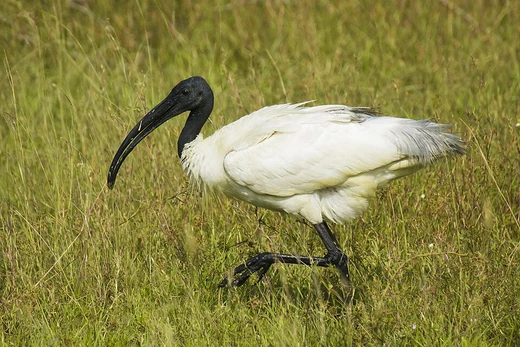
Giant ibis
Last updated
The giant ibis, also known as Pseudibis gigantea or sometimes Thaumatibis, is a wading bird from the ibis family. Its range is mostly northern Cambodia, with a small number in southern Laos and one recent sighting in Vietnam’s Yok Đôn National Park.
Scientific classification
- KingdomAnimalia
- PhylumChordata
- ClassAves
- OrderPelecaniformes
- FamilyThreskiornithidae
- GenusPseudibis
- SpeciesPseudibis gigantea
Named by (Oustalet, 1877)
Close relatives
Other species of Pseudibis with a Codexery entry.
- Red-naped ibis Pseudibis papillosa
- White-shouldered ibis Pseudibis davisoni
Sources: Wikipedia taxobox: Giant ibis (CC BY-SA 4.0)
Conservation status
Critically Endangered (CR)
- LC
- NT
- VU
- EN
- CR▲ this species
- EW
- EX
Source: IUCN Red List assessment
How big is it?
Largest length in the source, 1.06 m, next to a 1.8 m person.
Diagram: drawn by Codexery, schematic shapes to scale (not a likeness). Length: Wikipedia: Giant ibis
Where the giant ibis has been recorded
Each dot is a place where the species has been observed and reported (1,028 records, half-degree grid) — not a modelled range. 14 inland records left out (institution coordinates).
Map: drawn by Codexery. Data: GBIF occurrence search (records CC0 / CC BY) · Natural Earth basemap (public domain) · place coordinates: Wikipedia (CC BY-SA 4.0)
Description
The giant ibis lives up to its name as the biggest ibis species still around. These birds measure 102 to 106 centimeters long and tip the scales at roughly 4.2 kilograms. Their feathers are mostly dark grayish-brown, with a bare gray head and upper neck. Dark bands mark the back of the head and shoulders, while pale silvery-gray wingtips feature black crossbars.
The beak is yellowish-brown, the legs orange, and the eyes dark red. Young birds have short black feathers on the nape and neck, a shorter bill, and brown eyes. Around dawn or dusk, they often let out a loud, ringing call that sounds like a-leurk a-leurk.
Distribution and habitat
This lowland bird occurs in marshes, swamps, lakes, wide rivers, flooded plains, semi-open forests, pools, ponds, and seasonal water-meadows in denser deciduous forest. It generally is found in lowlands. Formerly believed to breed in eastern Thailand, central and northern Cambodia, southern Laos, and southern Vietnam, it was still fairly common in the Mekong Delta until the 1920s but is now almost depleted, with a small remnant population breeding in Cambodia, southern Laos, and possibly Vietnam.
Behaviour and ecology
The giant ibis feeds on aquatic invertebrates, eels, crustaceans, and small amphibians and reptiles. When locusts and cicadas are plentiful, it eats them regularly, and it sometimes consumes seeds. Outside of breeding season, frogs and mole-crickets seem to be its most important prey. It typically forages in muddy shallows but can feed at any depth in seasonal forest pools.
A feeding group is usually a breeding pair or a small family, and it has been seen feeding alongside black ibises. Very little is known about its breeding habits, though it nests in trees, possibly favoring Dipterocarpus species. Nests are usually placed at least 4 kilometers from human settlements, but the bird is not particularly timid unless it is repeatedly harassed or hunted. Females lay two eggs at the start of the rainy season, from June to September.
Earthworms taken from mounds in wet grasslands are an important food for nesting ibises. The species is generally resident but may travel widely for food or due to disturbances. It is territorial and often stays with its family group year-round, though during the dry season, groups of up to seven individuals—sometimes apparently unrelated—have been seen feeding together.
Status
The giant ibis is listed as Critically Endangered by the IUCN. Its decline is driven by wetland drainage for farming and widespread deforestation for rubber, cassava, wood pulp, and teak plantations across Southeast Asia. Local armed conflict can also damage its habitat. Growing human numbers in Cambodia cause more disturbance and clearing of lowland forests.
People hunt the ibis for food, while its eggs are taken by Asian palm civets and yellow-throated martens, and the species cannot survive steady predation. The loss of seasonal forest pools, once maintained by large animals like wild Asian water buffalo, has hurt the ibis. Droughts, possibly tied to climate change, have worsened breeding conditions. Conservationists have tried protecting nests with metal bands to block predators, but preserving good habitat amid Cambodia’s rising population remains a tough problem.
More ecotourism and local education are needed to pull the species back from the edge. The current population is thought to be around 100 breeding pairs, with fewer than 500 birds total, though even that may be too hopeful. In 2018, the IUCN estimated fewer than 200 mature individuals remained.
More in Ibises
Test yourself
Three questions drawn from this entry’s sources. Pick an answer to check it.
Answers checked against the source article
Sources
Compiled from Wikipedia and the sources listed below. Text from Wikipedia is available under CC BY-SA 4.0; this entry is adapted from it.
- Wikipedia: Giant ibis (CC BY-SA 4.0).
- Conservation status: IUCN Red List assessment.
- Occurrence records: GBIF (CC0 / CC BY). Basemap: Natural Earth (public domain).
- Word definitions: the Codexery glossary, each quoted from its Wikipedia article.
Spotted an error? Know more?
Reader corrections go straight into our review queue. Suggest an edit · How this site is sourced