
Turk Broda
First NHL goaltender to reach 300 wins.

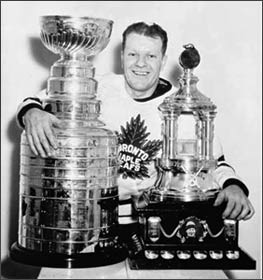
Walter Edward "Turk" Broda (May 15, 1914 – October 17, 1972) was a Canadian professional ice hockey goaltender who played his entire National Hockey League career for the Toronto Maple Leafs from 1936 to 1951, with a hiatus for military service during the Second World War. He is notable for being the first NHL goaltender to reach 300 wins, a five-time Stanley Cup champion, and a two-time Vezina Trophy winner.
Quick Facts
- Halloffame
- 1967
- Birth Date
- 1914-05-15
- Birth Place
- Brandon, Manitoba, Canada
- Death Date
- 1972-10-17
- Death Place
- Toronto, Ontario, Canada
- Height Ft
- 5
- Height In
- 9
- Weight Lb
- 180
- Position
- Goaltender
- Catches
- Left
- Played For
- Toronto Maple Leafs
- Career Start
- 1935
Facts from the source article.
Lore & Background
Broda acquired the nickname "Turkey Egg" during his school days in Brandon because of his many freckles, which shortened to "Turk." He began his playing career with the Brandon Athletics and Brandon Native Sons, later playing for the Winnipeg Monarchs, Detroit Farm Crest, and Toronto St. Michael's Majors. In 1933–34, the Detroit Red Wings invited him to training camp, but with Normie Smith and John Ross Roach already in Detroit, he started his professional career with the Detroit Olympics. He was acquired by the Toronto Maple Leafs in 1935–36 for $7,500.
During the 1942–43 season, Broda joined the Canadian Army for two and a half years, stationed in England to entertain troops by playing military hockey before being honourably discharged in 1945. After returning to the Maple Leafs in 1945–46, he was instrumental in Stanley Cup victories in 1947, 1948, 1949, and 1951. The "Battle of the Bulge" was a public dispute with owner Conn Smythe, who ordered Broda to lose 10 pounds in a week and brought Al Rollins and Gilles Mayer from the minors to pressure him. Broda lost enough weight to keep his job, though he later admitted the scales were rigged in his favour.
Reader's Guide
Broda's legacy is defined by his five Stanley Cup championships with the Toronto Maple Leafs (1942, 1947, 1948, 1949, 1951) and his two Vezina Trophies (1941, 1948), both accompanied by NHL First All-Star Team selections. He was the first goaltender to reach 300 wins, achieving that milestone in 1950. In the playoffs, he recorded 13 shutouts and a goals-against average of 1.98, helping establish a Leafs dynasty. After retiring, he coached minor league and junior teams, leading the Toronto Marlboros to back-to-back Memorial Cup championships in 1955 and 1956. Broda was inducted into the Hockey Hall of Fame in 1967, the Manitoba Sports Hall of Fame and Museum in 1983, and in 2017 was named one of the '100 Greatest NHL Players' in history. He died in 1972 at age 58 from a massive heart attack.
Did You Know?
- Broda was the first NHL goaltender to reach 300 wins, doing so in 1950.
- He acquired the nickname 'Turkey Egg' from his freckles, which became 'Turk.'
- During World War II, he served in the Canadian Army and played military hockey in England to boost troop morale.
- The 'Battle of the Bulge' was a weight dispute with owner Conn Smythe; Broda later admitted the scales were rigged in his favour.
A Dynasty-Defining Career
Walter Edward Broda spent his entire NHL tenure as the goaltender for the Toronto Maple Leafs, a singular loyalty that stretched from 1936 to 1951. During that span he anchored a dynasty that captured five Stanley Cup championships in 1942, 1947, 1948, 1949, and 1951. His regular-season brilliance was recognized twice with the Vezina Trophy, awarded in 1941 and 1948, and he earned NHL First All-Star Team honors in both of those campaigns. In 1941 he led the league in wins with 28 in 48 games while posting a 2.00 goals-against average. In 1950, Broda became the first goaltender in NHL history to reach 300 career victories. His playoff numbers were equally remarkable: 13 shutouts and a 1.98 goals-against average across his Cup runs. Before joining Toronto, he played for the Brandon Athletics, Brandon Native Sons, Winnipeg Monarchs, Detroit Farm Crest, and Toronto St. Michael's Majors, and was acquired by the Leafs for $7,500 in 1935-36. He also claimed a Turnbull Cup MJHL Championship in 1933 and a Calder Cup in 1936.
Defining Moments and the Battle of the Bulge
Two episodes stand out as the most dramatic chapters of Broda's story. The first was the 1942 Stanley Cup Final, where Toronto trailed Detroit three games to none before completing one of the greatest comebacks in NHL history. Broda recorded a shutout during that series and finished with an 8-5 record, cementing his place in Leafs lore forever. The second was the so-called "Battle of the Bulge," a very public dispute with owner Conn Smythe over Broda's weight. Smythe demanded the goaltender shed ten pounds within a single week and even brought up minor-league keepers Al Rollins and Gilles Mayer to apply pressure. The saga drew heavy media attention throughout Toronto. Broda ultimately lost enough weight to retain his position, though he later admitted the scales had been rigged in his favor. Sandwiched between these two events was a two-and-a-half-year hiatus from 1943 to 1945, during which Broda served in the Canadian Army stationed overseas in England, playing military hockey to lift Allied troop morale before receiving an honourable discharge in 1945.
Legacy, Honors, and Life After the Pads
Broda's influence on the game extended well beyond his playing days. After hanging up his pads in 1951 at age 38, he transitioned into coaching, first guiding the Ottawa Senators in the Quebec Hockey League and then taking the helm of the Toronto Marlboros, where he led them to consecutive Memorial Cup titles in 1955 and 1956. His legacy was formally recognized through numerous honors: induction into the Hockey Hall of Fame in 1967, a place as an Honoured Member of the Manitoba Hockey Hall of Fame, and membership in the Manitoba Sports Hall of Fame and Museum in 1983. In 1998, The Hockey News ranked him number 60 among the 100 Greatest Hockey Players. His number one jersey was retired by the Toronto Maple Leafs. In January 2017, Broda became part of the inaugural group named among the 100 Greatest NHL Players in history. He was also inducted into the National Polish American Sports Hall of Fame in 2005, a distinction reflecting a persistent misattribution of his ethnic background.
Ukrainian Roots and the Man Behind the Nickname
Born on May 15, 1914, in Brandon, Manitoba, Broda grew up in a Ukrainian family, a fact long obscured by a widespread and persistent error labeling him as Polish. Maple Leafs publicity director Stan Obodiac, who knew Broda personally, confirmed his Ukrainian heritage and corrected the record. The nickname "Turk" originated in his school days in Brandon, where classmates called him "Turkey Egg" because of his heavy freckling; the moniker shortened naturally over time and followed him through his entire career. Broda's connection to Manitoba ran deep—he even appeared in goal for the Riding Mountain Relief Camp All-Stars in 1933, a group of players drawn from Depression-era work camps near Riding Mountain National Park. In 1933-34 the Detroit Red Wings invited him to training camp, but with Normie Smith and John Ross Roach already occupying the net, he began his professional career with the Detroit Olympics instead. His life ended abruptly on October 17, 1972, when he suffered a massive heart attack at the age of 58.
Gallery
Frequently Asked Questions
Who is Turk Broda?
Walter Edward "Turk" Broda was a Canadian goaltender born in Brandon, Manitoba, in 1914, who dedicated his entire NHL career to the Toronto Maple Leafs from 1936 through 1951. His tenure was briefly interrupted by military service during the Second World War, after which he returned to the crease and continued his remarkable run.
What historic record did Turk Broda achieve?
Broda became the first goaltender in NHL history to collect 300 career wins, a longevity milestone that no netman before him had ever reached. That mark cemented his reputation as one of the most durable and consistently effective goalies of his generation.
How many Stanley Cups did Turk Broda win?
He hoisted the Stanley Cup five times with Toronto, in 1942, 1947, 1948, 1949, and 1951, serving as the backbone of one of the franchise's most celebrated championship eras. His between-the-pines steadiness was a defining factor in those repeated playoff runs.
Why is Turk Broda considered so important in hockey history?
Beyond the 300-win landmark, Broda earned two Vezina Trophies (1941 and 1948) and set a benchmark for career consistency that very few goalies of his era could approach. His two-decade stretch with a single club also made him a symbol of loyalty and sustained excellence in an era before modern specialization.
What happened to Turk Broda after his playing days?
Broda passed away on October 17, 1972, at the age of 58, ending the life of a player who had defined a generation of Maple Leafs goaltending. His legacy endures through the Hall of Fame recognition and the record books that still credit him with pioneering the 300-win threshold.
More in Hockey Hall of Fame Goaltenders 1-24
Spotted an error? Know more?
Reader corrections go straight into our review queue. Suggest an edit · How this site is sourced