
Charlie Gardiner (ice hockey)
Only NHL goaltender to captain his team to a Stanley Cup win.

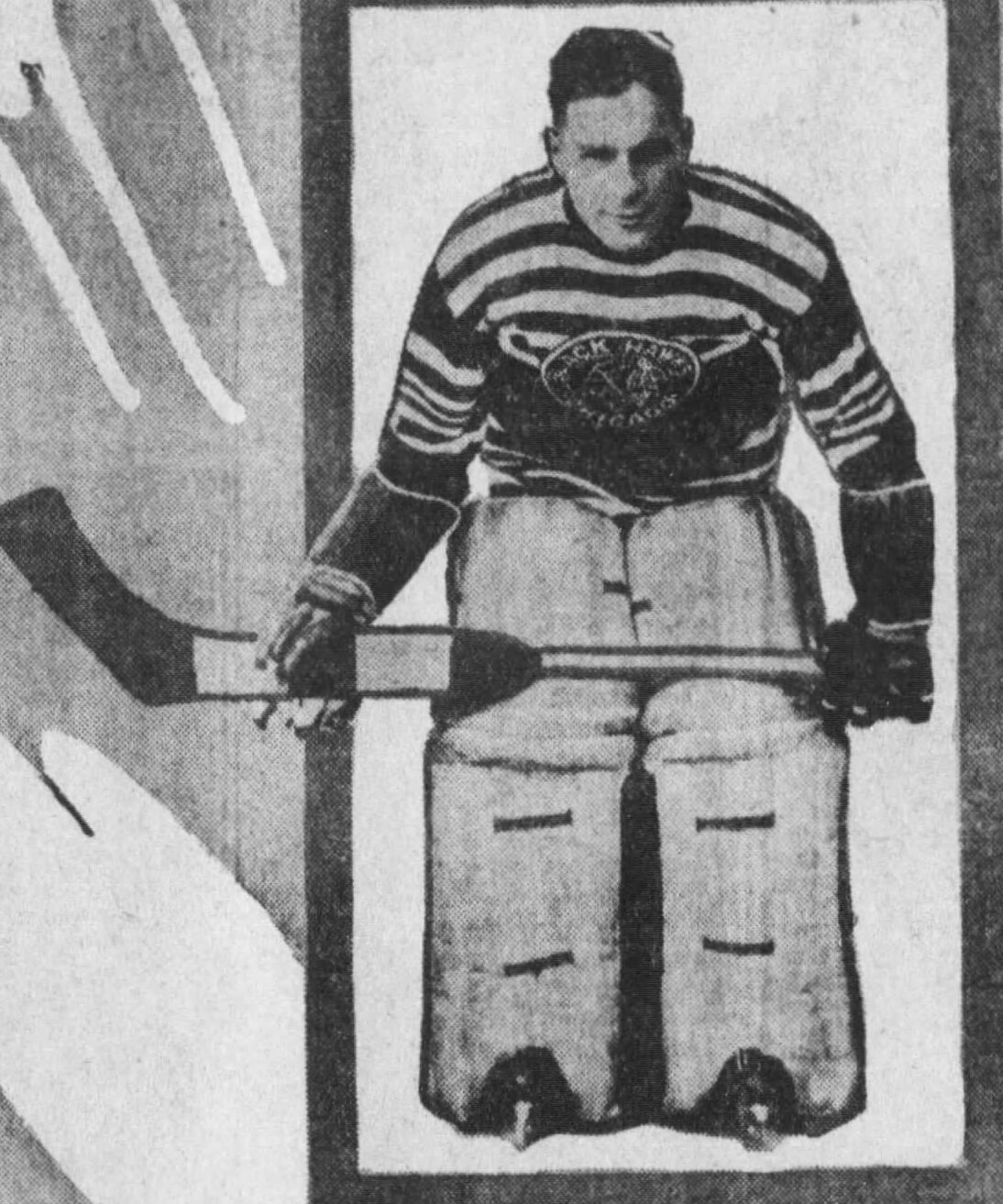
Detroit Free Press · Public domain
Charlie Gardiner was a Canadian professional ice hockey goaltender who played for the Chicago Black Hawks in the National Hockey League. He is notable for being the only NHL goaltender to captain his team to a Stanley Cup win, which he achieved in 1934, and for being one of the inaugural inductees into the Hockey Hall of Fame in 1945.
Quick Facts
- Position
- Goaltender
- Catches
- Right
- Height Ft
- 6
- Height In
- 0
- Weight Lb
- 176
- Played For
- Chicago Black Hawks
- Birth Date
- 1904-12-31
- Birth Place
- Edinburgh, Scotland
- Death Date
- 13 June 1934 · 1904 · 12 · 31
- Death Place
- Winnipeg, Manitoba, Canada
- Career Start
- 1927
- Career End
- 1934
Facts from the source article.
Lore & Background
Gardiner was born in Edinburgh, Scotland, and moved with his family to Winnipeg, Manitoba, in 1911. He learned to skate at age eight and, being too slow for other positions, became a goaltender. He employed an acrobatic style on frozen ponds to avoid frostbite, unlike the stand-up style common at the time. He played junior hockey with the Winnipeg Tigers and senior hockey with the Selkirk Fishermen before turning professional with the Winnipeg Maroons of the Central Hockey League.
Gardiner joined the Chicago Black Hawks in 1927. In the 1928–29 season, Chicago scored only 33 goals, earning the nickname 'goalless wonders,' yet Gardiner posted five shutouts and a 1.85 goals against average. After being booed by fans, he nearly retired but was talked out of it by Duke Keats. In the 1930–31 season, he led the league with 12 shutouts and a 1.73 goals against average, and was named to the First All-Star Team for the first time.
In 1934, Gardiner captained the Black Hawks to a Stanley Cup victory. A few months later, he died from a brain hemorrhage brought on by a tonsillar infection. He was named one of the inaugural inductees when the Hockey Hall of Fame was established in 1945.
Reader's Guide
Charlie Gardiner's significance lies in his unique achievement as the only NHL goaltender to captain his team to a Stanley Cup win, accomplished with the Chicago Black Hawks in 1934. His career was marked by exceptional goaltending despite playing for a team that struggled offensively, as seen in the 1928–29 season when Chicago scored only 33 goals yet Gardiner recorded five shutouts. He won two Vezina Trophies for allowing the fewest goals and was named to the First All-Star Team three times and Second All-Star Team once. His legacy is further cemented by his induction into the Hockey Hall of Fame as one of its inaugural members in 1945. Gardiner's death at age 29 from a brain hemorrhage shortly after his Stanley Cup victory adds a poignant note to his career, highlighting his brief but impactful tenure in the NHL.
Did You Know?
- Gardiner was born in Edinburgh, Scotland, and moved to Winnipeg, Manitoba, at age seven.
- He learned to skate at age eight and became a goaltender because he was too slow to play forward or defence.
- Gardiner died from a brain hemorrhage brought on by a tonsillar infection a few months after winning the Stanley Cup.
A Name Among the First Nine
Charlie Gardiner's place in hockey history is anchored to a single, defining moment: his inclusion in the very first class of honourees inducted into what was then called the International Hockey Hall of Fame. On April 30, 1945, his name was added alongside eight others—Hobey Baker, Eddie Gerard, Frank McGee, Howie Morenz, Tommy Phillips, Harvey Pulford, Hod Stuart, and Georges Vezina—as the inaugural honoured members. This was not a routine ceremony; it was the foundational act of an institution formally established just two years earlier in 1943 under the leadership of James T. Sutherland, a former president of the Canadian Amateur Hockey Association. The group's mandate was twofold: to honour great hockey players and to raise funds toward a permanent home. Gardiner's induction thus represents the earliest formal recognition the sport's most prestigious institution has ever bestowed, making his name inseparable from the Hall's very origin.
Inducted Before the Doors Opened
What makes Gardiner's 1945 induction particularly remarkable is the absence of a physical home for the honour. At the time of his enshrinement, the Hall of Fame had no permanent building whatsoever. The institution had been conceived in Kingston, Ontario—a city Sutherland championed as hockey's birthplace—but the NHL and CAHA agreement that created it in 1943 was essentially a promise of future recognition rather than an immediate reality. The first board of governors, which included hockey executives like Red Dutton, Art Ross, Frank Sargent, and Lester Patrick, along with journalists such as Abbie Coo and Wes McKnight, oversaw the selection of that initial nine without a dedicated facility to house their names. For Gardiner, the distinction was real but intangible, a membership in an idea rather than a place. It would be another sixteen years before a permanent building finally opened, and yet his name remained the first, untouched by the institution's later relocations and expansions.
The Architecture of the First Class
The composition of the 1945 inaugural class reveals the early vision of the Hall's selectors. All nine honourees—Gardiner included—were inducted as players, reflecting the institution's original focus on on-ice achievement. The broader categories that would later formalize the Hall's structure, such as builders (encompassing coaches, general managers, commentators, and team owners) and on-ice officials, did not yet exist as distinct designations at the time of his enshrinement. The 18-person selection committee of players, coaches, and others that meets annually in June to choose new honourees was a later development in the institution's governance. Gardiner's induction thus belongs to a simpler era of recognition, when the act of honouring a player was the singular purpose. The fact that the first class was selected before the Hall had secured a permanent location, before the NHL's support was fully locked in, and before the institution had even settled on its final name underscores how provisional—and how permanent—Gardiner's place in that list has been.
A Legacy Written in Stone
Gardiner's name has endured through every subsequent chapter of the Hall of Fame's physical and institutional evolution. The institution he helped inaugurate in 1945 eventually lost Kingston as its site when Sutherland died in 1955 and funding for a permanent building never materialized. The NHL withdrew its support, and by 1958 the Hall had relocated to Toronto, first as a temporary exhibit at the Canadian National Exhibition that drew 350,000 visitors during the 1958 fair. A permanent building at Exhibition Place opened in 1961, and in 1993 the Hall moved again to its current downtown Toronto location within Brookfield Place, featuring 4,700 square metres of exhibition space. As of May 2024, the Hall counts 310 players among its honourees. Gardiner remains the first of that number, his 1945 induction a fixed point around which the entire institution has grown, expanded, and reinvented itself across eight decades.
Gallery
Frequently Asked Questions
Who is Charlie Gardiner (ice hockey)?
Charlie Gardiner was a goaltender born in Edinburgh, Scotland, in 1904, who went on to play for the Chicago Black Hawks in the NHL. He is best remembered as the only goaltender in NHL history to serve as captain and lead his team to a Stanley Cup championship.
What made Charlie Gardiner's 1934 Stanley Cup win unique?
Gardiner captained the Chicago Black Hawks to their 1934 Stanley Cup title, a singular achievement no other NHL goaltender has ever matched. Holding the captaincy while guarding the net was extraordinarily rare in that era, making his accomplishment stand apart in hockey lore.
How many Vezina Trophies did Charlie Gardiner win?
Gardiner claimed two Vezina Trophies during his tenure with the Chicago Black Hawks, the award given to the NHL's top goaltender each season.
When was Charlie Gardiner inducted into the Hockey Hall of Fame?
He was selected as one of the inaugural class of inductees when the Hockey Hall of Fame opened its doors in 1945, eleven years after his death.
How did Charlie Gardiner's life end?
Tragically, Gardiner died on June 13, 1934, at just 29 years old, only a few months after guiding the Black Hawks to their Stanley Cup triumph. His brief career and untimely passing make his legacy all the more remarkable.
More in Hockey Hall of Fame Goaltenders 1-24
Spotted an error? Know more?
Reader corrections go straight into our review queue. Suggest an edit · How this site is sourced