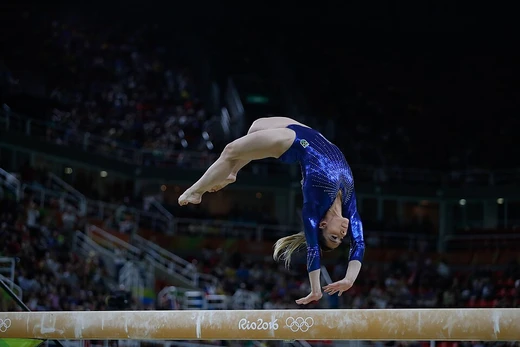
Epke Zonderland
Dutch gymnast, Olympic gold medalist, and three-time world champion on high bar.

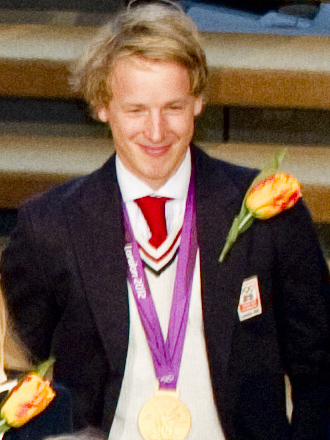
Jladage · CC BY-SA 3.0
Epke Jan Zonderland (born 16 April 1986) is a Dutch artistic gymnast who won the Olympic gold medal on high bar at the 2012 Summer Olympics. He is a four-time Olympian (2008–2020) and the first man to win three World Championships gold medals on high bar, achieving this feat at the 2013, 2014, and 2017 World Championships. Known as "The Flying Dutchman," he is also a medical doctor.
Quick Facts
- Fullname
- Epke Jan Zonderland
- Nickname
- The Flying Dutchman / The Lion of Lemmer / Epic Zonderland / Epke Wonderland
- Country
- NED · MAG
- Birth Date
- 1986-04-16
- Birth Place
- Lemmer, Netherlands
- Height
- 173 cm
- Discipline
- MAG
- Club
- TSH Heerenveen
- Eponymousskills
- Zonderland (Parallel Bars): Swing forward with 5/4 twist on one arm through handstand and Healy to support with difficulty assignment of F (0.6)
- Show-Medals
- yes
Facts from the source article.
Lore & Background
Zonderland started gymnastics at age four. He has three siblings—Herre, Johan, and Geeske—who are also international gymnasts. He enrolled in medicine at the University of Groningen in 2006 and, balancing his gymnastics career, completed his degree in 2018, qualifying as a medical doctor.
His early international success came as a junior in 2004, with a silver medal on horizontal bar at the European Junior Championships. In 2005, he and Jeffrey Wammes became the first Dutch gymnasts to qualify for the all-around final at the World Championships. He won his first World Cup gold in Tehran in 2006.
At the 2012 Olympics, Zonderland scored a personal best 16.533 on high bar, performing a triple combo of Cassina-Kovacs-Kolman. He became the first Dutch male gymnast to win an individual Olympic medal and the first Dutch Olympic gymnastics medal in 84 years. He successfully defended his world title in 2014 and won a third in 2017 at age 31.
Reader's Guide
Epke Zonderland's significance lies in his dominance on the high bar, an apparatus where he achieved an unprecedented three World Championship gold medals. His Olympic gold in 2012 ended an 84-year medal drought for Dutch gymnastics and marked the first individual Olympic medal for a Dutch gymnast. His routines, featuring difficult release combinations such as the Cassina-Kovacs-Kolman, set new standards in the sport. Despite injuries and setbacks, including a concussion in 2015 and a fall at the 2020 Olympics, he remained competitive across four Olympic cycles. His ability to balance elite gymnastics with medical studies, culminating in a medical degree in 2018, underscores his discipline. Zonderland was named Dutch Sportsman of the Year multiple times and was knighted in the Order of Orange-Nassau in 2012. His legacy is that of a pioneering figure in Dutch gymnastics and a benchmark for high bar excellence.
Did You Know?
- Zonderland is nicknamed 'The Flying Dutchman.'
- He took 12 years to complete his medical degree, qualifying as a doctor in 2018.
The Flying Dutchman: A High Bar Dynasty
Epke Zonderland, born in April 1986 in the small Dutch town of Lemmer, carved out a legacy on the horizontal bar that no male gymnast had ever matched before him. Competing as a four-time Olympian across the 2008, 2012, 2016, and 2020 Games, he became the first man in the history of artistic gymnastics to claim three separate World Championship titles on the high bar, achieving this at the 2013, 2014, and 2018 editions. His crowning moment came in London in 2012, when he claimed Olympic gold with a personal-best score of 16.533, making him the first Dutch gymnast of any gender to win an individual Olympic medal and ending an 84-year drought for the Netherlands in Olympic gymnastics. Affectionately known as "The Flying Dutchman," Zonderland also collected three European golds and multiple World Cup victories, cementing his status as the definitive high bar specialist of his generation.
Moments That Defined a Career
Several performances elevated Zonderland from a strong specialist into a figure whose routines are still discussed years later. In London 2012, his Olympic-winning routine featured a triple release combination of Cassina, Kovacs, and Kolman — the most difficult release sequence in the sport at that time — executed to a personal-best 16.533. At the 2013 World Championships in Antwerp, he paired a Cassina-Kovacs double release with a Kolman-Gaylord 2, finishing with a stuck double-twisting double layout dismount. Perhaps the most dramatic image of his career came in Montreal in 2017: after a flight element, he caught the bar with only one hand, yet managed to swing into a giant despite severe leg separation and completed his routine for a silver medal. In Doha in 2018, at the age of 32, he delivered two double release combinations to claim his historic third world title. Even in narrow defeat, as in the 2019 Melbourne World Cup where he tied Japan's Hidetaka Miyachi at 14.733 but lost the tiebreak on execution score, his presence commanded attention.
The Doctor in the Gymnastics Hall
Long before he was a household name in Dutch sport, Epke Zonderland was a four-year-old in Lemmer, picking up his first grip on a bar. Gymnastics ran deep in his family: his two brothers, Herre and Johan, along with his sister Geeske, all competed internationally in the sport. In 2004, as a junior, he claimed the Dutch national all-around title from his older brother Herre, a small but telling sign of the family's collective dedication. Yet Zonderland pursued an ambitious parallel path. In 2006 he enrolled in the medicine programme at the University of Groningen, a decision that would stretch his academic journey to a remarkable twelve years as he balanced grueling training schedules with clinical studies. He finally qualified as a medical doctor in 2018 — the same year he was winning his third World Championship gold on the high bar. Few athletes in any discipline have managed to complete a full medical degree while competing at the very pinnacle of their sport, making Zonderland's dual achievement as singular as his gymnastics.
Injury, Setback, and the Will to Return
Between 2015 and 2016, Zonderland endured a string of setbacks that threatened to derail his career. At the 2015 European Championships he fell off the high bar and failed to defend his title. Months later, a training accident left him with a concussion and a damaged thumb, curtailing his preparation so severely that he missed the world final in Glasgow entirely. The following year brought another finger sprain in the weeks before Rio, and in the Olympic final he fell during his routine, unable to retain his gold. Rather than fade, he rebuilt. In September 2017 he won the Paris Challenge Cup with a score of 14.800, and then produced the one-handed catch in Montreal that became one of the most memorable images in gymnastics. By August 2018, at 32, he was standing on the podium in Doha as world champion for the third time. In 2019 he added a third European gold in Szczecin, Poland, before an error cost him a place in the Stuttgart world final. His trajectory from injury to triumph remains one of the sport's most compelling narratives.
Gallery
Frequently Asked Questions
Who is Epke Zonderland?
Epke Jan Zonderland is a Dutch artistic gymnast born on 16 April 1986 in Lemmer, Netherlands. He is best known for claiming the Olympic gold medal on the high bar at the 2012 London Games.
What is Epke Zonderland's signature apparatus?
The high bar is Zonderland's specialty, where he has collected his most prestigious individual medals. His dominance on this event set him apart from many all-around gymnasts of his era.
How many World Championship gold medals has Epke Zonderland won on high bar?
He captured three World Championship titles on the high bar, taking gold at the 2013, 2014, and 2017 competitions. This made him the first male gymnast in history to secure three world titles on that specific apparatus.
What is Epke Zonderland's nickname and where does it come from?
He is widely referred to as "The Flying Dutchman," a nod to both his Dutch nationality and the spectacular swinging sequences he performs on the high bar.
What does Epke Zonderland do outside of gymnastics?
Beyond his competitive career, Zonderland is a qualified medical doctor. He competed in four consecutive Olympic Games spanning from 2008 through 2020.
More in Gymnastics 1-24
Spotted an error? Know more?
Reader corrections go straight into our review queue. Suggest an edit · How this site is sourced