Cecilia Colledge
British figure skater, Olympic silver medalist, and spin innovator.

Unknown author · Public domain
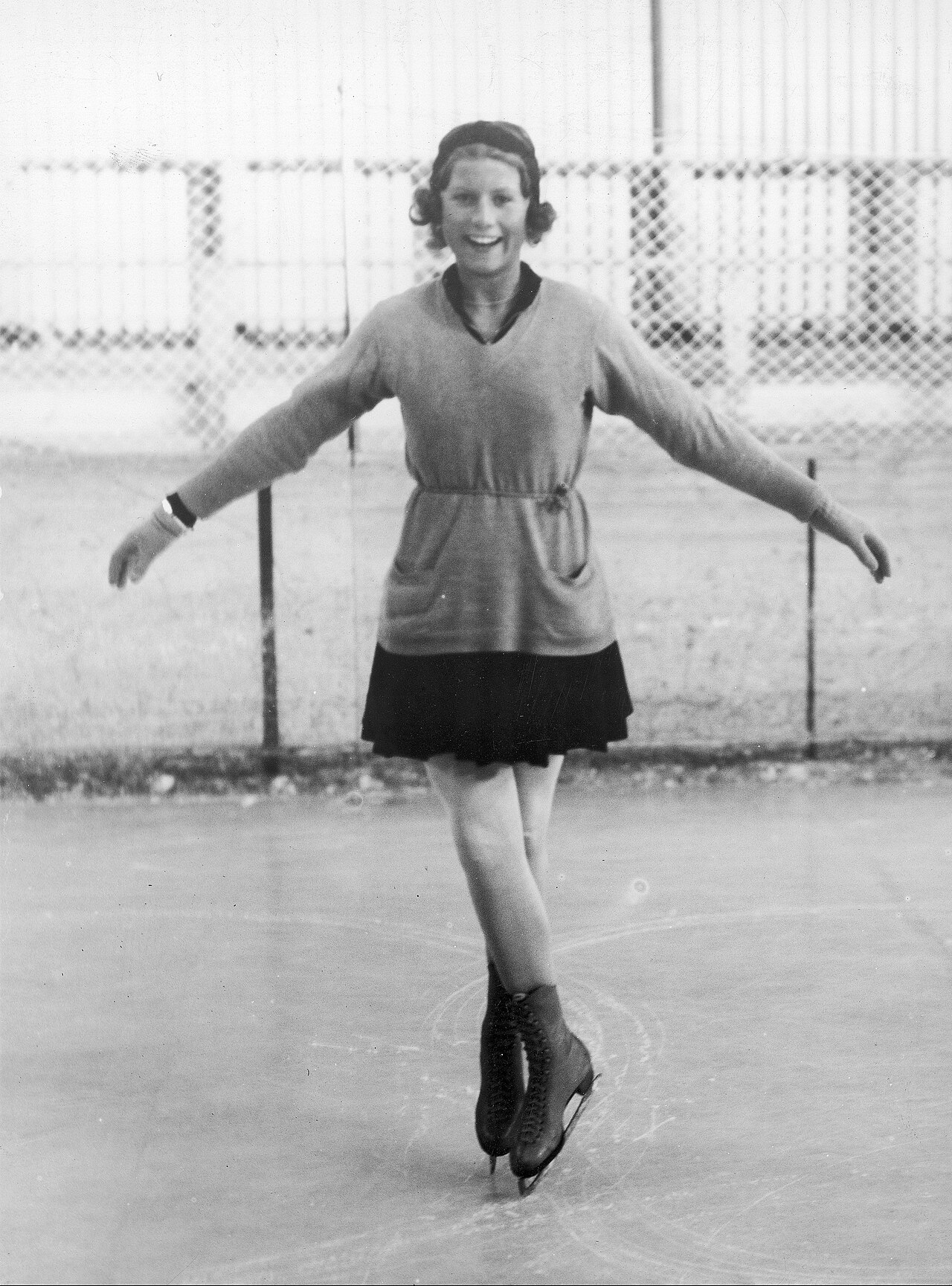
Magdalena Cecilia Colledge, a British figure skater, was born on 28 November 1920 and died on 12 April 2008. She earned an Olympic silver medal in 1936, became World Champion in 1937, and won the European title three years in a row from 1937 to 1939. She also claimed the British national championship six times, in 1935 through 1939 and again in 1946. Colledge is recognized as the first woman to complete a double jump in competition, and she invented the layback spin.
Colledge grew up in London. Her father, Lionel, was a surgeon who researched throat cancer treatments; her mother, Margaret, was the daughter of Admiral John Brackenbury. She had one brother, Maule, who served in the Royal Air Force and died in 1943 during World War II, reportedly after a collision with a Lancaster Bomber piloted by David Maltby, who also died. Colledge never married and had no children. She passed away at Mount Auburn Hospital in Cambridge, Massachusetts.
Her skating career began after she watched the 1928 World Championships in London. Her mother had been invited by the mother of Maribel Vinson. At that event, Cecilia was inspired by gold medalist Sonja Henie and silver medalist Maribel Vinson. She was coached by Eva Keats and Jacques Gerschwiler, a former gymnastics teacher whom Colledge described as "very progressive in his ideas." Since she was his youngest pupil, he tested his theories on her, directing her to take ballet and "stretch" lessons from Miss Lee, an acrobatics instructor and former circus performer. Gerschwiler conceived the layback spin while watching Lee train Colledge to do backbends with a rope around her waist.
At eleven years and four months old, Colledge represented Great Britain at the 1932 Winter Olympics, becoming the youngest Olympic figure skater; she placed eighth. She won a silver medal at the 1933 European Championships. Her first British national title came in 1935, the same year she took bronze at the European Championships and silver at the World Championships. In 1936, she won her second national title and another European silver medal. At the 1936 European Championships, she landed a double salchow, the first double jump by a woman in competition. At age fifteen, she competed in the 1936 Winter Olympics, winning the silver medal behind Henie in a very close contest.
Quick Facts
- Full Name
- Magdalena Cecilia Colledge
- Birth Date
- 1920-11-28
- Birth Place
- London, England
- Death Date
- 2008-04-12
- Death Place
- Cambridge, Massachusetts, U.S.
- Coach
- Jacques Gerschwiler / Eva Keats (former)
- Skating Club
- Queens Park Ice Rink
- Height
- 152 cm
- Retired
- 1946
- Show Medals
- yes
Facts from the source article.
Lore & Background
Cecilia Colledge grew up in London. Her father, Lionel, was a surgeon researching the treatment of throat cancer, and her mother, Margaret, was the daughter of Admiral John Brackenbury. She had one sibling, a brother named Maule who served in the Royal Air Force and died in 1943 during World War II. It is believed the cause of his death was a collision with a Lancaster Bomber piloted by David Maltby, who also died in the crash. Colledge never married and had no children. She died on 12 April 2008 at Mount Auburn Hospital in Cambridge, Massachusetts.
Colledge began skating after watching the 1928 World Championships, which were held in London. Her mother, Margaret, had been invited by the mother of Maribel Vinson. At the event, Cecilia was inspired by the performances of Sonja Henie and Maribel Vinson, who won gold and silver respectively. During her career, Colledge was coached by Eva Keats and Jacques Gerschwiler. Gerschwiler was a former gymnastics teacher; according to Colledge, he was 'very progressive in his ideas'. Colledge also stated that since she was his youngest pupil, he tested his theories on her. He directed her to take ballet lessons, as well as 'stretch' lessons from Miss Lee, an acrobatics instructor and former circus performer. Gerschwiler came up with the layback spin while watching Lee train Colledge how to do backbends with a rope tied around Colledge's waist.
At age eleven years and four months, she represented Great Britain at the 1932 Winter Olympics, where she became the youngest Olympic figure skater. She placed 8th in the event. She won the silver medal at the 1933 European Championships. She won her first British national title in 1935. She won the bronze medal at the 1935 European Championships and the silver medal at the 1935 World Championships. In 1936, she won her second national title and her second Europeans silver medal. At the 1936 European Championships, Colledge landed a double salchow jump, becoming the first woman to perform a double jump in competition. At age fifteen, she represented Great Britain at the 1936 Winter Olympics, where she won the silver medal behind Henie, finishing a very close second to her, became one of the youngest figure skating Olympic medalists.
Reader's Guide
Colledge's significance lies in her technical innovations and competitive achievements. She is credited as the first female skater to land a double jump, a double salchow at the 1936 European Championships. Along with her coach Jacques Gerschwiler, she invented the camel spin (in 1937) and the layback spin, as well as the one-foot Axel jump, also known as the 'Colledge'. Her free skating program in 1938 was described by T. D. Richardson as 'by far the most difficult attempted by anyone, man or woman, in the Skating World'. After World War II, during which she drove an ambulance in the London Blitz, she returned to win a sixth British national title in 1946. She later moved to the United States in 1951 and coached at the Skating Club of Boston between 1952 and 1977, teaching skaters such as Albertina Noyes, Paul McGrath, and Ron Ludington. She was inducted into the World Figure Skating Hall of Fame in 1980. Her legacy includes both her competitive record and the lasting influence of her spin innovations on the sport.
Did You Know?
- Colledge became the youngest Olympic figure skater at age 11 years and 4 months at the 1932 Winter Olympics.
- She invented the camel spin and the layback spin, along with her coach Jacques Gerschwiler.
- During World War II, she drove an ambulance in the Motor Transport Corps during the London Blitz.
- Her brother Maule died in 1943 in a collision with a Lancaster Bomber piloted by David Maltby.
A Career Forged in Titles
Cecilia Colledge's competitive record reads like a masterclass in sustained excellence. She captured six British national championships across 1935, 1936, 1937 (twice, as two events were held that year), 1938, 1939, and 1946. On the continental stage, she claimed three consecutive European titles from 1937 through 1939, and added silver medals at the 1933 and 1936 European Championships. Her world-level results included a 1937 World title, silver at the 1935 and 1938 World Championships, and a bronze at the 1935 Europeans. At the 1936 Winter Olympics she took silver, and at the 1932 Games—when she was barely eleven and a half—she became the youngest Olympic figure skater in history, finishing eighth. After a wartime hiatus, she returned to win her sixth national title in 1946, then transitioned to professional ice shows, claiming the Open Professional Championship in both 1947 and 1948. In 1980, the World Figure Skating Hall of Fame formally recognized her legacy.
Inventing the Spin and the Jump
Colledge's most lasting gift to figure skating is the technical vocabulary she helped create. At the 1936 European Championships she landed a double salchow, making her the first woman to execute a double jump in competition. Working alongside her coach Jacques Gerschwiler, she developed the camel spin in 1937. The layback spin also grew out of their partnership: Gerschwiler, a former gymnastics teacher who described himself as progressive in his thinking, conceived the move after watching acrobatics instructor Miss Lee drill Colledge in backbends using a rope looped around her waist. Colledge additionally created the one-foot Axel jump, which still carries her name as the 'Colledge.' In 1938, writer T.D. Richardson observed that her free programme was the most difficult attempted by any skater, male or female, yet she delivered those staggering combinations of jumps and spins with such effortless speed that even seasoned judges were sometimes fooled as to its true worth.
The 1936 Olympics and a Rivalry That Defined an Era
The 1936 Winter Olympics in Garmisch-Partenkirchen remains the single most dramatic chapter of Colledge's career. At fifteen, she squared off against the dominant Sonja Henie, and after the school figures segment the two were separated by mere points. Sandra Stevenson, writing in The Independent in 2008, recalled that Henie was so incensed by the closeness that she ripped the results sheet off the wall in the competitors' lounge and tore it to pieces. The free skating draw that followed drew scrutiny: Henie was assigned the coveted last slot among twenty-six skaters, while Colledge was placed second. An early performance was widely regarded as a handicap, since the audience had not yet warmed up and judges were known to inflate marks as the programme progressed. Colledge ultimately claimed silver, etching her name among the youngest Olympic figure skating medalists ever.
Beyond the Rink: War, Coaching, and a Quiet Life
Colledge's story did not end with her final competitive stride. During the London Blitz she left the ice behind and drove an ambulance as part of the Motor Transport Corps, a far cry from the gilded world of international skating. Her family life carried its own sorrow: her only sibling, Maule, lost his life in 1943 in what is believed to have been a mid-air collision with a Lancaster Bomber piloted by David Maltby, who also perished. Colledge never married and had no children. In 1951 she emigrated to the United States and settled in Boston, where she coached at the Skating Club of Boston for twenty-five years, from 1952 to 1977. Among her pupils were Albertina Noyes, Paul McGrath, and Ron Ludington. She passed away on 12 April 2008 at Mount Auburn Hospital in Cambridge, Massachusetts, at the age of eighty-seven.
Gallery
Frequently Asked Questions
Who is Cecilia Colledge?
Cecilia Colledge was a British figure skater born in London on 28 November 1920 who competed at the elite international level in the late 1930s. She passed away on 12 April 2008.
What are Cecilia Colledge's major competitive achievements?
She earned Olympic silver at the 1936 Games, took the World title in 1937, and won the European championship three straight years from 1937 through 1939. She also claimed the British national title six times, spanning 1935 to 1939 and again in 1946.
What technical innovations is Cecilia Colledge credited with?
Colledge is recognized as the first woman to land a double jump inside a competitive program. She also devised the layback spin, a rotational move that has remained part of the sport's vocabulary ever since.
Why is Cecilia Colledge important to figure skating history?
By bringing the double jump into women's competition, she opened a technical frontier that every later generation of skaters has had to build upon. Her creation of the layback spin further cements her legacy as a movement innovator rather than simply a medal collector.
What do we know about Cecilia Colledge's family and upbringing?
She grew up in London, where her father Lionel worked as a surgeon researching treatments for throat cancer and her mother was named Margaret. That London environment was the backdrop for the early development of her skating career.
More in Gymnastics 1-24
Spotted an error? Know more?
Reader corrections go straight into our review queue. Suggest an edit · How this site is sourced