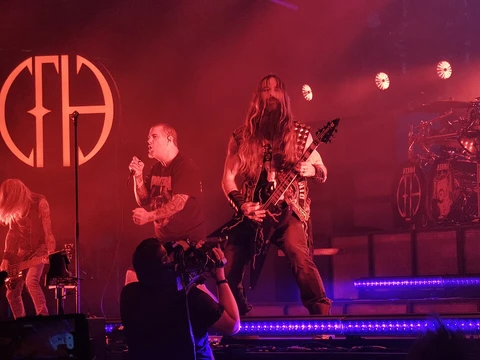
City of Fire (band)
Canadian metal band formed from Caustic Thought reformation.

Unknown author · Public domain
City of Fire is a Canadian metal band formed in 2008. The band grew from the one-off reformation of Caustic Thought, an early-1990s group, and features members from Fear Factory, Strapping Young Lad, and Econoline Crush. They have released two studio albums.
- Formed
- 2008
- Origin
- Canada
- Genre
- Metal
- Members
- Burton C. Bell, Byron Stroud, Bob Wagner
- Studio albums
- 2
Lore & Background
City of Fire originated from the 2008 one-off reformation of Caustic Thought, an early-1990s group featuring Byron Stroud, guitarist Ian White, and drummer Bob Wagner. When Stroud's other bands Fear Factory and Strapping Young Lad became inactive, the group considered continuing with Caustic Thought and added Sho Murray as a second guitarist. Ian White declined the vocalist role, so Stroud contacted Burton C. Bell, who accepted. The band's self-titled debut album was released in 2010, with a second pressing including bonus tracks such as a cover of T. Rex's 'Children of the Revolution'. Poorly recorded sample portions of songs were uploaded to MySpace in 2009, often with studio footage.
Reader's Guide
City of Fire represents a collaboration of musicians from prominent metal acts, formed during a period when their primary bands were inactive. Their debut album in 2010 and subsequent international tour supporting Soulfly in Australia and New Zealand established their presence. The band's single 'Rising' featured an unconventional bright, kaleidoscopic music video. Their second album, Trial Through Fire, was released in 2013. The band's significance lies in its connection to the broader metal scene through its members' histories, though their output remains limited to two studio albums.
Did You Know?
- The band grew from the 2008 reformation of Caustic Thought, an early-1990s group.
- A cover of T. Rex's 'Children of the Revolution' appeared as a bonus track on the second pressing of their debut album.
- The music video for 'Rising' used a bright color scheme with kaleidoscopic imagery, breaking from typical dark metal conventions.
- Jed Simon filled in for Ian White on guitar during the band's first international tour in September 2010.
Roots in Thrash and the Birth of a New Groove
The musical world that shaped this band's sound traces back to a deliberate slowing-down of one of heavy metal's most aggressive pillars. Groove metal, the subgenre that anchors the group's identity, emerged in the early 1990s as a direct offshoot of thrash metal. Rather than abandoning the intensity that defined thrash, musicians in this new vein chose to trade blistering speed for a heavier, more deliberate pulse. The result was a style that kept the raw power and distorted aggression of its parent genre while reorganizing the rhythmic architecture around syncopated, head-nodding patterns. For a band operating within this tradition, the lineage matters: every riff carries the DNA of thrash's forward momentum, yet it is channeled through a slower, more physically felt tempo that invites the listener to lock into the groove rather than simply ride the speed. This tension between inherited ferocity and deliberate weight defines the sonic territory the band inhabits.
Rhythm as the Central Engine
What distinguishes this band's musical approach from much of the broader heavy metal spectrum is the elevation of rhythmic guitar work to a primary compositional force. In groove metal, the guitar parts are not merely melodic or harmonic vehicles; they are constructed as interlocking rhythmic cells that drive the entire arrangement forward. The tempo sits lower than what thrash or even traditional heavy metal typically demands, which means each note carries more physical weight and occupies more sonic space. This slower pace forces the guitarist to make every hit count, shaping riffs that function almost like percussive statements. For a band rooted in this philosophy, the songwriting process centers on finding that pocket where the rhythm section and the guitar lock together in a way that feels both inevitable and physically compelling. The groove is not an ornament layered over a song structure; it is the structural foundation itself, and the band's identity is built upon that principle.
Primary Identity Versus Borrowed Elements
Within the wider catalog of heavy metal, a band's relationship to groove metal can take two distinct forms. Some artists adopt it as their primary genre, meaning the rhythmic, tempo-driven, thrash-derived approach described above is the core of their entire output and creative identity. Others treat groove metal as a secondary influence, weaving its characteristic slower tempos and syncopated guitar patterns into a broader palette that might also include elements from adjacent subgenres. This distinction matters for understanding where a particular band sits in the musical landscape. A group that claims groove metal as its primary language commits fully to the rhythmic philosophy and the specific tempo range that define the style. A group that draws on it as a secondary color might borrow a syncopated riff or a half-time feel for a single track while otherwise operating in a different rhythmic register. The band's placement in one camp or the other shapes how listeners perceive their consistency and artistic focus.
A Node in a Dense Metal Network
Groove metal does not exist in isolation; it occupies a specific node within a dense web of related heavy metal subgenres. Its closest kin is thrash metal, the parent style from which it directly descends, but its rhythmic sensibilities also create natural bridges toward crossover thrash, where punk energy meets metal aggression. The heavier, more textural side of groove metal's rhythmic vocabulary overlaps with industrial metal, while its emphasis on weight and groove has influenced the development of metalcore. Even the broader, more commercially oriented landscape of nu metal shares a philosophical debt to the slower, groove-centric approach that groove metal popularized in the early 1990s. For a band working within this tradition, these connections are not merely academic. They represent a living ecosystem of influence and exchange, where rhythmic ideas flow between subgenres and where a single band's sound can be understood as part of a much larger, interconnected conversation about what heavy music can feel like in the body.
Gallery
Frequently Asked Questions
Who is City of Fire (band)?
City of Fire is a Canadian groove metal band that came together in 2008. The project originated as a one-off reunion of the early-1990s group Caustic Thought before evolving into its own distinct act.
Who are the members of City of Fire (band)?
The lineup includes Burton C. Bell, Byron Stroud, and Bob Wagner. These musicians bring experience from well-known acts such as Fear Factory, Strapping Young Lad, and Econoline Crush.
How many studio albums has City of Fire (band) released?
The band has put out two full-length studio albums since their formation in 2008.
What is the connection between City of Fire (band) and Caustic Thought?
City of Fire grew directly out of a brief, one-time reformation of Caustic Thought, a group active in the early 1990s. Rather than staying a throwback project, the collaboration developed into its own ongoing Canadian metal band.
Why is City of Fire (band) notable in the groove metal scene?
The band draws attention because it unites high-profile names from the industrial and groove metal worlds—Fear Factory, Strapping Young Lad, and Econoline Crush—under a single new banner. Its roots in a 1990s reformation also give it a unique lineage that sets it apart from typical modern metal projects.
More in Groove metal musical groups 1-24
Spotted an error? Know more?
Reader corrections go straight into our review queue. Suggest an edit · How this site is sourced