Thetis
Sea nymph and mother of Achilles in Greek myth.
Thetis is a figure from Greek mythology with varying mythological roles, mainly appearing as a sea nymph, a goddess of water, and one of the 50 Nereids, daughters of the ancient sea god Nereus. She is best known as the mother of Achilles, but evidence suggests she was more central to Archaic Greek religious beliefs in her role as a sea-goddess, with an early Alcman hymn identifying her as the creator of the universe.
- Field
- Greek mythology
- Known for
- Mother of Achilles; sea nymph; goddess of water; one of the 50 Nereids
- Epithet
- Halosydne (sea-nourished or sea-born)
- Parents
- Nereus and Doris
- Spouse
- Peleus
- Children
- Achilles
Lore & Background
Thetis was the daughter of Nereus and Doris, and a granddaughter of Tethys. She often leads the Nereids and is sometimes identified with Metis. Only one written record, a fragment, attests to her worship in the archaic period, and an early Alcman hymn identifies her as the creator of the universe. Worship of Thetis as a goddess persisted in some regions into historical times, as documented by writers such as Pausanias. Her epithet Halosydne means 'sea-nourished' or 'sea-born' goddess.
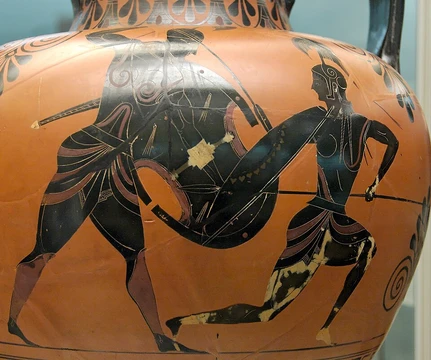
Thetis was courted by both Zeus and Poseidon, but was married off to the mortal Peleus due to a prophecy that her son would become greater than his father. She initially refused Peleus, but he subdued her by holding her fast as she shapeshifted into flame, water, a lioness, and a serpent. Their wedding on Mount Pelion was attended by deities, but Eris, not invited, threw a golden apple that eventually occasioned the Trojan War. Thetis is the mother of Achilles by Peleus.
In an attempt to make Achilles immortal, Thetis would burn away his mortality in a fire at night and anoint him with ambrosia during the day. When Peleus caught her, he cried out, and Thetis threw the child down and departed into the sea, never to return. Because she was interrupted, his heel was not protected. In a variant, she dipped him in the River Styx, but the heel by which she held him remained vulnerable. During the Trojan War, she concealed Achilles disguised as a girl at the court of Lycomedes, but Odysseus discovered him. She later had Hephaestus make armor for Achilles.
Reader's Guide
Thetis's significance extends beyond her role as mother of Achilles. She is a figure of cosmic capacity, capable of unsettling the divine order, as shown by the prophecy that her son would be greater than his father, which led Zeus and Poseidon to marry her to a mortal. Her role in succoring deities is emphasized by Homer: she caught Hephaestus when he was thrown from Olympus, and she sheltered Dionysus when he was expelled by Lycurgus. These accounts associate her with a divine past and a level of invulnerability extraordinary by Olympian standards, pointing to an alternative structure of cosmic relations. The pre-modern etymology of her name from 'tithemi' (to set up, establish) suggests a perception among Classical Greeks of an early political role. Walter Burkert considers her name a transformed doublet of Tethys. After Achilles's death, Thetis snatches him away to the White Island Leuke, an alternate Elysium, where an Achilles cult lingered into historical times. Her legacy is preserved in the Trojan War cycle, where her wedding to Peleus is a precipitating event, and in the Iliad, where she consistently influences the actions of the Twelve Olympians and her son.
Did You Know?
- An early Alcman hymn identifies Thetis as the creator of the universe.
- Thetis was courted by both Zeus and Poseidon before being married to the mortal Peleus.
- She caught Hephaestus when he was thrown from Olympus and allowed him to stay on Lemnos.
- Thetis once argued with Medea over which was the most beautiful; Idomeneus judged Thetis the victor.
Spotted an error? Know more?
Reader corrections go straight into our review queue. Suggest an edit · How this site is sourced