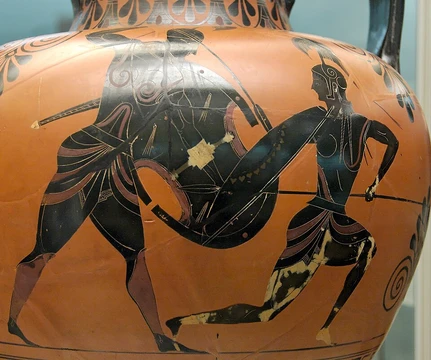
Athena
Ancient Greek goddess of wisdom, warfare, and handicraft.

Athena, also called Athene and often given the epithet Pallas, was an ancient Greek goddess linked to wisdom, warfare, and handicraft. She was later identified with the Roman goddess Minerva. She served as the patron and protector of many Greek cities, most notably Athens, which is thought to have given her name. Her main symbols are the owl, olive tree, snake, and gorgoneion. Artistic depictions usually show her wearing a helmet and holding a spear.
Her origins trace back to an Aegean palace goddess, closely tied to the city of Athens. She was called Polias and Poliouchos, both terms derived from *polis* (city-state), and her temples often stood on the fortified acropolis at a city’s center. The Parthenon on the Athenian Acropolis, along with many other temples and monuments, was dedicated to her. As the patron of crafts and weaving, she was known as Ergane. She was also a warrior goddess, believed to lead soldiers into battle as Athena Promachos. Her main festival in Athens was the Panathenaia, held during the midsummer month of Hekatombaion, which was the most important event on the Athenian calendar.
In Greek mythology, Athena sprang from the forehead of her father Zeus. According to Hesiod’s *Theogony*, this happened after Zeus swallowed his pregnant consort Metis. In Athens’ founding myth, she won a contest against Poseidon for the city’s patronage by creating the first olive tree. She was called Athena Parthenos, meaning “Athena the Virgin.” In one archaic Attic myth, Hephaestus attempted to rape her but failed, leading Gaia to give birth to Erichthonius, an important Athenian founding hero whom Athena raised. She was the patron goddess of heroic endeavors, aiding heroes such as Perseus, Heracles, Bellerophon, and Jason. Along with Aphrodite and Hera, she was one of three goddesses whose quarrel sparked the Trojan War. She appears actively in the *Iliad*, assisting the Achaeans, and in the *Odyssey*, she serves as the tutelary deity of Odysseus.
In later writings by the Roman poet Ovid, Athena competed with the mortal Arachne in a weaving contest, then turned Arachne into the first spider. Ovid also wrote that she transformed Medusa into a Gorgon after witnessing Poseidon raping her in Athena’s temple, and that she saved the mortal Corone from the same god by turning her into a crow. Since the Renaissance, Athena has become an international symbol of wisdom, the arts, and classical learning. Western artists and allegorists have often used her as a symbol of freedom and democracy.
**Etymology**
Athena’s name is linked to the city of Athens. In ancient Greek, the city’s name is Ἀθῆναι (Athȇnai), a plural toponym referring to the place where, according to myth, she presided over the Athenai, a sisterhood devoted to her worship. Ancient scholars debated whether Athena was named after Athens or vice versa. Today, scholars generally agree that the goddess took her name from the city; the ending -ene is common in place names but rare for personal names. Evidence from other ancient Greek cities shows similar city goddesses who took their names from their cities—for example, Mykene in Mycenae, whose sisterhood was called Mykenai, and Thebe in Thebes, whose city was known as Thebai (or Thebes in English, where the ‘s’ is a plural formation). The name Athenai is likely pre-Greek, as it contains the presumably pre-Greek morpheme *-ān-*.
In Plato’s dialogue *Cratylus*, the philosopher offers imaginative etymologies based on ancient Athenian theories. He writes that most interpreters of Homer believed Athena meant “mind” (νοῦς) and “intelligence” (διάνοια), and that the name’s maker intended a higher title, “divine intelligence” (θεοῦ νόησις), as if to say she has the mind of God (ἁ θεονόα). Alternatively, the name Theonoe might mean “she who knows divine things” (τὰ θεῖα νοοῦσα). Plato suggests the author may have identified her with moral intelligence (ἐν έθει νόεσιν) and called her Etheonoe, later altered to Athena. Thus, Plato believed Athena’s name derived from Greek Ἀθεονόα (Atheonóa), rationalized as from deity (θεός) and mind (νοῦς). The second-century AD orator Aelius Aristides tried to derive natural symbols from the etymological roots of Athena’s names, linking them to aether, air, earth, and moon.
**Origins**
Athena originally was the Aegean goddess of the palace, overseeing household crafts and protecting the king. A single Mycenaean Greek inscription, 𐀀𐀲𐀙𐀡𐀴𐀛𐀊 *a-ta-na po-ti-ni-ja*, appears at Knossos in the Linear B tablets from the Late Minoan II-era “Room of the Chariot Tablets,” which is the earliest Linear B archive anywhere. While *Athana potnia* is often translated as “Mistress Athena,” it could also mean “the Potnia of Athana,” or the Lady of Athens. However, any connection to the city of Athens in the Knossos inscription is uncertain. A sign series *a-ta-no-dju-wa-ja* also appears in the still undeciphered Linear A script.
- field
- Greek mythology
- known_for
- Goddess of wisdom, warfare, and handicraft; patron of Athens
- symbols
- Owls, olive trees, snakes, gorgoneion
- epithets
- Pallas, Polias, Poliouchos, Ergane, Promachos, Parthenos
Lore & Background
In Greek mythology, Athena was born from the forehead of her father Zeus; in Hesiod's Theogony, this occurred after Zeus swallowed his consort Metis while she was pregnant with Athena. In the founding myth of Athens, Athena bested Poseidon in a competition over patronage of the city by creating the first olive tree. She was known as Athena Parthenos 'Athena the Virgin.' In one archaic Attic myth, Hephaestus tried and failed to rape her, resulting in Gaia giving birth to Erichthonius, an important Athenian founding hero whom Athena raised. Athena was the patron goddess of heroic endeavor; she was believed to have aided the heroes Perseus, Heracles, Bellerophon, and Jason. Along with Aphrodite and Hera, Athena was one of the three goddesses whose feud resulted in the Trojan War. She plays an active role in the Iliad, in which she assists the Achaeans, and in the Odyssey, she is the tutelary deity to Odysseus. In the later writings of the Roman poet Ovid, Athena was said to have competed against the mortal Arachne in a weaving competition, afterward transforming Arachne into the first spider. (Note: Ovid's later account of Athena transforming Medusa into a Gorgon after witnessing her rape by Poseidon is a Roman addition, not part of the widely-known Greek canon; in earlier Greek sources such as Hesiod, Medusa was born a Gorgon. Similarly, Ovid's story of Athena saving the maiden Corone by turning her into a crow is not a standard Greek myth.)
Reader's Guide
Athena's significance extends from her origins as an Aegean palace goddess to her role as the patron and protectress of Athens, where the Parthenon on the Athenian Acropolis is dedicated to her. Her main festival in Athens was the Panathenaia, celebrated during the month of Hekatombaion in midsummer, the most important festival on the Athenian calendar. As the patron of craft and weaving, she was known as Ergane, and as a warrior goddess, she was believed to lead soldiers into battle as Athena Promachos. Since the Renaissance, Athena has become an international symbol of wisdom, the arts, and classical learning. Western artists and allegorists have often used Athena as a symbol of freedom and democracy. Her name is associated with the city of Athens, and scholars generally agree that the goddess takes her name from the city; the ending -ene is common in names of locations but rare for personal names. The name Athenai is likely of pre-Greek origin because it contains the presumably pre-Greek morpheme *-ān-.
Did You Know?
- Athena was born from the forehead of her father Zeus after he swallowed his consort Metis while she was pregnant.
- She bested Poseidon in a competition over patronage of Athens by creating the first olive tree.
- In Ovid's writings, Athena transformed the mortal Arachne into the first spider after a weaving competition.
- The Parthenon on the Athenian Acropolis is dedicated to Athena.
Origins and the Mystery of the Bond
The precise reasons why the little owl became inseparable from Athena remain debated among scholars. Some mythographers, including David Kinsley and Martin P. Nilsson, propose that the goddess may trace her roots to a Minoan palace deity connected with birds, while Marija Gimbutas pushes the lineage even further back to an Old European goddess of birds and serpents. Cynthia Berger offers a different lens, suggesting that owls' natural traits—particularly their capacity to see in darkness—made them compelling emblems of wisdom. William Geoffrey Arnott takes a more pragmatic view, arguing that the bond simply grew out of the founding myths of Athens and the region's notably large owl population, a fact already remarked upon by Aristophanes in both The Birds and Lysistrata. Regardless of the true origin, Athens embraced the owl as a visible declaration of loyalty to its virgin patron goddess, who, as depicted on the West pediment of the Parthenon, won the city's devotion by offering a gift more appealing than Poseidon's.
From Coin to Battlefield
Once the owl became Athena's emblem, it permeated nearly every facet of Athenian public life. Citizens stamped the bird onto vases, weights, and the prize amphoras awarded at the Panathenaic Games. The symbol's power extended beyond Athens' borders, too. In Roman tradition, the association passed to Minerva, though Ovid's Metamorphoses complicates the picture by casting the owl as Nyctimene, a cursed daughter of Epopeus of Lesbos, while Roman folklore treated a hooting owl on a rooftop as an omen of death and its feathers as a tool for extracting secrets from sleepers.
The Night Owl as Epistemological Caution
Long before the owl became a badge of intellectual pride, it served as a warning about the limits of human understanding. Aristotle, in his Metaphysics, drew an analogy between the day-blind eyes of bats and the human intellect, suggesting that our capacity for knowledge operates in a kind of darkness, unable to grasp the full daylight of truth. This negative epistemological image of the night owl was then carried forward through centuries of philosophical thought. Thomas Aquinas, in his Summa contra gentiles (quaestio 45), continued to transmit this cautionary metaphor, reinforcing the idea that human reason, like an owl in the daylight, is fundamentally constrained. For much of the Western philosophical tradition, the owl thus functioned less as a triumphant symbol of wisdom and more as a reminder of intellectual modesty—a creature that thrives in shadow precisely because it cannot endure the full illumination of absolute knowledge.
Hegel's Dusk and the Owl's Flight
The most celebrated transformation of the owl metaphor belongs to Georg Wilhelm Friedrich Hegel, the 19th-century German idealist, who declared that the owl of Minerva spreads its wings only with the falling of the dusk. For Hegel, philosophy does not precede or direct historical reality; rather, it arrives only after a form of life has completed its formative process and grown old. Philosophy apprehends the world in its maturity, painting its grey in grey—not to rejuvenate what has passed, but to know it. Klaus Vieweg, in his biography of Hegel, calls this one of the most beautiful metaphors in the entire history of philosophy. In this reading, the owl no longer signals ignorance but the hard-won, retrospective clarity of thought arriving just as the world it describes begins to fade.
Common Misconceptions (Editorial)
One common misconception is that Athena transformed Medusa into a Gorgon. In earlier Greek sources, such as Hesiod, Medusa was born a Gorgon; the story of Athena cursing her after a rape by Poseidon is a later Roman addition by Ovid. Another error is assuming the story of Athena turning the maiden Corone into a crow is a standard Greek myth—it is also exclusive to Ovid's Roman writings and not part of the widely-known Greek canon.
Why It Matters (Editorial)
Athena endures as a symbol of strategic wisdom and civic protection, embodying ideals that transcend ancient Greek culture. Her role as a patron of heroes and crafts, combined with her virginity and martial aspect, offers a complex model of female power that continues to inspire art, literature, and feminist reinterpretations today.
Frequently Asked Questions
Who is Athena in Greek mythology?
Athena is the ancient Greek goddess who presides over wisdom, strategic warfare, and skilled handicraft. In later Roman tradition she was merged with the goddess Minerva.
What are Athena's symbols?
Her most recognizable emblems are the owl, the olive tree, a serpent, and the gorgoneion (Medusa's severed head). In classical artwork she is typically shown wearing a helmet and gripping a spear.
How was Athena born?
She did not emerge from a mother; instead she sprang fully grown and armored from the forehead of Zeus. This unusual origin ties her identity closely to wisdom and strategic thought.
Why is Athena connected to the city of Athens?
She is traditionally the patron and protector of Athens, and the city most likely derived its name from hers. Legend says she won the city's allegiance by offering the olive tree, beating Poseidon's gift of a salt-water spring.
What is the difference between Athena and Minerva?
They are the same divine figure seen through Greek and Roman cultural lenses; the Romans gradually identified Minerva with Athena. Greek sources use the name Athena (or Athene), while Latin texts call her Minerva.
More in Greek Myths 1-22
Spotted an error? Know more?
This is a living reference — every entry is fact-audited, and reader corrections feed straight into our audit queue. Suggest an edit · See this site's audit record