Psamathe (Nereid)
Nereid who sent a wolf to avenge her son's death.
Psamathe is a Nereid in Greek mythology, one of the fifty daughters of the sea god Nereus and the Oceanid Doris. She is known primarily as the mother of Phocus by Aeacus, king of Aegina, and later as the wife of Proteus, king of Egypt, with whom she has two children. Her myths involve themes of transformation, revenge, and divine intervention, and she appears in works by Hesiod, Pindar, Euripides, Ovid, and others.
- Field
- Greek mythology
- Nationality
- Greek
- Known for
- Mother of Phocus; sending a giant wolf against Peleus's herd; transformation into a seal
Lore & Background
After Phocus is killed by his half-brothers Peleus and Telamon, Psamathe sends a giant wolf at Peleus's herd out of revenge. Ovid's Metamorphoses provides the most detailed account: the wolf is described as a 'huge beast' with 'great, murderous jaws' and 'eyes blazing with red fire'. Peleus prays to Psamathe to relent, but she remains unmoved until her sister Thetis prays for forgiveness alongside Peleus, at which point Psamathe transforms the wolf into marble. In other versions, such as that of Antoninus Liberalis (attributed to Nicander), the wolf is turned to stone by 'divine will', and John Tzetzes says Thetis turns it to stone.
Reader's Guide
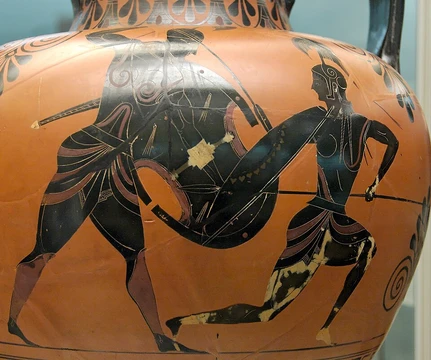
Psamathe's significance in Greek mythology lies in her dual roles as a Nereid associated with the sea and sand, and as a figure of maternal vengeance. Her story illustrates the intersection of divine and mortal realms, particularly through her relationships with Aeacus and Peleus. The myth of her transformation into a seal and the subsequent naming of her son Phocus highlights the etiological function of myth, explaining the origin of the word for 'seal'. The revenge narrative involving the wolf and its petrification demonstrates the power of Nereids to affect the mortal world and the importance of divine forgiveness, as mediated by Thetis. Psamathe appears in early sources such as Hesiod's Theogony and later in Ovid's Metamorphoses, showing her enduring presence in classical literature. Her depiction on Attic vases from the late fifth century BC, often in scenes with other Nereids, underscores her role in the broader mythological tradition surrounding Peleus and Achilles. The variant accounts of her story, particularly regarding the wolf's transformation, reflect the fluidity of oral and literary traditions in ancient Greece.
Did You Know?
- Psamathe's name means 'sand-goddess' or 'goddess of sand' in Ancient Greek.
- She transformed into a seal to escape Aeacus, but was unsuccessful, and her son Phocus was named after the Greek word for seal.
- After Phocus was killed by his half-brothers Peleus and Telamon, Psamathe sent a giant wolf to attack Peleus's herd.
- In Ovid's Metamorphoses, the wolf sent by Psamathe was turned to marble after Thetis interceded on Peleus's behalf.
Spotted an error? Know more?
Reader corrections go straight into our review queue. Suggest an edit · How this site is sourced