Proteus
Prophetic sea god who changes shape to avoid revealing the future.
Proteus (PROH-tee-əs, PROHT-yooss; Ancient Greek: Πρωτεύς) is an early prophetic sea god or god of rivers and oceanic bodies of water in Greek mythology, one of several deities whom Homer calls the 'Old Man of the Sea' (hálios gérôn). Some ascribe to him the domain of 'elusive sea change,' reflecting the changeable nature of the sea or the liquid quality of water. He can foretell the future but will change his shape to avoid doing so, answering only to those who can capture him. From this feature comes the adjective 'protean,' meaning versatile, mutable, or capable of assuming many forms, with positive connotations of flexibility and adaptability.
- Family
- Son of Poseidon and Phoenice; father of Polygonus, Telegonus, Eioneus, Theoclymenos, Theonoe, Cabeiro, Rhoiteia, Thebe, Thaicrucia
Lore & Background
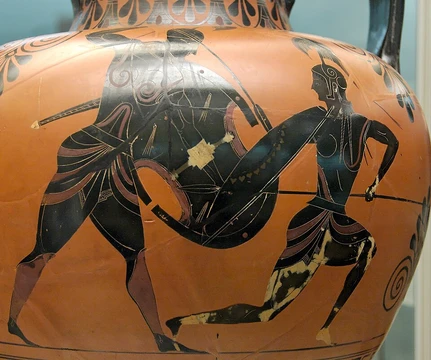
According to Homer's Odyssey, the sandy island of Pharos off the coast of the Nile Delta was the home of Proteus, the oracular Old Man of the Sea and herdsman of sea-beasts. Menelaus, becalmed there on his journey home from the Trojan War, learned from Proteus's daughter Eidothea that if he could capture her father, he could force him to reveal which god he had offended and how to propitiate them. Proteus emerged from the sea to sleep among his colony of seals, but Menelaus held him as he took the forms of a lion, a serpent, a leopard, a pig, water, and a tree. Proteus then answered truthfully, informing Menelaus of Agamemnon's murder, Ajax the Lesser's shipwreck, and Odysseus's captivity on Calypso's Isle Ogygia. In Virgil's fourth Georgic, the bees of Aristaeus, son of Apollo, died of disease. Aristaeus sought help from his mother Cyrene, who told him that Proteus could reveal how to prevent another disaster but would only do so if compelled. Aristaeus seized Proteus and held him through all his transformations until Proteus gave up and told him the bees' death was punishment for causing the death of Eurydice. To make amends, Aristaeus sacrificed twelve animals, left the carcasses, and returned three days later to find a swarm of bees in one carcass, which he took to his apiary; the bees were never again troubled by disease. Proteus was generally regarded as the son of the sea-god Poseidon and Phoenice, daughter of King Phoenix of Phoenicia. His children by Torone (Chrysonoe) of Phlegra were Polygonus (Tmolus) and Telegonus, both killed by Heracles. Another son, Eioneus, fathered Dymas, king of Phrygia and father of Hecuba. By the Nereid Psamathe, Proteus fathered Theoclymenos and Theonoe (also called Eidothea or Eurynome). Cabeiro, mother of the Cabeiri and Cabeirian nymphs by Hephaestus, was also called his daughter. Other daughters included Rhoiteia, Thebe (eponym of Thebes in Egypt), and Thaicrucia, who mothered Nympheus by Zeus.
Reader's Guide
Proteus's significance lies in his dual role as a prophetic deity and a symbol of changeable nature. His name, suggesting 'first' (from Greek 'πρῶτος' prōtos), may refer to his being Poseidon's eldest son, older than Triton, though this is uncertain. The adjective 'protean,' derived from his shape-shifting ability, has entered common usage to describe versatility and adaptability. In alchemy, the German mystic Heinrich Khunrath wrote of Proteus as a symbol of the unconscious and the perfection of the art, linking him to the 'Catholick Mercury' with the key to the sea. The Swiss psychologist Carl Jung defined Proteus as a personification of the unconscious, comparable to the elusive alchemical figure Mercurius. In literature, John Milton alluded to Proteus in Paradise Lost in the context of alchemists seeking the philosopher's stone. Shakespeare used the image of Proteus to characterize Richard III in Henry VI, Part Three, and named a main character Proteus in The Two Gentlemen of Verona. William Wordsworth's sonnet 'The world is too much with us' ends with a nostalgic reference to Proteus. James Joyce's Ulysses titled its third chapter 'Proteus,' using Protean transformations of matter for self-exploration. In biology, a cave-dwelling aquatic salamander is called Proteus anguinus, the only species in the genus Proteus of the family Proteidae.
Did You Know?
- Proteus's name is first attested in Mycenaean Greek in Linear B as po-ro-te-u, though it is uncertain whether it refers to the god or a person.
- In Virgil's Georgics, Proteus told Aristaeus that his bees' death was punishment for causing the death of Eurydice.
- The adjective 'protean' comes from Proteus's ability to change shape and has positive connotations of flexibility and adaptability.
- Proteus was said to have incarnated himself as the 1st-century philosopher Apollonius of Tyana, according to legends in the 3rd-century Life of Apollonius of Tyana.
Spotted an error? Know more?
Reader corrections go straight into our review queue. Suggest an edit · How this site is sourced